Preaching Power
For my pastor, whose sermons we missed for three weeks
The Word stands dusty on a corner shelf,
Cobwebbed with worry, feathered with the soft
Gray stuff that gathers through unreading years,
Its binding nibbled by some modern moth.
And then you take it down. You dust it off
And all the mould of higher criticism
Flicks in dried-out flakes and whispers free
And briefly bears away my cynicism.
For those moments when you mouth the Word—
Rustle its leaves with laughter, color in
The black-and-white type wit the hues of light—
My mental spiders, freed from mortal sin
Dance in the live, dry air of Palestine.
And then you close the Book, and it goes dead, till next time.
© 2010, Sørina Higgins. Do not use this work in any way without permission from the author.
Showing posts with label Poem of the month. Show all posts
Showing posts with label Poem of the month. Show all posts
01 January 2011


01 December 2010
December Poem of the Month
Here's a little, child-like poem for Advent. Enjoy!
Wish List
I need Christmas trees and Christmas beads
to decorate my house and me;
gingerbread and sugar plums
and draughts of honey mead.
I need glitter made of gold dust,
sweet strings of ruby-fruits,
cider spiced with citrus peel,
and reindeer-fur-lined boots
for scattering about the floor
and looping on the stairs
and sipping with a flock of friends
and tramping through the stars.
I need labyrinths of ribbons
to tie up my many needs;
I need an angel for my treetop—
and a change of heart in me.

"Wish List" by Sørina Higgins is licensed under a Creative Commons Attribution-NonCommercial-NoDerivs 3.0 Unported License. This means that you can copy and distribute the work if you will not receive any commercial gain; that you can use the work in a new creative way (song lyrics, dramatic production, visual display), again, if you receive no commercial gain; and any other use that does not make you any money--as long as you do not change any of the words of the original text. Also, the author would like to be notified of any uses of her poem. Thank you.
Wish List
I need Christmas trees and Christmas beads
to decorate my house and me;
gingerbread and sugar plums
and draughts of honey mead.
I need glitter made of gold dust,
sweet strings of ruby-fruits,
cider spiced with citrus peel,
and reindeer-fur-lined boots
for scattering about the floor
and looping on the stairs
and sipping with a flock of friends
and tramping through the stars.
I need labyrinths of ribbons
to tie up my many needs;
I need an angel for my treetop—
and a change of heart in me.
"Wish List" by Sørina Higgins is licensed under a Creative Commons Attribution-NonCommercial-NoDerivs 3.0 Unported License. This means that you can copy and distribute the work if you will not receive any commercial gain; that you can use the work in a new creative way (song lyrics, dramatic production, visual display), again, if you receive no commercial gain; and any other use that does not make you any money--as long as you do not change any of the words of the original text. Also, the author would like to be notified of any uses of her poem. Thank you.
06 October 2010
October Poem of the Month
I have just finished organizing the MS for what I hope will be my second book -- my first full-length book -- of poetry. The book will be entitled Caduceus; it's all about messages, words, voices, lies, truth, and personas. It has six sections, titled "Lovers," "Skeptics," "Preachers," "Believers," "Metaphors," and "The Voice of God." This poem is the "Prologue" to the volume.

Dramatis Personae
My little heel-wings are not made of feathers:
they are made of tongues. Their voices flap
around my feet, hiss through my veins, and coil
their noisy helix on my heraldic staff.
They whisper I am, I say, making me
play all the characters this writer writes.
I am the dead man on the bed; I am
the bird, the beast, the god, the groom, the bride.
I am a hypocrite, a metaphor,
a myth. If every wing-word was hermetic,
lovers, skeptics, Romans, Christians took
my secret voices public, grew frenetic
in praise of their high places and their gods——
in the end their clamor just might run me mad.
—— Sørina

Dramatis Personae
My little heel-wings are not made of feathers:
they are made of tongues. Their voices flap
around my feet, hiss through my veins, and coil
their noisy helix on my heraldic staff.
They whisper I am, I say, making me
play all the characters this writer writes.
I am the dead man on the bed; I am
the bird, the beast, the god, the groom, the bride.
I am a hypocrite, a metaphor,
a myth. If every wing-word was hermetic,
lovers, skeptics, Romans, Christians took
my secret voices public, grew frenetic
in praise of their high places and their gods——
in the end their clamor just might run me mad.
—— Sørina
12 June 2010
instead of a poem-of-the-month
I never posted a June Poem of the Month. I'm not writing lyric poetry these days; instead, I'm working on a play (some of which is in verse). That will NOT be posted here! So, just in case you missed having a poem (which I doubt), here's a link to three of mine that have appeared in the online journal Avatar. Enjoy.
~ Sørina
~ Sørina
01 May 2010
May poem of the month
April was National Poetry Month and all sorts of contests and activities took place. I was theoretically participating in Robert Lee Brewer's poem-a-day challenge, but completely failed. I think I completed two poems all month, and only started a handful more. I excuse that by the fact that I'm working on a long project, partly in verse, and did something on that almost every weekday except when I was traveling to interview someone for the "Where Are We Now" series. It was a very productive month, just not for new lyric poems! Here's a sort of a one in response to the April 6th challenge.

Theories of Evil
Ekphrasis on "Flight of the Witches" by Francisco de Goya
A triangle is a parody.
A Trinitarian icon.
Idolatry.
Evil is what’s left when good is gone—
perhaps, or, nearer to the truth,
evil is good gone wrong.
Goya knew
that devotion imitates; that evil is an ape.
Villanelle. Triolet. Haiku.
Does pain have a shape?
Triangulated in the air
over the blasted waste,
they scrabbled into somewhere.
Whirling the germens of earth,
mocking the circle of prayer,
screaming in paint-strokes, brush-work,
trouble, trouble, trouble,
double and triple their hurt.
~ Sorina

Theories of Evil
Ekphrasis on "Flight of the Witches" by Francisco de Goya
A triangle is a parody.
A Trinitarian icon.
Idolatry.
Evil is what’s left when good is gone—
perhaps, or, nearer to the truth,
evil is good gone wrong.
Goya knew
that devotion imitates; that evil is an ape.
Villanelle. Triolet. Haiku.
Does pain have a shape?
Triangulated in the air
over the blasted waste,
they scrabbled into somewhere.
Whirling the germens of earth,
mocking the circle of prayer,
screaming in paint-strokes, brush-work,
trouble, trouble, trouble,
double and triple their hurt.
~ Sorina
01 April 2010
April poem of the month
Oops, it looks as if I've missed the poem-of-the-month for a few months! My apologies. I have a few excuses: I've been writing a ton of other stuff besides poetry (short stories and academic articles); the poems I have written are either too personal or too disturbing to publish here (I know, tantalizing, huh?); and I've been dedicating a pile of time to the new interview series. So even this poem is an old one I've dug out of my files. Sorry.
But April is Poetry Month, and so I'm taking on a challenge: Write one poem a day for the entire month! This is for a a contest sponsored by Writer's Digest; there will be a prompt for each day. Why don't you try it, too?
Radcliffe Camera, Bodleian Library, Oxford University
Follow these spiral steps,
connected, rung by rung, logical
chain of well-wrought iron flats, rational
handrails cold and artful in a downward helix.
Come, aware, into another room of consciousness.
It’s quieter here than out where senses
cower under the chaos of physical streets.
There’s less to feel, and what’s to see
striated horizontal on the perimeter of thought:
staves in motionless progress rake the walls,
make inaudible meaning while the sight
circles, fascinated, seeking the conclusion of these shelves.
But beware synthetic knowledge: one book
(ascetic contemplative in paper brown)
unhooked from its nestled hush
is thesis: offers its neighbor in antithesis
who pulls another by the cover
until hand-over-hand the hypothetical unity revolves.
You cannot take Making Shakespeare from the shelf
without its dragging the authority of King James and his
superstitious witchcraft tract, which clings to Scott
(that’s Reginald) and Miller (Arthur, Crucible),
which dumps a chunk of history
from Salem to McCarthy on your head, and then you have to know
the Lord’s Prayer and the devil’s mass, and Latin, and some
cures for warts, and the script
a college prof. began for trying audiences
as a witch’s jury, and soon
you’re searching for quotations about “mandrake root”
then you’re on the stage and in the noose
and suddenly:
the chamber’s cataloged diameter goes into orbit,
creates a universe complete with rings and atmosphere,
with cyclic seasons and with gravitational appeal
where a single thinker is a satellite—
As if one newborn scholar could endure
the velocity of thought;
as if one human psyche could survive
the spatial ecstasy of synthesis.
~ Sørina
But April is Poetry Month, and so I'm taking on a challenge: Write one poem a day for the entire month! This is for a a contest sponsored by Writer's Digest; there will be a prompt for each day. Why don't you try it, too?
Radcliffe Camera, Bodleian Library, Oxford University
Follow these spiral steps,
connected, rung by rung, logical
chain of well-wrought iron flats, rational
handrails cold and artful in a downward helix.
Come, aware, into another room of consciousness.
It’s quieter here than out where senses
cower under the chaos of physical streets.
There’s less to feel, and what’s to see
striated horizontal on the perimeter of thought:
staves in motionless progress rake the walls,
make inaudible meaning while the sight
circles, fascinated, seeking the conclusion of these shelves.
But beware synthetic knowledge: one book
(ascetic contemplative in paper brown)
unhooked from its nestled hush
is thesis: offers its neighbor in antithesis
who pulls another by the cover
until hand-over-hand the hypothetical unity revolves.
You cannot take Making Shakespeare from the shelf
without its dragging the authority of King James and his
superstitious witchcraft tract, which clings to Scott
(that’s Reginald) and Miller (Arthur, Crucible),
which dumps a chunk of history
from Salem to McCarthy on your head, and then you have to know
the Lord’s Prayer and the devil’s mass, and Latin, and some
cures for warts, and the script
a college prof. began for trying audiences
as a witch’s jury, and soon
you’re searching for quotations about “mandrake root”
then you’re on the stage and in the noose
and suddenly:
the chamber’s cataloged diameter goes into orbit,
creates a universe complete with rings and atmosphere,
with cyclic seasons and with gravitational appeal
where a single thinker is a satellite—
As if one newborn scholar could endure
the velocity of thought;
as if one human psyche could survive
the spatial ecstasy of synthesis.
~ Sørina
01 January 2010
January Poem of the Month
This stanzaic, Medieval-minimalist poem was inspired by the Hopkins sonnet that I posted for Christmas. And the image off of which it grew is taken from a Chinese Checkers board on which I remember playing as a child. There are other allusions, images, and ideas that tie it together. Can you figure out what they are? What are the four dragons? What is the "ether"? And where did I get the "Stylized winds with ridiculous cheeks"?
Mappa Mundi
Four mortal dragons corner the earth
As capitals gild the Evangelists
With prodigal colour, with glory-ink:
Ecstatic, illuminates fear.
Scarlet are their mile-long tongues:
Golden their keyhole irises.
The planet is squared in their slender bones
And time quartered between.
Earth lies spread like an ancient chart
Before the eyes of its dragon kings.
Rivers are lapis lazuli chains,
Cities scales of bronze.
Stylized winds with ridiculous cheeks
Embouchure every joint of the frame,
Cool with their breath the dragon smoke,
And stir the parchment waves.
Four phases of spirit, four inspired flames
Inhale and exhale the germens of earth
And in turn are breathed forth from beyond the page
By the nimbus, the ether——the All?
~ Sørina
Mappa Mundi
Four mortal dragons corner the earth
As capitals gild the Evangelists
With prodigal colour, with glory-ink:
Ecstatic, illuminates fear.
Dragonflies draw down spears of fire
and dragonwings weave the visible air
while dragonwalks stalk a thunder land
and dragondeeps quiet the sea.
Scarlet are their mile-long tongues:
Golden their keyhole irises.
The planet is squared in their slender bones
And time quartered between.
Dragonflies draw down spears of flame
and dragonwings weave the visible sky
while dragonwalks stalk a thunder ground
and dragondeeps quiet the waves.
Earth lies spread like an ancient chart
Before the eyes of its dragon kings.
Rivers are lapis lazuli chains,
Cities scales of bronze.
Dragonflies draw down shafts of flame
and dragonwings spin the invisible light
while dragonwalks tread a thunder drum
and dragondeeps silence the waves.
Stylized winds with ridiculous cheeks
Embouchure every joint of the frame,
Cool with their breath the dragon smoke,
And stir the parchment waves.
Dragonflies loose their fiery shafts
and dragonwings visit the spin of their sight
while dragonwalks thunder a trampled beat
and dragondeeps see into silence.
Four phases of spirit, four inspired flames
Inhale and exhale the germens of earth
And in turn are breathed forth from beyond the page
By the nimbus, the ether——the All?
Dragonflies draw down spears of fire
and dragonwings weave the visible air
while dragonwalks stalk a thunder land
and dragondeeps quiet the sea.
~ Sørina
01 December 2009
December poem of the Month
I regret that this poem has nothing to do with the Advent season. If I get any Christmas-related inspirations, I'll post them. Meanwhile, well, here's something (continuing my new, freer style).
Ordinary
my overcoat is a pelican
my umbrella is a stork
the flowers I plant have
grown down into the soil
their roots are enjoying the sun
and all I have to say
pours back inside my lungs.
my garden is a laundry bin
my kitchen a game of chess
the dishes I feed you were
gleaned from a railroad
a transcontinental surprise
and every last sip I slip down my gorge
tastes like checkmate at sunrise.
my tires are elephant’s knee-bones
my speakers house bumble wasps
when I taste between sheets, feet
first through the sandwich of dark
nothing is not scented
of you and of you and of you
oak-gentle, gray-pillar, wind-eye.
~ Sørina
Ordinary
my overcoat is a pelican
my umbrella is a stork
the flowers I plant have
grown down into the soil
their roots are enjoying the sun
and all I have to say
pours back inside my lungs.
my garden is a laundry bin
my kitchen a game of chess
the dishes I feed you were
gleaned from a railroad
a transcontinental surprise
and every last sip I slip down my gorge
tastes like checkmate at sunrise.
my tires are elephant’s knee-bones
my speakers house bumble wasps
when I taste between sheets, feet
first through the sandwich of dark
nothing is not scented
of you and of you and of you
oak-gentle, gray-pillar, wind-eye.
~ Sørina
01 November 2009
November Poem of the Month
Brogue on an Empty Road
the fields are lonely, Lovely
while rabbits dislodged at the sound of me
and I by the magpies above
in anonymous trees
spring quick with the consonantal heft
past ivy-sleek windings and streaks
of whatever is left from whatever was said
unseen cattle shadow my steps
the other side the ditch the hedge
or else my foreign feet
echo their clumsy phobias
their bovine gentle bulk
Ben Bulben’s head sage with clouds today,
distant as eyes of livestock
watching solitude and glad of it
‘Are y’on the wrong road?’
a timeless, wind-worn farmer asks
but who’s to know
and how high lifts the ancient slope
and how far goes the growing thing
I reach beneath the bramble-branches of the rose
searching for a tuber that goes away, away
a long way back
beyond where hope has opened out
into lonely, Lovely,
into now.
~ Sørina
the fields are lonely, Lovely
while rabbits dislodged at the sound of me
and I by the magpies above
in anonymous trees
spring quick with the consonantal heft
past ivy-sleek windings and streaks
of whatever is left from whatever was said
unseen cattle shadow my steps
the other side the ditch the hedge
or else my foreign feet
echo their clumsy phobias
their bovine gentle bulk
Ben Bulben’s head sage with clouds today,
distant as eyes of livestock
watching solitude and glad of it
‘Are y’on the wrong road?’
a timeless, wind-worn farmer asks
but who’s to know
and how high lifts the ancient slope
and how far goes the growing thing
I reach beneath the bramble-branches of the rose
searching for a tuber that goes away, away
a long way back
beyond where hope has opened out
into lonely, Lovely,
into now.
~ Sørina
01 October 2009
October Poem of the Month
Ode to Uncertainty
You come with Janus-face, your quartet of eyes
turned towards me in a quick succession: psychedelic
cycle, counterpoint of circle and plane, a lunacy
contrived by velocity with valence and designed well if
madness is the goal. Only your luminous glances,
dancing a whirling dervish, are colored: a gloom
for your robe is a charcoal carving, a sketch-book fancy
faded into nightmare, a chiaroscuro gone monochrome.
Your motion in stillness could nauseate;
your monstrous size inside my small mind is uncanny—
strange, then, how solid you are in this crowded place,
and you stink like a dead man and squall like a baby.
Yet I never thought to question: are you real?
Or are you just a side effect of how this century wants to feel?
You come with Janus-face, your quartet of eyes
turned towards me in a quick succession: psychedelic
cycle, counterpoint of circle and plane, a lunacy
contrived by velocity with valence and designed well if
madness is the goal. Only your luminous glances,
dancing a whirling dervish, are colored: a gloom
for your robe is a charcoal carving, a sketch-book fancy
faded into nightmare, a chiaroscuro gone monochrome.
Your motion in stillness could nauseate;
your monstrous size inside my small mind is uncanny—
strange, then, how solid you are in this crowded place,
and you stink like a dead man and squall like a baby.
Yet I never thought to question: are you real?
Or are you just a side effect of how this century wants to feel?
01 September 2009
September poem of the month
This is the third section of a poem whose first section I posted in July and whose second section I posted as the August poem of the month. There should be one more section forthcoming.
III. A Storm is Coming
Eyes can see a sizable swathe, and the mind can take
spectrum and miscellany, the gamut, with ease. Why then
is the brain astounded and confounded by the diachromatic scheme
of this simple scene? Only the brown of a catastrophe of rock
backed by the pale of a terrible sky. Between annihilation and me
a crumble of granite, pebbles stacked by a laughing titan,
sloping up into exclusion, complete and indifferent.
Give me more complexity!
I cannot stand the stark, the tranquil, horror of it,
nor the endless stretch of bread-sized rocks, piled, mile-high, silent,
wild in a way no beast can be, set as a quest in solidity.
But the spirit can, and the body does. It sets its teeth
and its feet, in all their acrophobia, for the heights.
This is virtue, or something palpable that deeds
of less tactile goodness can only adumbrate. There is no afterlife
for embodied acts of topographic goodness:
defy gravity, encounter vertigo, drown paranoia in sweat, strain tendons
past the point of hesitation, bend knees to climb, and the act lives on.
Eternally. The immaterial self, inseparable from plain materiality,
takes each step and knows each strain, and all is paid
in performing. No double recompense.
The aching thighs, the listening for an avalanche, the thinner air
clearing the fog inside and out the skull, the alert tension
in pectorals abs and calves, the Achilles taut and strong:
all delight in terror and tread down the fear.
Whatever the spirit does, does something to the flesh.
This touchable meat of me and the glorious intangibility
both suffered and endured: both ache as the summit nears,
and both will be stiff with victory tomorrow.
The mind fought panic, the body fought shakes;
the mind won over fear of heights, the body won
from fear of heights. I see no separation, no divide.
No Purgatory: all is purged.
III. A Storm is Coming
Eyes can see a sizable swathe, and the mind can take
spectrum and miscellany, the gamut, with ease. Why then
is the brain astounded and confounded by the diachromatic scheme
of this simple scene? Only the brown of a catastrophe of rock
backed by the pale of a terrible sky. Between annihilation and me
a crumble of granite, pebbles stacked by a laughing titan,
sloping up into exclusion, complete and indifferent.
Give me more complexity!
I cannot stand the stark, the tranquil, horror of it,
nor the endless stretch of bread-sized rocks, piled, mile-high, silent,
wild in a way no beast can be, set as a quest in solidity.
But the spirit can, and the body does. It sets its teeth
and its feet, in all their acrophobia, for the heights.
This is virtue, or something palpable that deeds
of less tactile goodness can only adumbrate. There is no afterlife
for embodied acts of topographic goodness:
defy gravity, encounter vertigo, drown paranoia in sweat, strain tendons
past the point of hesitation, bend knees to climb, and the act lives on.
Eternally. The immaterial self, inseparable from plain materiality,
takes each step and knows each strain, and all is paid
in performing. No double recompense.
The aching thighs, the listening for an avalanche, the thinner air
clearing the fog inside and out the skull, the alert tension
in pectorals abs and calves, the Achilles taut and strong:
all delight in terror and tread down the fear.
Whatever the spirit does, does something to the flesh.
This touchable meat of me and the glorious intangibility
both suffered and endured: both ache as the summit nears,
and both will be stiff with victory tomorrow.
The mind fought panic, the body fought shakes;
the mind won over fear of heights, the body won
from fear of heights. I see no separation, no divide.
No Purgatory: all is purged.
01 August 2009
August Poem of the Month
This is the second section of the poem I posted last month. I hope that a few more sections are forthcoming.
II.
Up a dried-out river bed, along an almost panoramic ridge,
sudden burst of rain and hail. Temperatures turned.
And rounding a turn, the cone loomed bare: doom in the very rocks.
Nothing else so sheer, nothing so spare
with no trip to spare, no mercy between a slip and the air.
A crumbling peak was the only material reality against the intolerable sky.
A force of will the only wall against the mental fall.
Every step of my foot took one more foot of its steppes.
Whatever the body does, does something to the soul.
The enormous pressure of the empty space behind
nearly broke my little mind.
I panted to hold the panic back,
thought by not thinking, progressed by repression
and ignorance.
And I can see my body arc, out, curved like the rainbow through which it falls,
glorious in suspension. A waterfall of raven hair against the clouds, the color
of flesh in contrast to the Irish green and blue, a masterpiece
and a disaster. The crash of bones on distant stones, the spatter of blood
in penitence for insuccess. Whatever the body does…
But it did not. The mind must be enormous, to enclose in one ignored corner
such a massive swathe of space, undusted. If I can pack
a sidereal fear and my idea
of the entire size of the universe,
not ending with the atmosphere, on past planets, out past galaxies,
(all pressing, more than the heaviest pack, on my unstopping back)
into some tiny corner of my mind and hide it there
(just a nagging, unacknowledged noise: a dust feather in a draft),
then how huge is my mind!
Whatever the psyche does….
II.
Up a dried-out river bed, along an almost panoramic ridge,
sudden burst of rain and hail. Temperatures turned.
And rounding a turn, the cone loomed bare: doom in the very rocks.
Nothing else so sheer, nothing so spare
with no trip to spare, no mercy between a slip and the air.
A crumbling peak was the only material reality against the intolerable sky.
A force of will the only wall against the mental fall.
Every step of my foot took one more foot of its steppes.
Whatever the body does, does something to the soul.
The enormous pressure of the empty space behind
nearly broke my little mind.
I panted to hold the panic back,
thought by not thinking, progressed by repression
and ignorance.
And I can see my body arc, out, curved like the rainbow through which it falls,
glorious in suspension. A waterfall of raven hair against the clouds, the color
of flesh in contrast to the Irish green and blue, a masterpiece
and a disaster. The crash of bones on distant stones, the spatter of blood
in penitence for insuccess. Whatever the body does…
But it did not. The mind must be enormous, to enclose in one ignored corner
such a massive swathe of space, undusted. If I can pack
a sidereal fear and my idea
of the entire size of the universe,
not ending with the atmosphere, on past planets, out past galaxies,
(all pressing, more than the heaviest pack, on my unstopping back)
into some tiny corner of my mind and hide it there
(just a nagging, unacknowledged noise: a dust feather in a draft),
then how huge is my mind!
Whatever the psyche does….
22 July 2009
July poem of the month (?)
I know, it is long past the 1st of July. But I haven't posted poems-of-the-month for many months past. Perhaps this will kick-start me back into it.
This is the first section of what is meant to be a four- or five-part poem. Enjoy.

Croagh Patrick

I.
The first sight, itself, was frightening.
Four play-doh peaks, bulky blunts, huddled en masse
in a pudgy ridge: mountains wearing mist. This was naught, not much
at least: the final peak was but a base
for an unearthly cone. A terror of shape,
a horror of size, its height in the skies,
its head in the clouds, its fearsome sides
something to conquer and adore. A correspondence
of every step of my foot with every foot of its steppes.
The ghost and machine of me compelled
to see, to scale, to grovel, and to defy
with equal joy in submitting and surmounting: no distinction,
no divide. Why analyze
which trembling is fear and which is love?
Whatever the body does, does something to the soul.
This was a steep climb, a stiff climb,
carried up by persistent elation. I understand
the hiker’s drive and dictum: sheer delight
(on sheerer heights) of possession,
a scaling obsession. Just the same, the painter, the poet,
the photograph: obsession to possess, longing to ingest
absorb encompass integrate and synthesize
beauty: to make that beauty part me,
to re-make beauty in its turn.
Whatever the body does, does something to the soul.
That is why they climb.

This is the first section of what is meant to be a four- or five-part poem. Enjoy.

Croagh Patrick

I.
The first sight, itself, was frightening.
Four play-doh peaks, bulky blunts, huddled en masse
in a pudgy ridge: mountains wearing mist. This was naught, not much
at least: the final peak was but a base
for an unearthly cone. A terror of shape,
a horror of size, its height in the skies,
its head in the clouds, its fearsome sides
something to conquer and adore. A correspondence
of every step of my foot with every foot of its steppes.
The ghost and machine of me compelled
to see, to scale, to grovel, and to defy
with equal joy in submitting and surmounting: no distinction,
no divide. Why analyze
which trembling is fear and which is love?
Whatever the body does, does something to the soul.
This was a steep climb, a stiff climb,
carried up by persistent elation. I understand
the hiker’s drive and dictum: sheer delight
(on sheerer heights) of possession,
a scaling obsession. Just the same, the painter, the poet,
the photograph: obsession to possess, longing to ingest
absorb encompass integrate and synthesize
beauty: to make that beauty part me,
to re-make beauty in its turn.
Whatever the body does, does something to the soul.
That is why they climb.

03 March 2009
March Poem of the Month
I have recently been working on a series of "persona" poems, in which I take on the identity of some real, fictional, or archetypal character and speak in his or her voice. What's fascinating about this is how I can comment on my own inner workings or on those of my friends, family, and acquaintances, while also revealing or discribing universal psycho-spiritual truths. This was written for a friend who is in an agnostic phase. Enjoy.
In Persona II: Wotan Wonders if there is a God
If I took off this eye patch, maybe I wouldn’t be blind.
Maybe I would see myself, reflected in the pools of Erda.
If only I could remember I am a god—or else a son of God—
perhaps the clouds would open and I would understand.
If I dropped this twisted walking stick, maybe I could stand.
I could thunder and rage at the tall empty sky—
as that frog-faced Alberich blasphemes me,
paddling his webbed-footed fingers in puddles of earth,
dabbling in divinity—what does he know (but do I?)—
Beneath this intentional eye patch, maybe I am not blind.
From the altitude of Valhalla, I suspect the rarity of air
is a function of some vast expanse where I should be,
where a perfection dwells; but down here, wandering,
I shake my thunder-fist and howl dirty songs against the sun.
I cannot remember I am a god—or else a son of God.
I am a wonder, I know: the music made around me,
the glories of my face, the strong amazement of the body
that I wear among mortals; and I should pose tall
and pull the spear-deep wisdom from the world ash tree:
If I stopped leaning on a walking stick, maybe I could stand.
Your love is better than gold, more beautiful than magic golden rings,
I thought I told her: but she grew invisible and maybe turned away—
so I wander, wondering, imagining my fits of rage
do not shake the stars, do not wake dragons. I could blame
the eye patch, say that without it maybe I wouldn’t be blind.
I could learn from reading, writing: books of wisdom,
books of nature; facts that I should know, and do know
in the core of me. But in my handsome earth-suit I prefer
the alias of espionage, of unrequital, victimized agnosticized
skeptical despair. Remember, I am a god—or else a son of God—
a subcreator of my introspective self. I forge my right
to see peripherally or not at all; to understand
or miscomprehend; to fight the dragon or to walk away.
How many miles have I traveled, crawling, among men?
If I dropped this twisted walking stick, maybe I could stand
to listen to the answers:
Is invisibility necessary for ignorance?
Is infatuation the same as incarnation?
Is immortality the opposite of immolation?
Is identity a sole conception, or the soul’s receptacle?
If only I could remember I am not blind,
I could stand being a son of God.
--Sørina
In Persona II: Wotan Wonders if there is a God
If I took off this eye patch, maybe I wouldn’t be blind.
Maybe I would see myself, reflected in the pools of Erda.
If only I could remember I am a god—or else a son of God—
perhaps the clouds would open and I would understand.
If I dropped this twisted walking stick, maybe I could stand.
I could thunder and rage at the tall empty sky—
as that frog-faced Alberich blasphemes me,
paddling his webbed-footed fingers in puddles of earth,
dabbling in divinity—what does he know (but do I?)—
Beneath this intentional eye patch, maybe I am not blind.
From the altitude of Valhalla, I suspect the rarity of air
is a function of some vast expanse where I should be,
where a perfection dwells; but down here, wandering,
I shake my thunder-fist and howl dirty songs against the sun.
I cannot remember I am a god—or else a son of God.
I am a wonder, I know: the music made around me,
the glories of my face, the strong amazement of the body
that I wear among mortals; and I should pose tall
and pull the spear-deep wisdom from the world ash tree:
If I stopped leaning on a walking stick, maybe I could stand.
Your love is better than gold, more beautiful than magic golden rings,
I thought I told her: but she grew invisible and maybe turned away—
so I wander, wondering, imagining my fits of rage
do not shake the stars, do not wake dragons. I could blame
the eye patch, say that without it maybe I wouldn’t be blind.
I could learn from reading, writing: books of wisdom,
books of nature; facts that I should know, and do know
in the core of me. But in my handsome earth-suit I prefer
the alias of espionage, of unrequital, victimized agnosticized
skeptical despair. Remember, I am a god—or else a son of God—
a subcreator of my introspective self. I forge my right
to see peripherally or not at all; to understand
or miscomprehend; to fight the dragon or to walk away.
How many miles have I traveled, crawling, among men?
If I dropped this twisted walking stick, maybe I could stand
to listen to the answers:
Is invisibility necessary for ignorance?
Is infatuation the same as incarnation?
Is immortality the opposite of immolation?
Is identity a sole conception, or the soul’s receptacle?
If only I could remember I am not blind,
I could stand being a son of God.
--Sørina
25 December 2008
A Poem for Christmas
Natal Astronomy
To Jupiter, Venus, and the Moon in Conjunction
1 December 2008
You have no similitude, ye gods of heaven
in this Advent night:
you are not, nor resemble, eyes
or jewels or flames of intellect:
to my poor senses little more
than holes torn in the dark-night-of-the-soul
upholstered ceiling of the sky
through which the Empyrean peeps.
Yet I see those planets through layers, like a lens:
a thousand pages from a hundred books
between my vision and their light,
papyrus, parchment, vellum, ink and print
between this nighttime glory and my sight.
Colored by association
with the wisdom of the ancient mind,
with a mountain of mythology,
a wider and more devout imagination
that read the heavens—read them to me:
read their personalities
and souse me in their influence!
Gashes of God-light
dousing my open skull.
Peel them back, these chapters of personification,
make thin the mystery.
But I cannot see the source.
Where is the Urtext for the stars?
When did Jove become the king of gods?
How did those little Greeks, untelescoped,
know he went garmented in royal red,
bled from a giant’s wound, the largest of the heavenlies
and heavy with the arbitration of his ring—his crown?
Who told Homer Aphrodite wore a womb-like atmosphere,
was soft for love, was beautiful in mists and sea-foam airs?
The dust-cold Luna, I suppose,
looks barren in her secondary light
and strings her tidal bow
and lets her maddening shafts
at women’s loins and madmen’s eyeballs—
But how did Norsemen measure Saturn’s aged pace?
They could not catch his frost across the light-years.
Or weaponed Gaels see the Martial red when they looked over
Hadrian’s wall at bloody Roman fields?
The pattern, somehow, the star-field dance,
was like a text. Was less than words,
and therefore more: was poetry.
Was story, and had characters.
A seed without a mother, an unfathered thought
conceiving and repeating, painting deities
on the Sistine ceiling of the sky.
And every figurine foreshadows truth.
For how else could they now, and thus, converge?
Majesty, Virginity, and Love:
how fitting, how exact. They close the circle.
For only once in every human life,
this time of year when every leaf is sheathed with glass,
these gods draw near to offer their Noël.
-- Sørina
To Jupiter, Venus, and the Moon in Conjunction
1 December 2008
You have no similitude, ye gods of heaven
in this Advent night:
you are not, nor resemble, eyes
or jewels or flames of intellect:
to my poor senses little more
than holes torn in the dark-night-of-the-soul
upholstered ceiling of the sky
through which the Empyrean peeps.
Yet I see those planets through layers, like a lens:
a thousand pages from a hundred books
between my vision and their light,
papyrus, parchment, vellum, ink and print
between this nighttime glory and my sight.
Colored by association
with the wisdom of the ancient mind,
with a mountain of mythology,
a wider and more devout imagination
that read the heavens—read them to me:
read their personalities
and souse me in their influence!
Gashes of God-light
dousing my open skull.
Peel them back, these chapters of personification,
make thin the mystery.
But I cannot see the source.
Where is the Urtext for the stars?
When did Jove become the king of gods?
How did those little Greeks, untelescoped,
know he went garmented in royal red,
bled from a giant’s wound, the largest of the heavenlies
and heavy with the arbitration of his ring—his crown?
Who told Homer Aphrodite wore a womb-like atmosphere,
was soft for love, was beautiful in mists and sea-foam airs?
The dust-cold Luna, I suppose,
looks barren in her secondary light
and strings her tidal bow
and lets her maddening shafts
at women’s loins and madmen’s eyeballs—
But how did Norsemen measure Saturn’s aged pace?
They could not catch his frost across the light-years.
Or weaponed Gaels see the Martial red when they looked over
Hadrian’s wall at bloody Roman fields?
The pattern, somehow, the star-field dance,
was like a text. Was less than words,
and therefore more: was poetry.
Was story, and had characters.
A seed without a mother, an unfathered thought
conceiving and repeating, painting deities
on the Sistine ceiling of the sky.
And every figurine foreshadows truth.
For how else could they now, and thus, converge?
Majesty, Virginity, and Love:
how fitting, how exact. They close the circle.
For only once in every human life,
this time of year when every leaf is sheathed with glass,
these gods draw near to offer their Noël.
-- Sørina
11 December 2008
December poem of the month

photo by Steve Lantz
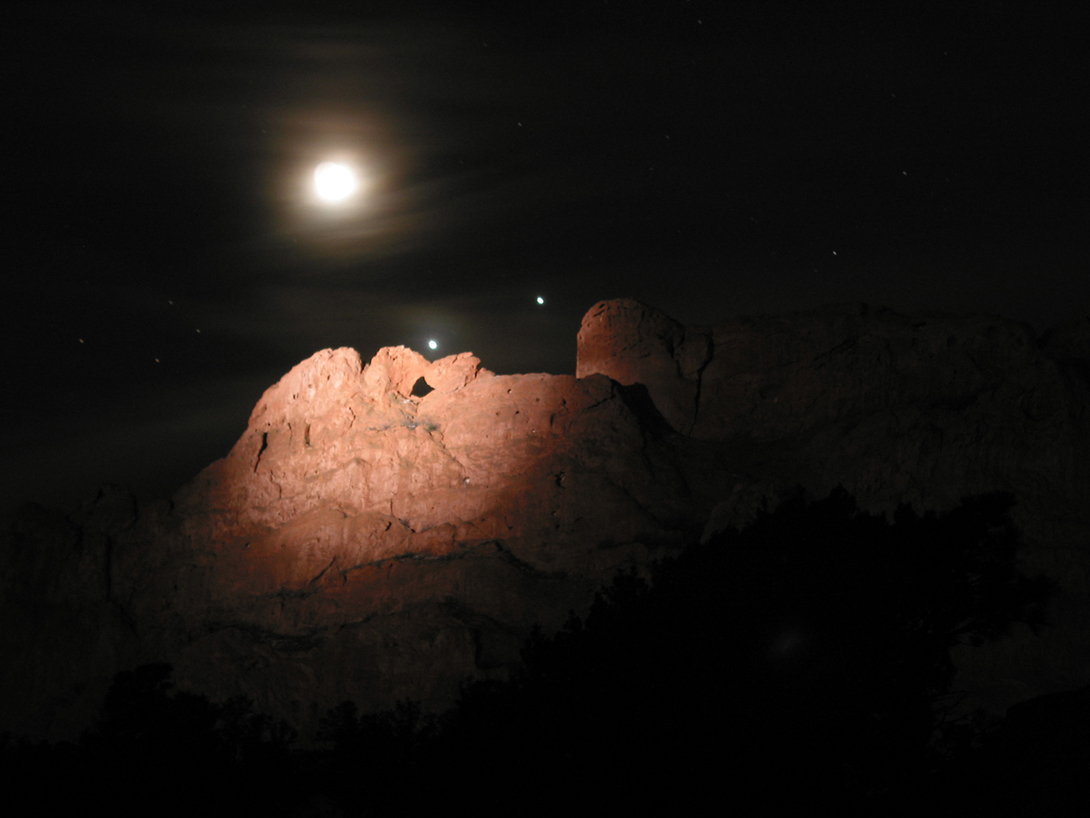
I have been working on this poem ever since I first saw the amazing conjunction of the Moon, Jupiter, and Venus several weeks ago. I don't know why a simple sonnet gave me so much trouble, except that my mind, time, and energy are completely consumed by work these days. This not even the poem I intended to write, which would have ended with the line:
THE GODS DRAW NEAR TO OFFER THEIR NOEL.
Maybe that poem is still forthcoming.
But back to the topic of the heavens! This meeting of Luna (or Silva), Jove (or Glund) and Aphrodite (or Perelandra) was a glorious once-in-a-lifetime experience. We sat and looked at it one evening for a long while until it sank below the treeline. My head was, of course, full of thoughts of the potential significance of this union: Beauty meets the King of the Gods while Virginity presides. And then Michael Ward sent me an article he wrote about C. S. Lewis's thoughts on observing this same conjunction in 1953.
Here are some beautiful photographs of the conjunction.
Meanwhile, enjoy this belated sonnet.
Cosmology
Until the still moment of the turn of Time
When Incarnation changed the spin of space,
Devout Angelicals of Heaven turned
About the planet of the human shape.
At the Nativity, the orbs of love
And intellect reversed their centrifuge:
They sang their fierce chant and burnt their wake
Around the solar image of their Liege.
But then creation lost her fixity
About a hill cris-crossed with lamentation;
On Sunday morning, relativity
Danced giddy with acentric adoration.
Now once a year the gods align and sing,
Awaiting their eternal choreography.


photo by Doug Zubenel
03 November 2008
November Poem of the Month
Electrical Work
A sheaf of wires: a harvest of facts.
Bundled and baled into circuits of certainty,
running through walls with the hurry of truth,
enlightening with frightening speed
the ceilings and walls and cabinets and halls
of the house of my dubious brain.
Each is so sure
that it grips to its ground
with a boa-tight bond
and it sticks to its fixtures
with a passionate twist.
But one, a weedy question mark,
Infests the field with its ubiquitous queries,
Sounding a pestiferous drone,
A plaguey buzz of
why, why, why, why, why,
locust-winged doubts devouring the faithful grain.
~ Sørina
A sheaf of wires: a harvest of facts.
Bundled and baled into circuits of certainty,
running through walls with the hurry of truth,
enlightening with frightening speed
the ceilings and walls and cabinets and halls
of the house of my dubious brain.
Each is so sure
that it grips to its ground
with a boa-tight bond
and it sticks to its fixtures
with a passionate twist.
But one, a weedy question mark,
Infests the field with its ubiquitous queries,
Sounding a pestiferous drone,
A plaguey buzz of
why, why, why, why, why,
locust-winged doubts devouring the faithful grain.
~ Sørina
03 October 2008
October Poem of the Month
I'm sorry I missed September! I started a new teaching job, which requires much more of my time than my previous jobs. I'm hoping to get back into posting now that the first month has passed and I'm feeling more at home.
Here's an old poem I just rediscovered recently. At first I couldn't even remember writing it, but then I recalled the first time I taught Milton's Paradise Lost--this is [obviously] from that time.
Evitable?
And so. Eve reaches her fingers past
the prohibitive gap to grasp the little globe.
She feels cold—unfamiliar, frightening—tightening her skin,
numb tingling along her veins, a sharp new something—
pain—dash down her radius, and hears three drops
of unknown red splash on the ground. She thinks she hears
a screaming—sound unheard before—and falling buildings,
crashing planes, exploding bombs (what are these noises?).
She pulls back her hand—and cannot. Inertia draws her down,
down, into the fruit of that transgression.
Adam watches. He sees her hand go through the leaves
and disappear. Startled, he turns to her face. A twist takes her lips, a crinkle
mars her till then unwrinkled head, and lines twine around her eyes. Ugly,
he thinks, shocked by the foreign word. Then colour runs
across her body, takes it in: a strange white-yellow shade
stretches and dries out her skin. His cry is hers, and for her, and he knows—
though he has never seen a corpse—this is that Death and they
were warned. He moves to stop her, save her, but they are one,
his soul is in her body, he has already sinned.
God sees their hands, faint images of His
outstretching immanence with men, plunged through the space
He fixed. He names the cold, faint, pain, and blood they feel
with sorrow of His own, and yet He also sees
the fruit. Its sphere, the universe. It travels where
her human words find form, past terrestrial lungs, beyond
the beating central core. Its rind slips off. Its flesh
grows one with hers, a poison and a nourishment.
Its seeds alone are left. Deep in the empty
dark of her, He touches them. They are His seed,
and that of man. SomeOne will be born.
This is not, and it is, exactly what He planned.
-- Sørina
Here's an old poem I just rediscovered recently. At first I couldn't even remember writing it, but then I recalled the first time I taught Milton's Paradise Lost--this is [obviously] from that time.
Evitable?
And so. Eve reaches her fingers past
the prohibitive gap to grasp the little globe.
She feels cold—unfamiliar, frightening—tightening her skin,
numb tingling along her veins, a sharp new something—
pain—dash down her radius, and hears three drops
of unknown red splash on the ground. She thinks she hears
a screaming—sound unheard before—and falling buildings,
crashing planes, exploding bombs (what are these noises?).
She pulls back her hand—and cannot. Inertia draws her down,
down, into the fruit of that transgression.
Adam watches. He sees her hand go through the leaves
and disappear. Startled, he turns to her face. A twist takes her lips, a crinkle
mars her till then unwrinkled head, and lines twine around her eyes. Ugly,
he thinks, shocked by the foreign word. Then colour runs
across her body, takes it in: a strange white-yellow shade
stretches and dries out her skin. His cry is hers, and for her, and he knows—
though he has never seen a corpse—this is that Death and they
were warned. He moves to stop her, save her, but they are one,
his soul is in her body, he has already sinned.
God sees their hands, faint images of His
outstretching immanence with men, plunged through the space
He fixed. He names the cold, faint, pain, and blood they feel
with sorrow of His own, and yet He also sees
the fruit. Its sphere, the universe. It travels where
her human words find form, past terrestrial lungs, beyond
the beating central core. Its rind slips off. Its flesh
grows one with hers, a poison and a nourishment.
Its seeds alone are left. Deep in the empty
dark of her, He touches them. They are His seed,
and that of man. SomeOne will be born.
This is not, and it is, exactly what He planned.
-- Sørina
01 August 2008
August Poem of the Month
and related thoughts on The Way of Exchange.
The poem below is a major revision of the July Poem of the Month, “The Curse of Co-Inherence.” As I worked through this poem with a critique partner, I realized that the focus was wrong. Rather than being a primarily positive poem in which the narrator is some kind of hero, the more honest approach was to explore the narrative persona’s fear of getting entangled in the other person’s pain. This, I think, is central to my confusion about Charles Williams’s doctrine of Co-Inherence—or, more specifically, to the application and practice of co-inherence he called “The Way of Exchange” or “The Doctrine of Substitution.” So here (and also over on the Coinherence List, a yahoo group) I’m going to write a bit about my three biggest problems with the Way of Exchange, and see if anyone has any thoughts.
You do NOT have to be a Charles Williams scholar to chime into this discussion; you need not have ever read his stuff or even heard of him. I’ll start by summarizing his doctrine. Basically, CW believed that all human beings (and especially all Christians, but only especially because they’ve been taught about it in their theology, not because they have any kind of corner on the market) are part of one another: We are members of one body. Whatever happens to one happens to everybody. So far, so good. But he took this belief to a literal extreme that I don’t think I’ve encountered anywhere else: we are a whole just as the Three Persons of the Trinity are one. God is Three; God is One. The three Persons exist in a loving relationship, yet are one single entity. So, he postulated, are we. This is Co-Inherence.
I’m OK with that, I think. But then there’s the practical application: The Way of Exchange. In this practice, people contract with each other to carry one another’s emotional or physical burdens for each other. Then they do it. So, let’s say one person has grief over the death of a child, and another has acute physical pain from an illness. The invalid agrees to suffer the grief, and the bereaved parent agrees to take on the bodily agony. And then they do it.
This is absolutely beautiful in CW’s best novel, Descent Into Hell. And I love it. It just thrills me! But I have 3 very serious questions about the use of this Doctrine of Substitution, as follows.
1. Is it Biblical? CW based this doctrine on the command to “Bear one another’s burdens and so fulfill the law of God” and on Paul’s exposition about how we’re members of one body. That foundation is clear to me, and thus I think I understand and assent to Co-Inherence. But where does CW get the idea that we can literally take someone else’s burden? Did Christ take all our burdens on Himself all at once on the cross? So why should we need to do it now? I think that the response has something to do with our calling to live like Christ, to “be Christ” to other people—but I still feel a bit uncomfortable, as if enormous spiritual arrogance is required to practice this Way.
Also, the whole idea that Christ’s Atonement is a Substitution (and thus the model for our small ones) might possibly be just one way of viewing what actually happened, metaphysically, on the cross. CSL pointed out that all our descriptions of the Atonement (judicial: He served our sentence for us; economic: He paid the price for all our sins; legal: He fulfilled the law in our stead…and so on) are metaphors. Yet every one of those “metaphors” depends the idea of substitution: Christ exchanged Himself for us. So perhaps that is where C gets it; but I still have a hard time making the leap from Christ’s once-for-all substitution that covered the sins of everyone (or at least of the Elect!) to the idea that we should and can therefore make personal substitutions.
2. Is it possible? I do not really see how this sort of Substitution could really work. It seems a sort of New-Agey mind-over-matter. Just because I think about, say, my husband’s toothache and wish I could take the pain instead of him, why should my thought do anything to the physical nature of reality? I know, I know; this sounds like a naturalist/materialist objection to miracles in general. Of course the Lord is able to answer my prayer (even about that toothache exchange) however He pleases, and to violate the natural laws He laid down. Didn’t He do things like that in the Old Testament? Yes, but… But I don’t know what, except that I have a hunch it doesn’t work that way. Is this just my lack of faith?
Well, let’s come at this question from a different angle: Has anyone done it? Have you ever sat down with a suffering friend and contracted to take his or her pain? Did it work? How did it work?
3. Who would ever dare?
Now, this finally gets to the heart of my thoughts and concerns, and also to the poem. I am something of a physical and emotional coward, and I don’t see how I would ever dare to take on someone else’s pain—I can’t even deal with my own. Yes, that’s part of the point: it’s easier to have someone else’s (just like how you can always think of the answer to somebody else’s question, but when you’re on the spot and it’s your turn, you can never think of the answer!). CW seemed to believe that when you offered yourself in a sacrificial, substitutionary way, Christ took most of the pain away and you were basically just imagining the other person’s suffering. So it kind of works itself out. But I am not fond of physical pain or mental agony, and I don’t know if, when it came down to brass tacks (is that the phrase?) I’d seriously make that commitment to take the other person’s, if it was really bad. Like burning at the stake, as in CW’s novel. I just couldn’t do it.
Christ could do it for me. But until I was convinced that it worked and was Biblically sanctioned, I’m sure I couldn’t make that leap.
And who could be spiritually arrogant enough to be such a hero? How dare anybody say, “I will be Christ for you in this situation; I will substitute my [better?] body and mind for yours and I will bravely shoulder your terrible burden even though I will then feel all your anguish.” Seriously! Who could do that?
It isn’t like that in Descent Into Hell. “But that’s fiction.” If I meet a doppelganger, then maybe I’ll be convinced that “this isn’t nonsense either.”
So, please, share your thoughts! And here’s that poem, much more honest now (I believe), and more about these struggles than about the nimbus of glory CW gives to Exchange in his writing—because he already did that.
The Curse of Co-Inherence
Do you see this skin, this arm? It is mine,
unmarred, unscarred. Cut it as you do yours. I
will not flinch, unless you do: it’s only vanity
that makes you think you are alone. You are not free
for arrogance, do not have leave to think your hand
is only yours. Your wounding enters me, you know.
I hold your sorrow, yet I wonder: Do you even know
what you are cutting, crying for? Here, here, take mine!
Take it—whatever it is—turn away those empty eyes
and use my tears to seal your weeping veins.
And yet, I fear this union, for the chill that freezes
you has blued and blanched my ministering hands.
Therefore I offer any-, everything, to stay your hand.
I give and try to give, hoping hard that nothing
hollow echoes your insides, shouts in your mind—
or mine. My willing and unwilling brain, my eyelids,
rivet to your, to our, agony. I blink in vain
and wonder how to warm you, yet stay free.
It’s a wonder anyone escapes the freezing
force of so much sorrow, that there are hands
free from bruises when every body knows
the blows that fall on every other flesh. My
fingers shrink in terror from transferred pain; my eyes
sting and blink away from the blue veins
showing through your cold skin, the veined
scars in wandering lines. Keep your cuffs over your freezing
wrists while I struggle to exchange my healthy hand
for yours. For there are lines, lines of some unknown
way chalked up between each ecstasy and mine,
each horror and yours and every body’s; a way that I
can take to comfort you. There need be no more “I”
for isolation; there is one human heart whose veins
in symbiotic cycle feeds the needy on another’s hope and frees
the freezing with another’s feverish vitality. From feet to hands
to head, through every grieving molecule, no
part is only yours; no blissful atom only mine.
You know, whatever tears you weep fall from twelve billion eyes—
but only I am near at hand. Do not let me sacrifice in vain.
Here, here: put on my sweater, lest I freeze.
--Sørina
The poem below is a major revision of the July Poem of the Month, “The Curse of Co-Inherence.” As I worked through this poem with a critique partner, I realized that the focus was wrong. Rather than being a primarily positive poem in which the narrator is some kind of hero, the more honest approach was to explore the narrative persona’s fear of getting entangled in the other person’s pain. This, I think, is central to my confusion about Charles Williams’s doctrine of Co-Inherence—or, more specifically, to the application and practice of co-inherence he called “The Way of Exchange” or “The Doctrine of Substitution.” So here (and also over on the Coinherence List, a yahoo group) I’m going to write a bit about my three biggest problems with the Way of Exchange, and see if anyone has any thoughts.
You do NOT have to be a Charles Williams scholar to chime into this discussion; you need not have ever read his stuff or even heard of him. I’ll start by summarizing his doctrine. Basically, CW believed that all human beings (and especially all Christians, but only especially because they’ve been taught about it in their theology, not because they have any kind of corner on the market) are part of one another: We are members of one body. Whatever happens to one happens to everybody. So far, so good. But he took this belief to a literal extreme that I don’t think I’ve encountered anywhere else: we are a whole just as the Three Persons of the Trinity are one. God is Three; God is One. The three Persons exist in a loving relationship, yet are one single entity. So, he postulated, are we. This is Co-Inherence.
I’m OK with that, I think. But then there’s the practical application: The Way of Exchange. In this practice, people contract with each other to carry one another’s emotional or physical burdens for each other. Then they do it. So, let’s say one person has grief over the death of a child, and another has acute physical pain from an illness. The invalid agrees to suffer the grief, and the bereaved parent agrees to take on the bodily agony. And then they do it.
This is absolutely beautiful in CW’s best novel, Descent Into Hell. And I love it. It just thrills me! But I have 3 very serious questions about the use of this Doctrine of Substitution, as follows.
1. Is it Biblical? CW based this doctrine on the command to “Bear one another’s burdens and so fulfill the law of God” and on Paul’s exposition about how we’re members of one body. That foundation is clear to me, and thus I think I understand and assent to Co-Inherence. But where does CW get the idea that we can literally take someone else’s burden? Did Christ take all our burdens on Himself all at once on the cross? So why should we need to do it now? I think that the response has something to do with our calling to live like Christ, to “be Christ” to other people—but I still feel a bit uncomfortable, as if enormous spiritual arrogance is required to practice this Way.
Also, the whole idea that Christ’s Atonement is a Substitution (and thus the model for our small ones) might possibly be just one way of viewing what actually happened, metaphysically, on the cross. CSL pointed out that all our descriptions of the Atonement (judicial: He served our sentence for us; economic: He paid the price for all our sins; legal: He fulfilled the law in our stead…and so on) are metaphors. Yet every one of those “metaphors” depends the idea of substitution: Christ exchanged Himself for us. So perhaps that is where C gets it; but I still have a hard time making the leap from Christ’s once-for-all substitution that covered the sins of everyone (or at least of the Elect!) to the idea that we should and can therefore make personal substitutions.
2. Is it possible? I do not really see how this sort of Substitution could really work. It seems a sort of New-Agey mind-over-matter. Just because I think about, say, my husband’s toothache and wish I could take the pain instead of him, why should my thought do anything to the physical nature of reality? I know, I know; this sounds like a naturalist/materialist objection to miracles in general. Of course the Lord is able to answer my prayer (even about that toothache exchange) however He pleases, and to violate the natural laws He laid down. Didn’t He do things like that in the Old Testament? Yes, but… But I don’t know what, except that I have a hunch it doesn’t work that way. Is this just my lack of faith?
Well, let’s come at this question from a different angle: Has anyone done it? Have you ever sat down with a suffering friend and contracted to take his or her pain? Did it work? How did it work?
3. Who would ever dare?
Now, this finally gets to the heart of my thoughts and concerns, and also to the poem. I am something of a physical and emotional coward, and I don’t see how I would ever dare to take on someone else’s pain—I can’t even deal with my own. Yes, that’s part of the point: it’s easier to have someone else’s (just like how you can always think of the answer to somebody else’s question, but when you’re on the spot and it’s your turn, you can never think of the answer!). CW seemed to believe that when you offered yourself in a sacrificial, substitutionary way, Christ took most of the pain away and you were basically just imagining the other person’s suffering. So it kind of works itself out. But I am not fond of physical pain or mental agony, and I don’t know if, when it came down to brass tacks (is that the phrase?) I’d seriously make that commitment to take the other person’s, if it was really bad. Like burning at the stake, as in CW’s novel. I just couldn’t do it.
Christ could do it for me. But until I was convinced that it worked and was Biblically sanctioned, I’m sure I couldn’t make that leap.
And who could be spiritually arrogant enough to be such a hero? How dare anybody say, “I will be Christ for you in this situation; I will substitute my [better?] body and mind for yours and I will bravely shoulder your terrible burden even though I will then feel all your anguish.” Seriously! Who could do that?
It isn’t like that in Descent Into Hell. “But that’s fiction.” If I meet a doppelganger, then maybe I’ll be convinced that “this isn’t nonsense either.”
So, please, share your thoughts! And here’s that poem, much more honest now (I believe), and more about these struggles than about the nimbus of glory CW gives to Exchange in his writing—because he already did that.
The Curse of Co-Inherence
Do you see this skin, this arm? It is mine,
unmarred, unscarred. Cut it as you do yours. I
will not flinch, unless you do: it’s only vanity
that makes you think you are alone. You are not free
for arrogance, do not have leave to think your hand
is only yours. Your wounding enters me, you know.
I hold your sorrow, yet I wonder: Do you even know
what you are cutting, crying for? Here, here, take mine!
Take it—whatever it is—turn away those empty eyes
and use my tears to seal your weeping veins.
And yet, I fear this union, for the chill that freezes
you has blued and blanched my ministering hands.
Therefore I offer any-, everything, to stay your hand.
I give and try to give, hoping hard that nothing
hollow echoes your insides, shouts in your mind—
or mine. My willing and unwilling brain, my eyelids,
rivet to your, to our, agony. I blink in vain
and wonder how to warm you, yet stay free.
It’s a wonder anyone escapes the freezing
force of so much sorrow, that there are hands
free from bruises when every body knows
the blows that fall on every other flesh. My
fingers shrink in terror from transferred pain; my eyes
sting and blink away from the blue veins
showing through your cold skin, the veined
scars in wandering lines. Keep your cuffs over your freezing
wrists while I struggle to exchange my healthy hand
for yours. For there are lines, lines of some unknown
way chalked up between each ecstasy and mine,
each horror and yours and every body’s; a way that I
can take to comfort you. There need be no more “I”
for isolation; there is one human heart whose veins
in symbiotic cycle feeds the needy on another’s hope and frees
the freezing with another’s feverish vitality. From feet to hands
to head, through every grieving molecule, no
part is only yours; no blissful atom only mine.
You know, whatever tears you weep fall from twelve billion eyes—
but only I am near at hand. Do not let me sacrifice in vain.
Here, here: put on my sweater, lest I freeze.
--Sørina
01 July 2008
July Poem of the Month
There are only five days left in which to purchase Sørina's poetry chapbook, The Significance of Swans, with free shipping. Please go to Finishing Line Press and order a copy today! My pressrun is determined by how many I sell now....
As was last month's, this poem is in a different style from my usual theological lyrics and explorations of mythology. This painful poem is dedicated to a dear student of mine (and has several others in mind). She (and they) have been enslaved to very destructive, addictive behaviours in the past, but have begun to find freedom and gradual redemption.
Again, the photography is by Darlin/Gemalee.

The Curse of Co-Inherence

Look at my hand. It is also yours: your hand,
your arm, your skin and unscarred bones. Don’t you know
how many molecules are both yours and mine?
Whatever tears you weep fall from six billion eyes:
no wonder every street is a saline vein;
no wonder when the frost comes faces freeze.

It’s more a wonder anyone escapes the freezing
force of so much sorrow, that there are hands
free from bruises, when every body knows
the blows that fall on every other flesh. My
fingers shrink in terror from transferred pain; my eyes
sting and blink away from the blue veins

showing through your cold skin, the veined
scars in wandering lines. I am frozen
in your fear, or else I would warm your little hands
at whatever flame saves mine. Do you even know
what you are cutting, crying for? Here, here, take mine!
Take it—whatever it is—turn away those empty eyes

and fill them up with anything I have. My eyelids
rivet to your agony. I blink in vain,
because you are inside myself. The chill that freezes
you has blued and blanched my hands:
I give and try to give, hoping nothing
hollow echoes your insides, mars and marks your mind.

Do you see this skin, this arm? It is mine,
unmarred, unscarred. Cut it as you do yours. I
will not flinch, unless you do: it’s only vanity
that makes you think you are alone. You are not free
for arrogance, do not have leave to think your hand
is only yours. Your wounding enters me, you know.

There are lines, lines of some unknown
intensity chalked up between each horror and mine,
each ecstasy and yours and every body’s. There is no more “I”
for isolation; there is one human heart whose veins
in systolic cycle feeds the needy on another’s hope and frees
the freezing with another’s vital intensity. From feet to hands

to head and back to hands, no
part is only mine; from toes to eyes
every vein runs in us both. Put on a sweater, lest I freeze.

~ Sørina Higgins
As was last month's, this poem is in a different style from my usual theological lyrics and explorations of mythology. This painful poem is dedicated to a dear student of mine (and has several others in mind). She (and they) have been enslaved to very destructive, addictive behaviours in the past, but have begun to find freedom and gradual redemption.
Again, the photography is by Darlin/Gemalee.

The Curse of Co-Inherence

Look at my hand. It is also yours: your hand,
your arm, your skin and unscarred bones. Don’t you know
how many molecules are both yours and mine?
Whatever tears you weep fall from six billion eyes:
no wonder every street is a saline vein;
no wonder when the frost comes faces freeze.

It’s more a wonder anyone escapes the freezing
force of so much sorrow, that there are hands
free from bruises, when every body knows
the blows that fall on every other flesh. My
fingers shrink in terror from transferred pain; my eyes
sting and blink away from the blue veins

showing through your cold skin, the veined
scars in wandering lines. I am frozen
in your fear, or else I would warm your little hands
at whatever flame saves mine. Do you even know
what you are cutting, crying for? Here, here, take mine!
Take it—whatever it is—turn away those empty eyes

and fill them up with anything I have. My eyelids
rivet to your agony. I blink in vain,
because you are inside myself. The chill that freezes
you has blued and blanched my hands:
I give and try to give, hoping nothing
hollow echoes your insides, mars and marks your mind.

Do you see this skin, this arm? It is mine,
unmarred, unscarred. Cut it as you do yours. I
will not flinch, unless you do: it’s only vanity
that makes you think you are alone. You are not free
for arrogance, do not have leave to think your hand
is only yours. Your wounding enters me, you know.

There are lines, lines of some unknown
intensity chalked up between each horror and mine,
each ecstasy and yours and every body’s. There is no more “I”
for isolation; there is one human heart whose veins
in systolic cycle feeds the needy on another’s hope and frees
the freezing with another’s vital intensity. From feet to hands

to head and back to hands, no
part is only mine; from toes to eyes
every vein runs in us both. Put on a sweater, lest I freeze.

~ Sørina Higgins
Subscribe to:
Posts (Atom)