So, I'm working on a PPT called "Poetry, Dance, & the Patterned Glory of the Universe", and I've asked photographers to send me images. Thanks tons to those who have responded! I'll write a follow-up post later thanking each of you and linking to your websites.
For now, here's an updated list of the images I would still like to add. Are there any more intrepid photographers out there who are willing to donate a photograph or two?
I am looking for images of the following:
- a heartbeat shown on a EKG monitor
- footprints
- an Irish landscape
- an illustration for "Shall I compare thee to a summer's day?" by Shakespeare
- an illustration for a love sonnet set in a garden
- a picture of the 9/11 skyline
- comedy & tragedy masks
- a fist punching
- a chambered nautilus shell
- a pine cone
- Venus de Milo
- dancers in a circle
- patterns cut in ice by the blades of ice skates
- a kingfisher
- vaulted arches & buttresses in Gothic architecture
Feel free to email me (iambic dot admonit at gmail dot com) with any questions -- or with your photos! And please forward this post to any other photographers you know. Thanks!!
~ Sørina
Tweet
Showing posts with label Photography. Show all posts
Showing posts with label Photography. Show all posts
03 April 2012


31 March 2012
Calling Photographers!
Dear Photographer friends:
I have been developing a presentation called "Poetry, Dance, & the Patterned Glory of the Universe". It is a combination of lecture, dance demonstration, and powerpoint. I'd like to enlist your help in improving the powerpoint presentation.
Would you be willing to donate a photograph or two so that I can make this into a powerful visual experience as well as an engaging lecture and entertaining demonstration? I can't pay you anything, but I will put your name on the powerpoint and will write a blog post thanking all the photographers involved and giving their website, so you'll get a tiny bit of publicity out of this small collaboration.
I am looking for images of the following:
- a heartbeat shown on a EKG monitor
- footprints
- an illustration for this legend: http://en.wikipedia.org/wiki/The_Pursuit_of_Diarmuid_and_Gr%C3%A1inne
- rain falling
- a ship at sea
- an illustration for "Shall I compare thee to a summer's day?" by Shakespeare
- an illustration for a love sonnet set in a garden
- a musical score
- a picture of the 9/11 skyline
- comedy & tragedy masks
- ocean waves
- a fist punching
- illustrations for "sonnet," "villanelle," "sestina," and "rondeau"
- a chambered nautilus shell
- a pine cone
- the head of a daisy or sunflower
- the Parthenon
- Venus de Milo
- dancers in a circle
- patterns cut in ice by the blades of ice skates
- a kingfisher
- vaulted arches & buttresses in Gothic architecture
You can download the powerpoint as it is in its cheesy clip-art phase by going to www.iambicadmonit.com/books and scrolling down to the .pdf. Thank you very much to Rosie Perera for donating photos of a spiral staircase, and to Kent Smith for directing me to the spiral image that appears on his website.
Feel free to email me (iambic dot admonit at gmail dot com) with any questions -- or with your photos! And please forward this post to any other photographers you know. Thanks!!
~ Sørina
Tweet
I have been developing a presentation called "Poetry, Dance, & the Patterned Glory of the Universe". It is a combination of lecture, dance demonstration, and powerpoint. I'd like to enlist your help in improving the powerpoint presentation.
Would you be willing to donate a photograph or two so that I can make this into a powerful visual experience as well as an engaging lecture and entertaining demonstration? I can't pay you anything, but I will put your name on the powerpoint and will write a blog post thanking all the photographers involved and giving their website, so you'll get a tiny bit of publicity out of this small collaboration.
I am looking for images of the following:
- a heartbeat shown on a EKG monitor
- footprints
- an illustration for this legend: http://en.wikipedia.org/wiki/The_Pursuit_of_Diarmuid_and_Gr%C3%A1inne
- rain falling
- a ship at sea
- an illustration for "Shall I compare thee to a summer's day?" by Shakespeare
- an illustration for a love sonnet set in a garden
- a musical score
- a picture of the 9/11 skyline
- comedy & tragedy masks
- ocean waves
- a fist punching
- illustrations for "sonnet," "villanelle," "sestina," and "rondeau"
- a chambered nautilus shell
- a pine cone
- the head of a daisy or sunflower
- the Parthenon
- Venus de Milo
- dancers in a circle
- patterns cut in ice by the blades of ice skates
- a kingfisher
- vaulted arches & buttresses in Gothic architecture
You can download the powerpoint as it is in its cheesy clip-art phase by going to www.iambicadmonit.com/books and scrolling down to the .pdf. Thank you very much to Rosie Perera for donating photos of a spiral staircase, and to Kent Smith for directing me to the spiral image that appears on his website.
Feel free to email me (iambic dot admonit at gmail dot com) with any questions -- or with your photos! And please forward this post to any other photographers you know. Thanks!!
~ Sørina
Tweet
12 February 2012
Rock & Roll & Abel in Allentown

Last night I attended the super hip preview party for two exhibits at the Allentown Art Museum:
"Who Shot Rock & Roll?" guest curated by author Gail Buckland
and
"The Mark of Abel" by Lydia Panas.
It was a hip crowd, hot music, good food and drink, and very, VERY impressive renovations to the Allentown Art Museum. What with the new hockey arena going in, the changes around and in Symphony Hall (both physical and in programming), the ambitious growth at the Pennsylvania Shakespeare Festival, I'm starting to believe that maybe the Lehigh Valley could become the arts destination it dreams of being. Wow! I'm surprised I said that, but I'm going to do some poking around and see what other people are saying, dreaming, hoping, and believing.
So, the party! The art exhibits!
"Who Shot Rock & Roll" is just bursting with color, shock, and motion. It's really an impressive show. There are works in it that have never been seen before. There are candid shots, backstage, at home, stepping off the plane. There are onstage images: Tina Turner in five blurred, overlapping silhouettes as she leapt and danced; the earliest photos of a very young Elvis; a virtuosic collage of Michael Jackson that practically danced by itself. There are album covers and portraits that are works of art in their own right. There is also violence, dirty nudity, obscenity, and sheer perversion. It's really a powerful show: don't see it right before bed, or you might have nightmares!
I think my favorite pieces were four close-up, black-and-white portraits of the Beatles by Richard Avedon. He somehow managed to capture nearly the same expression on each of their faces. They were clean, shy, expectant, before the rugged dust of fame greyed them.
 Then the second exhibit I went to see was Lydia Panas's mysterious series, "The Mark of Abel." In these outdoor portraits of family relationships, Lydia washed out her subject's personalities, reducing everyone in the entire series into despairing, confused people with tragic histories and no futures. And yet they are still compelling, beautiful like rainy weather even when you wanted sun.
Her photographs are not narrative, but they provoke narratives. The photographer friend who attended the show with me, Nienke Izurieta, and I talked more about these images than about anything else in the museum. I found the titles thoughtful; Nienke explained to me the camera and exposures and focus, and we debated technique and content to our heart's content. So, go see it!

Tweet
08 October 2011
Earlier this week, I posted a review of Marco Calderon's photography exhibit. Marco sent me some photos to supplement my review, so here they are! I hope they encourage you to stop by Muhlenberg College, Baker Center for the Arts, between now and Oct. 23rd. Enjoy.
 Here is a view of the entire show (or just about).
 A patron viewing the photographs.
 Another patron taking in the art.
 Here is the subject of one of the portraits together with
his picture and with the photographer.
 Here I am enjoying the photos and the descriptions.
 Here I am with Marco.
Tweet


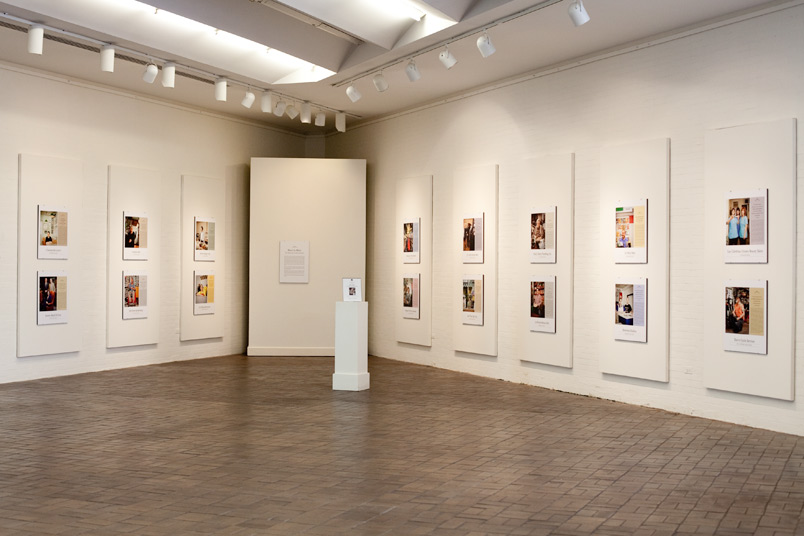 Here is a view of the entire show (or just about).
 A patron viewing the photographs.
 Another patron taking in the art.
 Here is the subject of one of the portraits together with
his picture and with the photographer.
 Here I am enjoying the photos and the descriptions.
 Here I am with Marco.
Tweet
04 October 2011
Marco Calderon exhibit opening
It is a perfect fall day: bright sun, cold wind, colors easing into the trees; boots, tights, plaid skirt, beret. A lovely day for a walk, or a drive, or an art show. So here I am, at Muhlenberg College, at the opening of photographer Marco Calderon's solo show "Block by Block: The Merchants of Old Allentown".
 This show is an excellent, fascinating combination of art, documentation, and living community. Each photograph is a portrait of the owner(s) of a small business in the old part of Allentown (Liberty, Chew, 9th, 10th, Linden streets). Each is accompanied by a lively little history of the person, when s/he bought the business, interesting biographical background, etc. So they are visual and textual, immediate and vested with psst/present stories and personalities.
 Barry Houser
I think it's the personalities that jump out. Calderon has captured joyful, expressive facial expression and has depicted these colorful local characters each in the midst of business, wearing the clothing or carrying the accoutrements of their trades. There is exciting diversity here, representative of Allentown's demographic: people from the Dominican Republic, Pakistan, Mexico, Greece, and of Thai, Italian, and various other European ancestry. The pictures are colorful in more than ethnic ways, as well: replete with grocery goods, beauty supplies, and the tools and trappings of landscape design, law, cuisine, floral arrangements, motorcycles, and formal wear.
 Heidi (Roth) Semmel
I'll list each of the merchants here, in case you live in the area and can patronize their businesses. It would be great to walk into one of their shops and let them know I saw their portrait in the Calderon show!
Louis Belletieri of Cheesesteak Louie's
Martin Karess of Maress, Reich & Furst
Candida Svirovsky of Candida's Bar
Barry Houser of 12th Street Barbershop
Christian Brown of Brown Design Corp.
Ana Pena of Las Palmas Restaurant
Carlos Rodriquez of Rodriquez Mini Market
Heidi (Roth) Semmel of C. E. Roth Formal Wear
Peter Phrom of Kow Thai Take Out
Fred J. Moery of Fred J. Moyer Plumbing
Jorge Rosales of La Placita Mexico Deli
Iftekhar Ansari of A1 Mini Mart
Chris Farkas of Bossman Studios
Mery Garcia of Las Calenitas Unisex Beauty Salon
Bill Boberski of Dan's Cycle Service
 Christian Brown
I think my favorite is the one of Christian Brown. It's dynamic, enthusiastic, and it works on a limited palette of simple, clear colors. The delight on Brown's face seems to me to be the passion of a person who loves his work. That's how I felt yesterday, reciting "Kubla Kahn" to my students as they sat in the dark watching a slide show of beautiful images illustrating the poem. That's how I felt expounding upon the eternal nature of art as we read "Ozymandias." That's how I felt discussing "true myth" with a student who is writing a paper comparing Oedipus and Jesus. That's how I imagine Christian Brown must feel in this picture, as the flame of joyful work, the flame of fulfilled human[ism], burns through him. And he gets to share that through this photograph, just as I hope the artist's I've interviewed got to share it in their talks with me.
 Fred J. Moyer
There's also a "Norman Rockwell" quality about a few of the photos, especially the one of Fred J. Moyer. Again, there's a limited color palette (although the majority of the pictures are vibrant with many hues). It is a close study of his face, lined and kind, in his work environment, where he belongs, with the accumulated stuff of a long life of work around him. It's very American. This whole show is very American.
When I met Marco Calderon at a Lehigh Valley Arts Council event this past summer, we had a great talk about the nature of this area. I expressed the ignorant, self-perpetuating stereotype that is exactly what he hates to hear: "Allentown is such a tough place to live, with only a small arts community, high crime rates, high poverty rates, and not much beautiful to look at." He immediately, but politely, jumped into a passionate denunciation of this misconception. On the contrary, he asserted, Allentown is a beautiful, colorful, rich place. Sure, you need to open your eyes and not just walk through with head down, clutching your purse (that's my interpretation), but there are fascinating people to see all throughout the most "troubled" areas. And he's out to prove that, camera in his hand, enterpreneurial energy in his spirit, photo by photo.
His other big project in this area was Welcome, Neighbor, a series of portraits of immigrant residents of the area. For each of these endeavors, Calderon has employed his considerable charm, talent, and energy to secure commissions or grants. The first series was the result of a commission by the ACLU of the Lehigh Valley. The current show, "Block by Block," was "made possible by a grant from the Rider-Pool Foundation, the Allentown Economic Development Corporation, and the Old Allentown Preservation Association."
Art can have a transformative influence on the community in which it is created, for sure, especially when it has such personal connection with individuals, organizations, and particular spaces in its area. This is, perhaps, yet another aspect of the recent resurgence in public art. Artists are opening their process to public view. Artists are speaking for, about, and into current events, national/international situations, human rights crises, etc. Art is coming out of the garret and into the street, the school, the shop, the home again. I am on the lookout for ways it is coming into the church. But that's another story.
Tweet
 This show is an excellent, fascinating combination of art, documentation, and living community. Each photograph is a portrait of the owner(s) of a small business in the old part of Allentown (Liberty, Chew, 9th, 10th, Linden streets). Each is accompanied by a lively little history of the person, when s/he bought the business, interesting biographical background, etc. So they are visual and textual, immediate and vested with psst/present stories and personalities.
 Barry Houser
I think it's the personalities that jump out. Calderon has captured joyful, expressive facial expression and has depicted these colorful local characters each in the midst of business, wearing the clothing or carrying the accoutrements of their trades. There is exciting diversity here, representative of Allentown's demographic: people from the Dominican Republic, Pakistan, Mexico, Greece, and of Thai, Italian, and various other European ancestry. The pictures are colorful in more than ethnic ways, as well: replete with grocery goods, beauty supplies, and the tools and trappings of landscape design, law, cuisine, floral arrangements, motorcycles, and formal wear.
 Heidi (Roth) Semmel
I'll list each of the merchants here, in case you live in the area and can patronize their businesses. It would be great to walk into one of their shops and let them know I saw their portrait in the Calderon show!
Louis Belletieri of Cheesesteak Louie's
Martin Karess of Maress, Reich & Furst
Candida Svirovsky of Candida's Bar
Barry Houser of 12th Street Barbershop
Christian Brown of Brown Design Corp.
Ana Pena of Las Palmas Restaurant
Carlos Rodriquez of Rodriquez Mini Market
Heidi (Roth) Semmel of C. E. Roth Formal Wear
Peter Phrom of Kow Thai Take Out
Fred J. Moery of Fred J. Moyer Plumbing
Jorge Rosales of La Placita Mexico Deli
Iftekhar Ansari of A1 Mini Mart
Chris Farkas of Bossman Studios
Mery Garcia of Las Calenitas Unisex Beauty Salon
Bill Boberski of Dan's Cycle Service
 Christian Brown
I think my favorite is the one of Christian Brown. It's dynamic, enthusiastic, and it works on a limited palette of simple, clear colors. The delight on Brown's face seems to me to be the passion of a person who loves his work. That's how I felt yesterday, reciting "Kubla Kahn" to my students as they sat in the dark watching a slide show of beautiful images illustrating the poem. That's how I felt expounding upon the eternal nature of art as we read "Ozymandias." That's how I felt discussing "true myth" with a student who is writing a paper comparing Oedipus and Jesus. That's how I imagine Christian Brown must feel in this picture, as the flame of joyful work, the flame of fulfilled human[ism], burns through him. And he gets to share that through this photograph, just as I hope the artist's I've interviewed got to share it in their talks with me.
 Fred J. Moyer
There's also a "Norman Rockwell" quality about a few of the photos, especially the one of Fred J. Moyer. Again, there's a limited color palette (although the majority of the pictures are vibrant with many hues). It is a close study of his face, lined and kind, in his work environment, where he belongs, with the accumulated stuff of a long life of work around him. It's very American. This whole show is very American.
When I met Marco Calderon at a Lehigh Valley Arts Council event this past summer, we had a great talk about the nature of this area. I expressed the ignorant, self-perpetuating stereotype that is exactly what he hates to hear: "Allentown is such a tough place to live, with only a small arts community, high crime rates, high poverty rates, and not much beautiful to look at." He immediately, but politely, jumped into a passionate denunciation of this misconception. On the contrary, he asserted, Allentown is a beautiful, colorful, rich place. Sure, you need to open your eyes and not just walk through with head down, clutching your purse (that's my interpretation), but there are fascinating people to see all throughout the most "troubled" areas. And he's out to prove that, camera in his hand, enterpreneurial energy in his spirit, photo by photo.
His other big project in this area was Welcome, Neighbor, a series of portraits of immigrant residents of the area. For each of these endeavors, Calderon has employed his considerable charm, talent, and energy to secure commissions or grants. The first series was the result of a commission by the ACLU of the Lehigh Valley. The current show, "Block by Block," was "made possible by a grant from the Rider-Pool Foundation, the Allentown Economic Development Corporation, and the Old Allentown Preservation Association."
Art can have a transformative influence on the community in which it is created, for sure, especially when it has such personal connection with individuals, organizations, and particular spaces in its area. This is, perhaps, yet another aspect of the recent resurgence in public art. Artists are opening their process to public view. Artists are speaking for, about, and into current events, national/international situations, human rights crises, etc. Art is coming out of the garret and into the street, the school, the shop, the home again. I am on the lookout for ways it is coming into the church. But that's another story.
Tweet
11 October 2010
Interview with Kevin Sprague, Photographer
This is the twenty-ninth interview in the “Where are we now?” series. This is a very exciting and important addition to the series; Kevin is a thoughtful artist who articulates his theories about the interaction of arts, technology, and human biology in clear and insightful ways.
Please take a moment to peruse the INTRODUCTION AND INDEX to this series and to leave a comment at the end. Thank you.

photo by Eric Korenmann
Interview with Kevin Sprague, photographer and graphic designer
via email, 6 and 17 August 2010
 IA: Please tell us about yourself: your writing, photography, graphic design, digital composition, teaching…. What are some of your past projects of which you are most proud? What current projects do you have in progress now?
 KS: I’ve been a working professional in the graphic design/photography/web field since 1994. I’m entirely self-taught in the technical aspects of my career—I was an English major at Cornell and did a lot of creative writing then, including my first novel Viewfinder which was, ironically enough, about a photographer. I’ve always been a photographer—it was always something we did growing up. The transition from film to digital in early in my career really opened up the world to me in terms of how one “tells stories” through images. The possibility of compositing multiple images, of manipulating them to make something completely new, was very appealing and effective for me.

The work that I am most proud of over my career is the 16+ years I have spent illustrating the works of William Shakespeare for Lenox, Massachusetts, based theatre troupe Shakespeare & Company. studio two, my business, has handled all the marketing for the company for the duration and during that time I’ve had the opportunity to illustrate many, many of the plays for posters, brochures and the like. It’s a rich and compelling body of work to play with again and again. It has also been a great collaboration with many other artists.
Currently, my active personal projects are focused on the moving image—working with HD video and the exciting imaging possibilities of the new breed of digital SLR cameras that shoot video. I just completed a shoot for a client on a short film, and I have a couple of film projects that I am playing with in the development stage. I’m interested in how simply and effectively one can produce a good film—that’s the challenge ahead.
IA: What other specific techniques do you use?
KS: Editing, editing, editing. For me a big part of the creative process is making choices about what to include and what to exclude. I’ll shoot a hundred photos in a 5-minute session with the aim of getting just THE one.
Sketching, just getting ideas out of my head and onto paper is very important. I’m not a great illustrator—I just make these scribbles that are the bare bones of the idea I am hoping to create, but getting the idea down is a key part. If I can see it in my mind, I can make it happen in camera and in Photoshop.
Intuition—believing that your inspiration, your first thought, the flash of an image is RIGHT. I don’t over-think, or analyze. The doing is all.
My tools are Photoshop, Photo Mechanic, InDesign, and Wordpress. I shoot with Nikon cameras and an odd assortment of lenses.

IA: On pages 204 and 205 of Imagining Shakespeare, you explain your process of digital composition. Would you mind summarizing that explanation here for the readers of this interview?

KS: I use Photoshop, which is the king of photo editing and manipulation. In Photoshop, you can have multiple “layers” and the layers interact via masks and other methods. The metaphor would be a stack of slides, where you were looking down through the slides and masking out elements you want to eliminate and enhancing other areas you want to keep. Using layers you can seamlessly combine photographs, which is often used to eliminate distracting elements, power lines, etc. in typical “straight” photography. In my work I use the function to create new relationships between images through composition and collaging. In addition, you have at your fingertips many special effects type of tools and techniques where you can create the surreal or impossible with a few clicks of the mouse.

IA: Would you talk to us about your graphic novel, Muse? How did you get the idea for the compositional techniques in this book? And for the storyline? Would you discuss your work with Catherine Taylor-Williams?

KS: Muse arose out of a creative dry spell—back a few years ago, in the winter, I was just bored creatively, so I started a little project. The basic format was based on the idea of making a book—and at the time the apple i-book format was popular. I created a document in Photoshop that was 22x8.5”—essentially the full panoramic width of two pages. I started the project by culling a couple of thousand “interesting” images from my collection of photos (I have something like 300K+ images on our servers at the studio—I never throw my pictures out). I just picked images from all sorts of different shoots. Then I would pick 4-5 of them that seemed to want to “play” together and I would bring them into Photoshop and start moving them around the canvas. I had a “3 strikes, you’re out” rule—if it took more than 3 moves or so for an image to start working with the other ones, I would chuck it and find something else. In short time – a couple of weekends – I had some 90 new composite images done. I put them in an order that seemed intuitively correct and made the first copy of the book.
When I got the book back from Apple, I started to realize that there was a story in the images—a narrative without words. The narrative was inspired from a central event that was represented in the book. I have had the pleasure of working with a couple of great models over the years in my work—people who contribute creatively to my work by their energy, willingness and presence. Actress Catherine Taylor-Williams is one of those people. Catherine had modeled for me over the previous couple of years on both commercial and personal projects—she was always willing to “play” with my ideas no matter what they were. I’m a great believer that the creative process is something that happens by process, energy, intuition and experience. Having someone who is willing to participate in that process without criticism or question can be a real benefit to the artist.
In any case, in the woods far behind my house there is a small, old pond. For years I had in mind an image of someone in the pond, rising up from it. I finally posed the question to Catherine about posing in the pond and she said “yes” despite it being late October in New England! So one morning we went up to the pond and she stripped down to her skivvies and jumped/slid into the freezing water. She swam out to the center of the pond where there were these floating lily pad/weeds and for a scary moment, she got a little tangled up in them. That, combined with the breathless cold of the water, panicked her slightly. Of course, all this time I’m shooting from the edge of the pond and as she started to panic it occurred to me that I should put down the camera and jump in to help her.... but just as quickly the moment passed and she got control of her situation. We shot some nice pictures and then went home.

The point of this long story is that I had used images of Catherine in the pond in the composites that made it into the book. Looking at them, I realized that there was this amazing power that the creative process could have over people—Catherine had put herself in a dangerous, uncomfortable position for really little to no benefit to herself—just a belief that the product we would make together would somehow be worth the risk. I began to think about the role of the “muse” in an artist’s process—an individual who is wholly and completely committed to the artist’s vision, no questions asked. Such individuals are rare creatures and I began to grasp the vision that the ancient concept of the Muse as a kind of deity—a demi-god or spirit that comes to earth to inspire artists... Anyway, in looking at the images I had created, I realized that central to them was the character of a muse—and that this muse while both immortal and transcendent was also abused, neglected, ignored. It turns out that being a muse is a tough business. My character travels through many lives and times without a knowledge of her fate or role but she begins to get a glimmer of it as the books goes on. In the end, the muse transcends her proscribed fate and transitions from “inspiration to creation”—to escape her muse-ship she has to become an artist, or a creator herself.
The book is a kind of graphic novel, in that the images and the words work together to tell the story. But it is not a comic book and the images are really broad dreams of the circumstances. The whole thing is really more of a piece of art than a novel.

IA: You say in your description of Muse, “the muse transcends her proscribed fate and transitions from ‘inspiration to creation’—to escape her muse-ship she has to become an artist, or a creator herself.” This movement from the passive position as object to an active role as subject: is this the account of what one particular woman experienced? Or the account of what every woman must do if she is to find her life’s work? Or a metaphor for women’s history—what women as a community have encountered from the limitations past to the relatively more open present?

KS: Although the Muse is a woman, typically, and in my story is always so, I think there are male muses in the world certainly. My idea of her needing to transition from “inspiration to creation” was meant not so much as a comment on the role of women versus men but on the necessary act of DOING that is at the heart of creation. In other words, it is only when we grab onto the tools and materials of our world and make
something new out of them that we become artists. Making, doing, creating are core human activities so I think I was looking at this transition as a symbol of her evolution as a human. It certainly could be interpreted as the evolving identity and role of women across history—but it was not what I was focused on. I think her evolution was potentially timeless—it could have happened in any era.

IA: You have worked closely with Shakespeare & Co. for many years; is Imagining Shakespeare the result of these years? How have you interacted with the company, the plays, and with Shakespeare? What have you learned from this theatre company, and how has it influenced your work?
KS: Working with Shakespeare has been such a rich experience—his words have aged so well that they continue to resonate with modern audiences—and my relationship with the Company has allowed me to become fluent and conversant in the deeper aspects of William Shakespeare and his many plays. My Book Imagining Shakespeare was really just an attempt to condense, compile and organize my work for the Company into something that might help people understand my creative process and also give them a glimpse into this marvelous world and the creative people who live in it.

My work for the Company is primarily a commercial relationship—they are my client, and my job is to create compelling images and materials that sell tickets, and lots of them. If I had not been successful in this endeavor, our relationship would have ended a long time ago. As a commercial relationship, a lot of the work is driven by tight budgets, crazy short deadlines, and external requirements that threaten the creative process at every turn. I’ve learned how to work lighting-fast, how to show up, set up, direct and shoot, and break down in 15 minutes on location. I’ve learned how to be creative on my feet with a pencil and scrap of paper while 20 people stand around waiting for my direction. I always tell people that “creativity is a muscle”—i.e., the more you exercise it, the stronger and faster it gets. I love the flow of the creative process under pressure—the way that solutions, ideas and results condense moment by moment into extraordinary results. I don’t think that we, as a society, spend enough time talking about or teaching “creativity” as a necessary life skill—a learnable skill like addition and subtraction, or becoming fluent in a foreign language. In our world, creativity is tied to “talent,” this idea that you either have it or you don’t. I think that is baloney—we’re here to learn things and to express that learning and to learn again. I’m always learning from my own work and from the people around me and exercising and growing that creative muscle. Shakespeare is just one of the better places to work it out.

IA: Throughout Imagining Shakespeare, you occasionally discuss some limitations that have held Shakespeare & Co. back, at times, from fully realizing their dreams. These have almost all been financial. However, you discuss one incident in 2007 in which you thought “self-censorship” prevented the Company from achieving full artistic freedom. You had designed a poster for Macbeth that showed Lady Macbeth’s hand grasping two bloody daggers; the daggers were piercing the skin of her own wrist. The idea is that those who commit—or incite—bloody murder will not go unscathed by violence. However, you were asked to withdraw this image; there were fears about the effect this image would have on teenage audiences. At that time, cutting was rampant among high school students (and still are, unfortunately); it was perhaps one of the more widespread addictions among young people in America. There is some concern that images of self-mutilation can spur children on to try it for the first time, or to revert to that very disturbing negative behavior if they have been in the habit in the past. Aren’t there times when artistic freedom really should be sacrificed to concerns of morality, social justice, or other communal needs? In other words, is creative excellence always the highest goal an artistic company should strive for, or do they sometimes need to take into consideration potentially harmful real-life effects of their work?
KS: Certainly, I think that any organization that is participating in the lives of children should use common sense and good judgment about what materials, representations, and information gets disseminated. My observation was not so much about the content of the decision that was made but the context—I felt like there needed to be a discussion about the issue, and an examination of the role that the marketing image plays in the fabric of the entire experience they are creating. In other words, the Company needed to apply the same rigor, artistic examination and process to my work as it would to a decision regarding manipulating or editing Shakespeare's text and the presentation
thereof. By the same measure, it could be argued that many of the tragedies should not be presented to high school audience because the stories (and their enactments) are full of bloody, profligate violence and murder. My work is not ancillary to their presentation—it is part of it. It's an ongoing discussion but I think that any artist or group of artists need to work from the heart of their inspiration and need to be given an opportunity to defend, discuss and present their work before summary judgment.
IA: What other topics tend to recur in your work?
KS: We’re a branding agency—one of the things we do is help organizations distill their values, vision and identity and express those things. I do that for myself. In my personal value space relating to my work I have some core precepts—beauty, honesty, extraordinary. I’m always trying to live up to those values. I’m interested in the beautiful—ugliness, shock value, the grotesque, have no appeal to me. I love making things that make people happy, or thrilled, or excited. I’m interested in life, and the living of it. I find much of the current phase of commercial and art photography being curated by the leading magazines and critics to be lifeless, vapid, disturbed, devoid, emotionless. So many photos of people in ruined places looking exhausted, bored, or vacant. I don’t know where these people are (or rather, where the photographers creating these scenarios live). My world isn’t like that. I’m surrounded by creative people striving, working and applying tremendous energy to their activities every day—hoping to make a difference, hoping to be successful, hoping to make an impression. No one I know has time to stand around looking vacant. We’re too busy DOING stuff. We live in a fantastic world full of beauty and mystery. Get outside—go look at it.

I’m a scientist by nature—a side interest of mine is evolutionary theory and the writings of Richard Dawkins (The Selfish Gene) and Daniel Dennett (Darwin’s Dangerous Idea). I think the natural world and the amazing accidents of life and of natural selection are deeply true and compelling. Some of that, I hope, comes into my work.
IA: What theories inform your work?
KS: I believe that we are visual beings—and that our ability to understand and interpret images is driven by life experience but also by physiology—the nature of how the brain works. Working with images on computers all the time, I’ve formed some theories about the relationship between image content, image compression and the way that memory works. In a nutshell, the brain needs to compress data to optimize storage, much like a hard drive does. It does this by deleting unnecessary detail. If you think about images that you remember, you often can describe the point of focus, a face perhaps, but not really what is happening in the background. My theory is that images that reflect our mental processes tap into those emotional states of memory or perception. Why are people drawn to the aesthetic of short depth of field portraits where the emphasis is on the face or the eyes? Because that is how we, as human beings, focus our attention and our minds—faces matter, eyes matter—background doesn’t matter, most of the time. I like to play with the theories in how I approach the task of making my work effective and powerful.
IA: Do you think these topics, techniques, and theories are typical of those working in your genres?
KS: I don’t think they are typical. There is very little discussion that I come across of the relationships between “being human” in a biological sense and art—I think there are hard facts at work here, not vague ideas of composition, color, motion and so on. Where my work is perhaps typical to others working in the field is the assumption that we can create compelling images by the combination and manipulation of multiple images together—thereby removing most of the sacred truth of a given photograph and really turning it into something new, fictional and different. I don’t subscribe much to the theory of the sacrosanct image—photographs have always been subject to a degree of manipulation since the first photo was made—through developing, printing, enhancing. I think photojournalists need to live by a stricter code in this day and age, but I’m not a photojournalist—I create new fictions.
IA: Do you think of yourself as belonging to any particular ‘school’ or ‘movement’?
KS: Only the digital imaging and Photoshop movement, if such a thing exists.
IA: What can you tell us about the current state of the arts? Please talk specifically about photographers, writers, artists, actors, etc. whom you know (or whose work you know), their topics/techniques/theories, and in general about your sense of North American arts right now.
KS: I believe that we might be at a tipping point for the arts in the USA. This tipping point has to do with the evaluation of the role that the arts plays in our larger economy, focused in part by the evolving dialogue about the “Creative Economy.” I live in a community that is defined to a large degree by the economic impact of the arts—performing, visual, commercial and industrial. We’ve been changing the language about what our regional economy means by tracking, quantizing, and promoting the impact that the Creative Economy has on our regional economic health and development. In particular, I’ve been focusing on the role of capital investment in the arts and the effect of that investment. In the arts community, capital is often spoken of strictly in an agnostic sense, divorced from its impact—“Donations,” “Sponsor,” “Philanthropists,” “Grants.” All of these are a form of public or private capital investment—a donation to an arts organization is no different than an equity investment in a private sector business—the expectation of return is different from the investor’s point of view, but the impact is the same—new product development, new construction, jobs, growth.
The Arts and related creative industries have long been the whipping boy of public investment. Arts funding continues to be cut across the board. But I think that people are starting to see the glimmer. One of the great remaining exports of the USA is our creative output—movies, video games, software, media of all kinds. These are the arts in action, believe it or not. I’m a commercial artist—I make my living on my ability to think creatively every day. As a fine artist, I seek to go to deeper places to enjoy the flow of my creative output, but I make no distinction between my commercial and my personal work—I hold nothing back during the day at my desk.
I think that a new generation of artists who have many more and varied ways of expressing themselves is upon us, and this generation, and I count myself among the vanguard, find no inherent borders between commercial and personal work. We are designers, photographers, filmmakers, web developers, animators, printers, painters, performers, musicians—we are all these things, all the time. And we are good at it.
IA: If you have a religious point of view, can you comment on the differences between sacred and secular arts?
KS: I’m not a religious person. I enjoy the history and presence of the sacred arts—I love visiting churches and cathedrals when I travel and seeing the local stamp on the familiar stories, but I don’t perceive any active role in my sphere where the religious or secular are in contrast or tension.
IA: How do you think the arts (your own or others’) are responding to present and potential world-movements, such as postmodernism, the looming “post-human” phase, and the possible artistic effects of the Eastward orientation of economics and Christianity?
KS: It’s interesting to think and see internationally—there is a world of diversity at our fingertips. I get frustrated when it is clear that a western curatorial view of what is and isn’t “art” gets applied to work from other farther, different places.
My personal theory on the “post human” phase is that we are already deeply in it, and that technology, if it gets smarter, might do well to play dumb. I joke that I spend my days working so that my technology is happy—I provide it power, access to other technology via high-speed connections, I upgrade it constantly and fix it when it breaks.... Who is working for whom? Owning computers and devices these days is like living with a bunch of housecats who occasionally catch a nuisance rodent but otherwise spend a good part of the day eating and sleeping! That’s the life.
I’m not interested particularly in the “looming” of China and the East. When I was younger it was all about Japan eating our lunch, and now it is about being in 2nd place to China, etc. Who cares? We live in a global society. I live in a free country, relatively speaking, and I work on a local level—my family, my friends, my town, my region. I seek to strengthen these things.
Our world gets better. Many people like to see it always getting worse, but it isn’t true. My environment has never been cleaner, the air fresher, the water more drinkable. The opportunities have never been so abundant, the possibilities of communicating and connecting never so rich and varied. It’s all amazing.
IA: How do you think we got to the phase where we are now?
KS: Technology. I’m a geek by breeding and nature. The computer, the integrated circuit, and the Internet have changed everything. And we have only just started. This is the horse-and-buggy days of technology. Just watch.
IA: Where are we going?
KS: Amazing places—why was the movie “Avatar” so successful? Did it have the best story, the best characters, the best plot? No. But it was a tour-de-force of imagination and imaging. It was so beautiful—again, back to the idea that we are visual creatures—the movie experience was like a drug—positively addicting.
I think that was a taste of where we are going in the arts, expression and story-telling. The bar is going to be continually pushed ahead. Some of the most amazing creative imaging and imagination I see is in the gaming space—your new x-box or playstation game contains whole worlds with features, architecture and elements that exceed anything possible in the physical world—and you can walk, run, jump and fly through these spaces. This is art—whether you like it or not. It is also significant that these art forms are collaborative—movies, games, theater—these forms all require large numbers of creatives to work together. I think that the demands, expectations and economic possibilities for arts in the future will require this kind of broad collaboration, which is perhaps a refreshing change from the lone artist in his garret that has been the tradition for so long. Making art with other people is fun. Why shouldn’t it be fun?

Please take a moment to peruse the INTRODUCTION AND INDEX to this series and to leave a comment at the end. Thank you.

photo by Eric Korenmann
Interview with Kevin Sprague, photographer and graphic designer
via email, 6 and 17 August 2010
 IA: Please tell us about yourself: your writing, photography, graphic design, digital composition, teaching…. What are some of your past projects of which you are most proud? What current projects do you have in progress now?
 KS: I’ve been a working professional in the graphic design/photography/web field since 1994. I’m entirely self-taught in the technical aspects of my career—I was an English major at Cornell and did a lot of creative writing then, including my first novel Viewfinder which was, ironically enough, about a photographer. I’ve always been a photographer—it was always something we did growing up. The transition from film to digital in early in my career really opened up the world to me in terms of how one “tells stories” through images. The possibility of compositing multiple images, of manipulating them to make something completely new, was very appealing and effective for me.
The work that I am most proud of over my career is the 16+ years I have spent illustrating the works of William Shakespeare for Lenox, Massachusetts, based theatre troupe Shakespeare & Company. studio two, my business, has handled all the marketing for the company for the duration and during that time I’ve had the opportunity to illustrate many, many of the plays for posters, brochures and the like. It’s a rich and compelling body of work to play with again and again. It has also been a great collaboration with many other artists.
Currently, my active personal projects are focused on the moving image—working with HD video and the exciting imaging possibilities of the new breed of digital SLR cameras that shoot video. I just completed a shoot for a client on a short film, and I have a couple of film projects that I am playing with in the development stage. I’m interested in how simply and effectively one can produce a good film—that’s the challenge ahead.
IA: What other specific techniques do you use? KS: Editing, editing, editing. For me a big part of the creative process is making choices about what to include and what to exclude. I’ll shoot a hundred photos in a 5-minute session with the aim of getting just THE one.Sketching, just getting ideas out of my head and onto paper is very important. I’m not a great illustrator—I just make these scribbles that are the bare bones of the idea I am hoping to create, but getting the idea down is a key part. If I can see it in my mind, I can make it happen in camera and in Photoshop.
Intuition—believing that your inspiration, your first thought, the flash of an image is RIGHT. I don’t over-think, or analyze. The doing is all.
My tools are Photoshop, Photo Mechanic, InDesign, and Wordpress. I shoot with Nikon cameras and an odd assortment of lenses.
 IA: On pages 204 and 205 of Imagining Shakespeare, you explain your process of digital composition. Would you mind summarizing that explanation here for the readers of this interview?
 KS: I use Photoshop, which is the king of photo editing and manipulation. In Photoshop, you can have multiple “layers” and the layers interact via masks and other methods. The metaphor would be a stack of slides, where you were looking down through the slides and masking out elements you want to eliminate and enhancing other areas you want to keep. Using layers you can seamlessly combine photographs, which is often used to eliminate distracting elements, power lines, etc. in typical “straight” photography. In my work I use the function to create new relationships between images through composition and collaging. In addition, you have at your fingertips many special effects type of tools and techniques where you can create the surreal or impossible with a few clicks of the mouse.
 IA: Would you talk to us about your graphic novel, Muse? How did you get the idea for the compositional techniques in this book? And for the storyline? Would you discuss your work with Catherine Taylor-Williams?
 KS: Muse arose out of a creative dry spell—back a few years ago, in the winter, I was just bored creatively, so I started a little project. The basic format was based on the idea of making a book—and at the time the apple i-book format was popular. I created a document in Photoshop that was 22x8.5”—essentially the full panoramic width of two pages. I started the project by culling a couple of thousand “interesting” images from my collection of photos (I have something like 300K+ images on our servers at the studio—I never throw my pictures out). I just picked images from all sorts of different shoots. Then I would pick 4-5 of them that seemed to want to “play” together and I would bring them into Photoshop and start moving them around the canvas. I had a “3 strikes, you’re out” rule—if it took more than 3 moves or so for an image to start working with the other ones, I would chuck it and find something else. In short time – a couple of weekends – I had some 90 new composite images done. I put them in an order that seemed intuitively correct and made the first copy of the book.
When I got the book back from Apple, I started to realize that there was a story in the images—a narrative without words. The narrative was inspired from a central event that was represented in the book. I have had the pleasure of working with a couple of great models over the years in my work—people who contribute creatively to my work by their energy, willingness and presence. Actress Catherine Taylor-Williams is one of those people. Catherine had modeled for me over the previous couple of years on both commercial and personal projects—she was always willing to “play” with my ideas no matter what they were. I’m a great believer that the creative process is something that happens by process, energy, intuition and experience. Having someone who is willing to participate in that process without criticism or question can be a real benefit to the artist.
In any case, in the woods far behind my house there is a small, old pond. For years I had in mind an image of someone in the pond, rising up from it. I finally posed the question to Catherine about posing in the pond and she said “yes” despite it being late October in New England! So one morning we went up to the pond and she stripped down to her skivvies and jumped/slid into the freezing water. She swam out to the center of the pond where there were these floating lily pad/weeds and for a scary moment, she got a little tangled up in them. That, combined with the breathless cold of the water, panicked her slightly. Of course, all this time I’m shooting from the edge of the pond and as she started to panic it occurred to me that I should put down the camera and jump in to help her.... but just as quickly the moment passed and she got control of her situation. We shot some nice pictures and then went home.

The point of this long story is that I had used images of Catherine in the pond in the composites that made it into the book. Looking at them, I realized that there was this amazing power that the creative process could have over people—Catherine had put herself in a dangerous, uncomfortable position for really little to no benefit to herself—just a belief that the product we would make together would somehow be worth the risk. I began to think about the role of the “muse” in an artist’s process—an individual who is wholly and completely committed to the artist’s vision, no questions asked. Such individuals are rare creatures and I began to grasp the vision that the ancient concept of the Muse as a kind of deity—a demi-god or spirit that comes to earth to inspire artists... Anyway, in looking at the images I had created, I realized that central to them was the character of a muse—and that this muse while both immortal and transcendent was also abused, neglected, ignored. It turns out that being a muse is a tough business. My character travels through many lives and times without a knowledge of her fate or role but she begins to get a glimmer of it as the books goes on. In the end, the muse transcends her proscribed fate and transitions from “inspiration to creation”—to escape her muse-ship she has to become an artist, or a creator herself.
The book is a kind of graphic novel, in that the images and the words work together to tell the story. But it is not a comic book and the images are really broad dreams of the circumstances. The whole thing is really more of a piece of art than a novel.
 IA: You say in your description of Muse, “the muse transcends her proscribed fate and transitions from ‘inspiration to creation’—to escape her muse-ship she has to become an artist, or a creator herself.” This movement from the passive position as object to an active role as subject: is this the account of what one particular woman experienced? Or the account of what every woman must do if she is to find her life’s work? Or a metaphor for women’s history—what women as a community have encountered from the limitations past to the relatively more open present?
 KS: Although the Muse is a woman, typically, and in my story is always so, I think there are male muses in the world certainly. My idea of her needing to transition from “inspiration to creation” was meant not so much as a comment on the role of women versus men but on the necessary act of DOING that is at the heart of creation. In other words, it is only when we grab onto the tools and materials of our world and make
something new out of them that we become artists. Making, doing, creating are core human activities so I think I was looking at this transition as a symbol of her evolution as a human. It certainly could be interpreted as the evolving identity and role of women across history—but it was not what I was focused on. I think her evolution was potentially timeless—it could have happened in any era.
 IA: You have worked closely with Shakespeare & Co. for many years; is Imagining Shakespeare the result of these years? How have you interacted with the company, the plays, and with Shakespeare? What have you learned from this theatre company, and how has it influenced your work? KS: Working with Shakespeare has been such a rich experience—his words have aged so well that they continue to resonate with modern audiences—and my relationship with the Company has allowed me to become fluent and conversant in the deeper aspects of William Shakespeare and his many plays. My Book Imagining Shakespeare was really just an attempt to condense, compile and organize my work for the Company into something that might help people understand my creative process and also give them a glimpse into this marvelous world and the creative people who live in it.
My work for the Company is primarily a commercial relationship—they are my client, and my job is to create compelling images and materials that sell tickets, and lots of them. If I had not been successful in this endeavor, our relationship would have ended a long time ago. As a commercial relationship, a lot of the work is driven by tight budgets, crazy short deadlines, and external requirements that threaten the creative process at every turn. I’ve learned how to work lighting-fast, how to show up, set up, direct and shoot, and break down in 15 minutes on location. I’ve learned how to be creative on my feet with a pencil and scrap of paper while 20 people stand around waiting for my direction. I always tell people that “creativity is a muscle”—i.e., the more you exercise it, the stronger and faster it gets. I love the flow of the creative process under pressure—the way that solutions, ideas and results condense moment by moment into extraordinary results. I don’t think that we, as a society, spend enough time talking about or teaching “creativity” as a necessary life skill—a learnable skill like addition and subtraction, or becoming fluent in a foreign language. In our world, creativity is tied to “talent,” this idea that you either have it or you don’t. I think that is baloney—we’re here to learn things and to express that learning and to learn again. I’m always learning from my own work and from the people around me and exercising and growing that creative muscle. Shakespeare is just one of the better places to work it out.
 IA: Throughout Imagining Shakespeare, you occasionally discuss some limitations that have held Shakespeare & Co. back, at times, from fully realizing their dreams. These have almost all been financial. However, you discuss one incident in 2007 in which you thought “self-censorship” prevented the Company from achieving full artistic freedom. You had designed a poster for Macbeth that showed Lady Macbeth’s hand grasping two bloody daggers; the daggers were piercing the skin of her own wrist. The idea is that those who commit—or incite—bloody murder will not go unscathed by violence. However, you were asked to withdraw this image; there were fears about the effect this image would have on teenage audiences. At that time, cutting was rampant among high school students (and still are, unfortunately); it was perhaps one of the more widespread addictions among young people in America. There is some concern that images of self-mutilation can spur children on to try it for the first time, or to revert to that very disturbing negative behavior if they have been in the habit in the past. Aren’t there times when artistic freedom really should be sacrificed to concerns of morality, social justice, or other communal needs? In other words, is creative excellence always the highest goal an artistic company should strive for, or do they sometimes need to take into consideration potentially harmful real-life effects of their work? KS: Certainly, I think that any organization that is participating in the lives of children should use common sense and good judgment about what materials, representations, and information gets disseminated. My observation was not so much about the content of the decision that was made but the context—I felt like there needed to be a discussion about the issue, and an examination of the role that the marketing image plays in the fabric of the entire experience they are creating. In other words, the Company needed to apply the same rigor, artistic examination and process to my work as it would to a decision regarding manipulating or editing Shakespeare's text and the presentation
thereof. By the same measure, it could be argued that many of the tragedies should not be presented to high school audience because the stories (and their enactments) are full of bloody, profligate violence and murder. My work is not ancillary to their presentation—it is part of it. It's an ongoing discussion but I think that any artist or group of artists need to work from the heart of their inspiration and need to be given an opportunity to defend, discuss and present their work before summary judgment.
IA: What other topics tend to recur in your work? KS: We’re a branding agency—one of the things we do is help organizations distill their values, vision and identity and express those things. I do that for myself. In my personal value space relating to my work I have some core precepts—beauty, honesty, extraordinary. I’m always trying to live up to those values. I’m interested in the beautiful—ugliness, shock value, the grotesque, have no appeal to me. I love making things that make people happy, or thrilled, or excited. I’m interested in life, and the living of it. I find much of the current phase of commercial and art photography being curated by the leading magazines and critics to be lifeless, vapid, disturbed, devoid, emotionless. So many photos of people in ruined places looking exhausted, bored, or vacant. I don’t know where these people are (or rather, where the photographers creating these scenarios live). My world isn’t like that. I’m surrounded by creative people striving, working and applying tremendous energy to their activities every day—hoping to make a difference, hoping to be successful, hoping to make an impression. No one I know has time to stand around looking vacant. We’re too busy DOING stuff. We live in a fantastic world full of beauty and mystery. Get outside—go look at it.
I’m a scientist by nature—a side interest of mine is evolutionary theory and the writings of Richard Dawkins (The Selfish Gene) and Daniel Dennett (Darwin’s Dangerous Idea). I think the natural world and the amazing accidents of life and of natural selection are deeply true and compelling. Some of that, I hope, comes into my work.
IA: What theories inform your work? KS: I believe that we are visual beings—and that our ability to understand and interpret images is driven by life experience but also by physiology—the nature of how the brain works. Working with images on computers all the time, I’ve formed some theories about the relationship between image content, image compression and the way that memory works. In a nutshell, the brain needs to compress data to optimize storage, much like a hard drive does. It does this by deleting unnecessary detail. If you think about images that you remember, you often can describe the point of focus, a face perhaps, but not really what is happening in the background. My theory is that images that reflect our mental processes tap into those emotional states of memory or perception. Why are people drawn to the aesthetic of short depth of field portraits where the emphasis is on the face or the eyes? Because that is how we, as human beings, focus our attention and our minds—faces matter, eyes matter—background doesn’t matter, most of the time. I like to play with the theories in how I approach the task of making my work effective and powerful.IA: Do you think these topics, techniques, and theories are typical of those working in your genres? KS: I don’t think they are typical. There is very little discussion that I come across of the relationships between “being human” in a biological sense and art—I think there are hard facts at work here, not vague ideas of composition, color, motion and so on. Where my work is perhaps typical to others working in the field is the assumption that we can create compelling images by the combination and manipulation of multiple images together—thereby removing most of the sacred truth of a given photograph and really turning it into something new, fictional and different. I don’t subscribe much to the theory of the sacrosanct image—photographs have always been subject to a degree of manipulation since the first photo was made—through developing, printing, enhancing. I think photojournalists need to live by a stricter code in this day and age, but I’m not a photojournalist—I create new fictions.IA: Do you think of yourself as belonging to any particular ‘school’ or ‘movement’? KS: Only the digital imaging and Photoshop movement, if such a thing exists.IA: What can you tell us about the current state of the arts? Please talk specifically about photographers, writers, artists, actors, etc. whom you know (or whose work you know), their topics/techniques/theories, and in general about your sense of North American arts right now. KS: I believe that we might be at a tipping point for the arts in the USA. This tipping point has to do with the evaluation of the role that the arts plays in our larger economy, focused in part by the evolving dialogue about the “Creative Economy.” I live in a community that is defined to a large degree by the economic impact of the arts—performing, visual, commercial and industrial. We’ve been changing the language about what our regional economy means by tracking, quantizing, and promoting the impact that the Creative Economy has on our regional economic health and development. In particular, I’ve been focusing on the role of capital investment in the arts and the effect of that investment. In the arts community, capital is often spoken of strictly in an agnostic sense, divorced from its impact—“Donations,” “Sponsor,” “Philanthropists,” “Grants.” All of these are a form of public or private capital investment—a donation to an arts organization is no different than an equity investment in a private sector business—the expectation of return is different from the investor’s point of view, but the impact is the same—new product development, new construction, jobs, growth.The Arts and related creative industries have long been the whipping boy of public investment. Arts funding continues to be cut across the board. But I think that people are starting to see the glimmer. One of the great remaining exports of the USA is our creative output—movies, video games, software, media of all kinds. These are the arts in action, believe it or not. I’m a commercial artist—I make my living on my ability to think creatively every day. As a fine artist, I seek to go to deeper places to enjoy the flow of my creative output, but I make no distinction between my commercial and my personal work—I hold nothing back during the day at my desk.
I think that a new generation of artists who have many more and varied ways of expressing themselves is upon us, and this generation, and I count myself among the vanguard, find no inherent borders between commercial and personal work. We are designers, photographers, filmmakers, web developers, animators, printers, painters, performers, musicians—we are all these things, all the time. And we are good at it.
IA: If you have a religious point of view, can you comment on the differences between sacred and secular arts? KS: I’m not a religious person. I enjoy the history and presence of the sacred arts—I love visiting churches and cathedrals when I travel and seeing the local stamp on the familiar stories, but I don’t perceive any active role in my sphere where the religious or secular are in contrast or tension.IA: How do you think the arts (your own or others’) are responding to present and potential world-movements, such as postmodernism, the looming “post-human” phase, and the possible artistic effects of the Eastward orientation of economics and Christianity? KS: It’s interesting to think and see internationally—there is a world of diversity at our fingertips. I get frustrated when it is clear that a western curatorial view of what is and isn’t “art” gets applied to work from other farther, different places.My personal theory on the “post human” phase is that we are already deeply in it, and that technology, if it gets smarter, might do well to play dumb. I joke that I spend my days working so that my technology is happy—I provide it power, access to other technology via high-speed connections, I upgrade it constantly and fix it when it breaks.... Who is working for whom? Owning computers and devices these days is like living with a bunch of housecats who occasionally catch a nuisance rodent but otherwise spend a good part of the day eating and sleeping! That’s the life.
I’m not interested particularly in the “looming” of China and the East. When I was younger it was all about Japan eating our lunch, and now it is about being in 2nd place to China, etc. Who cares? We live in a global society. I live in a free country, relatively speaking, and I work on a local level—my family, my friends, my town, my region. I seek to strengthen these things.
Our world gets better. Many people like to see it always getting worse, but it isn’t true. My environment has never been cleaner, the air fresher, the water more drinkable. The opportunities have never been so abundant, the possibilities of communicating and connecting never so rich and varied. It’s all amazing.
IA: How do you think we got to the phase where we are now? KS: Technology. I’m a geek by breeding and nature. The computer, the integrated circuit, and the Internet have changed everything. And we have only just started. This is the horse-and-buggy days of technology. Just watch.IA: Where are we going? KS: Amazing places—why was the movie “Avatar” so successful? Did it have the best story, the best characters, the best plot? No. But it was a tour-de-force of imagination and imaging. It was so beautiful—again, back to the idea that we are visual creatures—the movie experience was like a drug—positively addicting.I think that was a taste of where we are going in the arts, expression and story-telling. The bar is going to be continually pushed ahead. Some of the most amazing creative imaging and imagination I see is in the gaming space—your new x-box or playstation game contains whole worlds with features, architecture and elements that exceed anything possible in the physical world—and you can walk, run, jump and fly through these spaces. This is art—whether you like it or not. It is also significant that these art forms are collaborative—movies, games, theater—these forms all require large numbers of creatives to work together. I think that the demands, expectations and economic possibilities for arts in the future will require this kind of broad collaboration, which is perhaps a refreshing change from the lone artist in his garret that has been the tradition for so long. Making art with other people is fun. Why shouldn’t it be fun?

Subscribe to:
Posts (Atom)