Pages

29 June 2013

The Doctor Diaries III.8 & 9: “Human Nature” and “The Family of Blood”

Stories About Stories


This two-episode story is one of the tightest, best-written, and best-acted I've seen so far. It's just packed with brilliant themes and lots of heartbreak. I could write about the love story, the christological themes, the historicist look at the first world war, or so many other topics. I could rave about how these two episodes are a showcase for Tennant's consummate acting skill. I could approach them psychoanalytically, through the Doctor's dreams.

But instead, I want to talk about Meta-Narrative and about The Causes of Creepiness.

OK, meta-narrative is not the right word for what I'm going to discuss. A meta-narrative is a big story that explains everything: science, religion, etc.

What I'm thinking of is more like a sub-narrative: The Journal of Impossible Things. This is the diary John Smith keeps of his dreams, which are dreams of the truth. There are many, many layers here: there is reality, which is his past as the Doctor. There are revelatory dreams, in which he dreams the truth but thinks it's fiction. There is the Journal itself, in which he writes truth as if it is fiction. The Journal is a beautiful artifact, and a beautiful plot device. With images and text, it takes reality and pushes it into a fantasy realm (from the Doctor's point of view), while simultaneously giving that disbelieved reality a new plausibility (to Joan Redfern's point of view).

Then there is the real-fiction of his life as John Smith, which is a real life on earth in a certain place, at a certain time, with real relationships with other people, but which is less real (in one sense) than his true identity as The Doctor and more real (in another sense) as a human existence. It is a real life, for a few months, in which he falls in love with a woman in as serious a manner as man has ever done. For her, this is all the reality: love and heartbreak.

Then there is Martha, again filling in for the viewer, watching him with all of her inside and outside knowledge: only she knows all the stories.
The second theme I want to pick up on is that of The Causes of Creepiness. The writers of Doctor Who do a brilliant job creating explanations for creepy things. What creeps you out for no reason? Spiral staircases? Gauzy window curtains moving in a evening breeze? Or maybe angel statues, mirrors, or scarecrows? Whatever it is, eventually an episode of Doctor Who will explain to you why those things are creepy—and will creep you out permanently while doing so.


25 June 2013

The Doctor Diaries III.7: “42”

What shape is your story?


I have written before about narrative structure. Narrative structure is the short of shape that a story takes: it begins with an exposition in which the characters, setting, and situation are laid out. Then the conflict is introduced, and tension starts to build. At some point, the tension is resolved at the “crisis,” and then the narrative eases back down to a conclusion. The simplest visual representation is Freytag's pyramid:
Another way to think about this is to reveal the screenplay's “Three-Act Structure”:
Now, this episode has essentially the same plot as “The Impossible Planet” and “The Satan Pit” but with a compressed narrative arc, so we can talk about what effect that has. The basic storyline breaks down like this:

Act I/Exposition: The story opens with a limited number of humans trapped on a space ship/space station in a near-fatal situation near a celestial body. In one, it's a black hole. In the other, it's the sun.

Act II/Rising Action: As the danger increases, the human die off one by one. The Doctor prepares to sacrifice himself to hold off evil, nearly dies, and comes through at the last minute. In Impossible Planet/Satan Pit I'd say the midpoint is when the Doctor jumps, and everyone thinks he's dead. In 42, it's when he's possessed by the sun creature.

Act III/Climax and Falling Action. Only the Doctor, his companion, and three people are left, one of whom is actually the enemy. In each, someone else beside the Doctor takes out that last enemy, at great emotional cost to herself, and “equilibrium is restored.”

So, the same story. But “42” takes place in one episode while the other story took up two. Doesn't that mean every element of the story receives half the time in “42”?

Nope. Basically what it means is that the tension part of “42” is disproportionately longer than it is in the the other story, with less time spent on Rising Action and Falling Action. Acts I and III are significantly shorter than Act II, in other words.

 I have not timed this. It is an instinctive response.


Do you think I'm right?

22 June 2013

The Doctor Diaries III.6: “The Lazarus Experiment”

The Power of Music

In my post about “The Shakespeare Code,” I wrote about the saving, magical power of words. Now this episode concludes with a victory based on the power of music.
This is a gorgeous concept: I hope that every one of you readers has had your heart wrenched, your soul uplifted, and your life changed by listening to live music, especially orchestral, operatic, chamber ensemble, piano, or organ music (I find those to be the most powerful). And if you have, perhaps you wondered what exactly was going on. Why should a particular combination of mechanical waves, setting up patterns of oscillating pressure in air (thanks, wikipedia), make me cry or make me feel like I am in heaven? Well, words do the same thing, and words are also sounds; i.e., mechanical waves setting up patterns of oscillating pressure in air. And any particular set of those mechanical waves, originating at someone else's mouth and ending at my ear, to be processed by my brain, can cause me to cry or laugh or want to die or think I'm in heaven.

 But words are different. Words carry meaning. We could have a delightful conversation about whether the meanings words convey are simply arbitrary social conventions, or whether they have an essential relationship with the sounds of the words themselves. But either way, there is something astonishing about how sound waves cause emotional reactions, even when they have no textual meaning.

Why should a Chopin prelude sound sad? It's not that the series of notes sound like certain sad words (in English, or Polish, or any language). Why should Beethoven's Third Symphony sound victorious? It is only because the rhythms and the instrumentation resemble traditional military music? Or is it more than that? Is all of this also only culturally constructed? A minor scale doesn't necessarily sound sad to someone who grew up listening to scales involving microtones.

I don't know the answers to those questions. But the point is, however music has its effect, and whatever kinds of music have particular effects in certain cultures: music is very powerful.

And in “The Lazarus Experiment,” it is powerful enough to kill.

 This is not an original idea, although used to great effect in this episode. I encountered deadly music previously in The Nine Tailors by Dorothy L. Sayers: it's my favorite of all her books (so far; Gaudy Night and Busman's Honeymoon are waiting for me at the library right now). But I can't say any more. Even that much is a bit of a spoiler. After you read The Nine Tailors, check out this amazing sock knitted in its honor.

Yet the music in “The Lazarus Experiment” doesn't only kill; it also saves.

By killing the monster (to whom he had already given chance after chance), the Doctor saves Martha, Letitia, and possibly the whole human race.

 Before I go, I do have one more point to make. When the Doctor plays the organ (so much fun!), he doesn't play a piece of music. He just plays random chords as he tries to find just the right combination of pitches that will destroy the monster. Later, though, Martha says that she didn't know he plays the organ. He says, “Well, you know, you hang around with Beethoven, you're bound to pick a few things up.” That's cute.

 But Beethoven isn't really known for organ music. Here is the rather short list of Beethoven's works for organ. Didn't the Doctor mean Bach?

20 June 2013

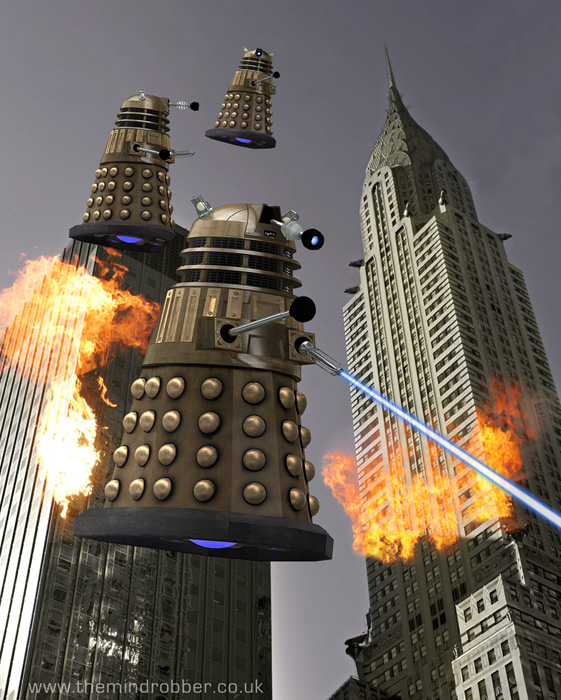
The Doctor Diaries III.4 & 5b: “Daleks in Manhattan” and “Evolution of the Daleks”

Professor Diggins' Dragons

I wrote yesterday that I used to get really annoyed every time the Daleks appeared again, until I realize that each time they are threatening different humans, so the Doctor has to intervene over and over again, to save different people.

This has, I believe, a metaphorical application:

The sci-fi enemies represent the recurring problems that humans face over and over and over again. Every human faces the same temptations, the same tragedies, the same weaknesses, the same challenges. We don't really learn by example. We make the same mistakes our parents and grandparents and ancient ancestors made. We suffer the same diseases.

So the Daleks, Cybermen, Carrionites, Sycorax, Weeping Angels, Family of Blood, and all the other enemies recur, season after season, just as we suffer in the same ways, generation after generation, day after day.

This is one way that someone who is not usually a sci-fi fan could perhaps come to enjoy Doctor Who. I mean, even I hate these stupid aliens and overdone monsters.

But they're metaphors. None of us will ever face a Dalek (well, we might dredge one up in a pond somewhere), but each enemy represents something awful that we actually do fight every day.

The Cybermen could represent our addictions to technology and our increasing willingness to allow the virtual world to take over our identities.

(I type this as I'm following the #BenedictCumberbatch hashtag on twitter and clicking on all the pictures).

The Daleks could represent our proclivity towards racism and genocide.

The Family of Blood could be an embodiment of ways in which we prioritize our own tribe, culture, and other in-group over other people's needs.

The Weeping Angels will get a post of their own!

Oh, and by the way, what's with the title of this post? Professor Diggins' Dragons
is a kids' book about just this theme -- dragons are metaphors for whatever challenges the kids need to overcome.

19 June 2013

The Doctor Diaries III.4 & 5a: “Daleks in Manhattan” and “Evolution of the Daleks”

The Doctor Is Not Jesus!

I used to get really annoyed every time the Daleks appeared again. First of all, they're very silly. Their ridiculous computer-generated voices grate on my ears. Their pepper-pot shape drives me crazy. Their arbitrary decisions about when to exterminate and when to stand there like idiots for the convenience of the plot pushed me beyond endurance.

But then I realized why it is important that the same enemies come back over and over again and why the Doctor has to defeat them time and time again. After each encounter, he believes he has eradicated them for good. Each time, they come back and threaten humanity again.

The reason this matters is that each time they are threatening different humans.

Each human needs to be saved, each time. So he saved the earth from Daleks in 2005; well, he needs to save the world from them again in 2007, or in 5100, or in 300 B.C., because the earth contains different people every time. Some have been born and others have died in the intervening time, and he has to save them all, over and over and over.

I see two matters of thematic importance as a result. I'll post this theme today and another one tomorrow.

First, this is a major difference between the Doctor and Jesus. I blogged last time about how the Doctor is a “Christ-figure” in the literary sense. But Jesus only gave Himself once. The Doctor has to give himself over and over and over.

Now, there are a lot of things I could say about that.

I could talk about how the Doctor doesn't really die; he's always saved at the last minute. There are a few times that he does die, though, and then something wibbly-wobbly has to happen to reset time the way it was supposed to be.

That could lead me to talk about Predestination: the Way Things Were Meant To Be. Think back to Series One, the episode “Father's Day.” Pete Tyler was “supposed” to die that day, and when he didn't, the entire universe began to fall apart and everyone else was destroyed. But who said he was supposed to die that day? Did God ordain it? Did it have something to do with linear time, like a story—since he died the “first time” through that time, he had to the “second time” through that time? (we'll come back to that later).

Or I could talk about resurrection and regeneration; is every kind of regeneration/rebirth/return in literature always a symbol of resurrection? Or is resurrection just our longing for regeneration turned into a wish-fulfillment doctrine?

Or I could get into the symbolic ways in which Jesus' sacrifice is remembered over and over again, such as in baptism and the Lord's Supper. In Roman Catholic Christianity, of course, the sacrifice is literal in each celebration of the Mass: the elements become Christ's body and blood, thus enacting His death and resurrection over again for each believer. So maybe in that sense the Doctor's repetitive sacrifice is still a very accurate spiritual symbol.

Or I could talk about another important part of the Dying-and-rising-god conversation. In most other religions that have a Dying-and-rising-god (besides Christianity, I mean), the god's life cycle is tied to the cycle of the seasons: he or she dies and rises every year, and the resurrection is connected to the regeneration of plants in the springtime. So another argument against Christianity is that it is just another permutation of these seasonal cycle myths: after all, Easter is celebrated in the springtime. The opposite argument is possible, too: that all the other seasonal cycle myths are wish-fulfillment and Christianity is the real thing that happened just once, historically.

Which brings me back around to where I started. Jesus died just once, in an efficacious, substitutionary atonement with eternal consequences. In this piece of fiction, even within the fictional world (unlike, say, Aslan, whose sacrifice occurred only once), the Doctor's sacrifices do not stick. He has to do it over and over and over again.

Of course, that's also just necessary to keep the show going. If he went back to the beginning of time and did something so huge that it destroyed the Daleks, Cybermen, Carrionites, Sycorax, and Weeping Angels all in one go, there wouldn't be any story.

Come back tomorrow to read about the other theme this brings to mind!

18 June 2013

The Doctor Diaries III.3 “Gridlock”

New-new-new-new-new-new-new-new-new-new-new-new-new-new-new Old Story


As you know by now, I am “reading” Doctor Who through two sets of lenses: English-teacher glasses, and Christian glasses. I'm looking at them as I look at carefully-crafted works of literature, searching for literature devices, structure, cultural significance, mythical resonance, and theological implications. That's how my mind works. Sci-fi is a perfect venue for communicating the deeper truths about humanity, because it can use the wildest physical metaphors imaginable, not being restricted by a particular set of historical events or a narrow segment of current science. Sci-fi also taps into the most profound traditions of fantasy and mythology, which means it uses the collective human imagination's most enduring archetypes to communicate emotionally and spiritually.

And “Gridlock” employs what I believe is the most profound archetype of all: the Christ-figure. The entirety of Doctor Who is arguably “about” how the Doctor is a symbol of Christ, so I know I will come back to this idea again and again. I would like to deepen, clarify, and enrich my thoughts on this point, so I would love it if somebody wanted to debate with me about this. In the meanwhile, “Gridlock” makes its christological references very obvious, so it's a good place to begin delving into this idea more deeply.

Let's go through a few of the background ideas first.

There are only a few plots in the world—only a handful of narrative shapes that stories can take.

Here is a list of “Master Plots,” and here are the Seven Basic Plots. I'll talk about a few that came into my mind before reading those lists.

There's the Cinderella plot, in which someone goes from rags-to-riches either literally or figuratively. I think that Hobbit-like plots, in which a small person achieves great things, is a variation on this theme. I think that the making-of-a-hero story (Batman Begins, Man of Steel, etc.) is another such variation.

There's the Rake's progress story, the slow downward trajectory of a bad person—or even an ordinary person—getting gradually worse.

There's the Tragic Hero's demise, usually in a kind of recognition-and-reversal arrangement, on the classical model of Oedipus.

There's the basic Marriage Plot, moving characters towards pairing off, often involving mistaken identity, miscommunication, and disguises before the resolution.

They can be combined, such as the common union of the Cinderella plot with the Marriage Plot.

There are a few other patterns. Can you name some?

And there is the ubiquitous Creation→ Fall→ Redemption story, which is also the Birth→ Death→Resurrection story. It could be argued that this is the oldest, most wide-spread, and most powerful plot arc. It might be the most common. I don't know whether it occurs more frequently than the others, or in more permutations. But I do know that when combined with a strong, admirable main character, especially when that main character chooses sacrifice, it is one of the most moving.

Now, I'm a Christian. And Christianity is a narrative religion. We base our faith on a Story. On a double-layered story, actually: it's Creation → Fall → Redemption and Birth → Death → Resurrection. It's historical, divine, and personal. It's linear and cyclical, universal and individual.

The ubiquity of the Creation→Fall→Redemption/ Birth→Death→Resurrection narrative could present a problem to Christian belief, especially because it occurs in so very many other religions, including ones that appear to have developed before or independently of Christianity. In other words, if this is such a common human story, what makes the Christian one any more likely to be true?

Or let me approach that question another way. How can the Christian story and all these other stories be so similar, if there were no obvious cultural or literary imitations from one to another?

There are lots of possible answers.
1. Somebody came up with a Birth→Death→Resurrection story way back in the beginning of human history, and it got passed around by word-of-mouth from culture to culture, so all the others are just copying that one.
2. There is something in the human imagination, perhaps something like Jung's “collective unconscious,” that makes us all love the same stories, regardless of our culture, education, reading, or anything—so we all come up with the Birth→Death→Resurrection story, independently.
3. The early Christians and the writers of the Gospels were copying one or more of the older stories.
4. Jesus' Birth→Death→Resurrection really happened, and it's just a coincidence that this pattern resembles so many earlier stories and stories from other cultures.
5. God planned all along that Jesus' life would follow that pattern, so He planted the Birth→Death→Resurrection story into the human imagination, intending for lots and lots of poets to tell the story all over the world before Jesus came and acted it out for real, so that then people would be primed and ready to accept it.
6. There is something so inevitable about the Birth→Death→Resurrection pattern that the universe just has to follow it. That is the way things are, on the personal level, in history, and on the divine scale. Even if Jesus' life had not happened yet, it would eventually have to happen just that way, because Birth→Death→Resurrection is the only way things can possibly unfold.

So there are some possible answers. Can you suggest some others?

Numbers 1, 2, and 3 are the most commonly believed in American culture just now, I would say.

#5 is C.S. Lewis'.

#6 is Charles Williams'.

I suggest that #2 is Doctor Who's.

Now, let's finally talk about “Gridlock.” In every episode, the Doctor does something self-sacrificial to save someone else, frequently to save everyone else. He is willing to die, over and over and over, that others may live. Obviously that's based on the Christ-pattern, whichever of those interpretations you accept. Usually the Doctor's selfless love goes un-interpreted. But in “Gridlock,” the association becomes as clear as it can be without a character yelling out, “He's like Jesus!”

It's made clear by the music. As everyone's driving along, year after year, stuck on the motorway, they get a musical interlude on the radio, and they all stop to listen to hymns. Specifically, they listen to “The Old Rugged Cross,” whose lyrics are just about a clear a statement of the Gospel as you will find. When the song first started playing, I cringed, thinking that of course this was going to be parody, mockery. I was certain the screenwriters would be making fun of the characters for their archaic, meaningless faith. While that potential was there, however, Martha's and the Doctor's reactions led to a much different reading.

They take the hymn seriously. Martha starts to cry. She even sings along. 

And then later, Martha made the statement that created an explicit analogy between Jesus and the Doctor. She shouted to the residents of New New York: “You have your hymns and your fiath. I have the Doctor!” In other words, they have the same thing (literarily speaking).

I hope to continue digging into this idea as we proceed, and to point out some of the important differences between the Doctor and Jesus in my next post. Please stay tuned.

17 June 2013

King Arthur was an Elf

The Fall of Arthur is AMAZING! It has rocked my world. I hope it rocks your world. It contains information that should make us re-evaluate all of Tolkien's works, plus some of Lewis' and Williams', as well.

But I won't give away the secret here. You have to read it. And then you have to read my review on Curator in a few weeks.

Meanwhile... Did you get to read my "illegal" article on Curator a few weeks ago? Well, here it is, a pre-review of The Fall of Arthur by J.R.R. Tolkien. In it, I made a bunch of predictions about the poem before reading it.

Now I get to rate myself as a prophet.

I'm writing a proper review for Curator, which will appear in due course. Meanwhile, how did I do? Am I oracular? Here are the predictions I made, and my evaluation of them now that I've read the book.

1. I said that The Fall of Arthur will be a thoroughly twentieth-century work. I got this one wrong. It is thoroughly imitative of two sources: the Norse/Old English poetry from which it takes its form, and the later Frenchified romances on King Arthur. 

2. I predicted that there would be echoes of the First World War in the battle scenes. I got this one wrong. There was only a sea battle, and it was quite Viking in its atmosphere.

3. I said there would be a feeling of hopelessness in the Battle of Camlann, counteracted by the individual heroism of ordinary people. Wrong on both counts; the fragment doesn't get as far as that battle, and there are no ordinary people; only big characters. There is a Frisian sea captain who does something heroic, but it's for the wrong reasons, and he goes to hell for it (!). 

4. I said that the little knight whose name has been forgotten will do deeds to rival those of Gawain, Lancelot and Arthur himself. Wrong. See #3 above. 

5. I thought that if The Fall of Arthur contains a description of what T.S. Eliot called “The Wasteland,” it would be seen through Tolkien’s radical environmental vision. Well, there is no such description. So, wrong. 

6. I said that there would be “Victorian” depictions of stylized women. Right, but Guinevere is a very strong, powerful, active, complex character, even though she has an elvish beauty. 

7. I talked about his concept of absolutism in language. Well, this one is hard to judge. I can't point to any specific moments that go either way.

8. I predicted that it would be a good poem, with a lively meter, vivid imagery and beautiful sounds, but not a great poem. Right. Excellent, masterful meter, but awkward inverted syntax, some amazing descriptions, and a surprisingly lively plot.

9. I said that this poem would show off Tolkien's mythopoeic genius. Right, right, right again. Just wait until you see how right! Whew. 

10. And finally, I said that Tolkien gave up this poem because wanted to refigure the mythic power of the Christian religion, to rewrite it in an entirely new universe of his own creation. Well, perhaps, but I think I have to count this one wrong -- because he found a way to do both! Or perhaps, although he found the way, it was not satisfactory in the end, since he didn't end up using this method in the poem itself, only in his notes. So I'm going to say I'm right on this one. 

That's still not a very good score: 4 out of 10?  
I fail as a prophet. 
I guess I'll stick to literary analysis. 
BUT YOU: GO READ THE BOOK !