Pages

Showing posts with label Mythology. Show all posts

03 February 2014

On the Supposed Unsuitability of Fairytales for Children

This is a guest post by J. Aleksandr Wootton. It originally appeared on his online writing scrapbook, Smithy of the Written Word, on April 13th, 2012.
J. Aleksandr Wootton is the author of the folktale-based threshold fantasy Fayborn, and of the poetry collection Forgetting: impressions from the millennial borderland. Please check out his writing.


On the Supposed Unsuitability of Fairytales for Children 


Shortly after supporting a local library event promoting fairytale literature, the folklore department at Lightfoot College received an animated communication from a very concerned mother regarding, in short, the "unsuitability of fairytales for children." As this seems to be a rather widespread idea (I might mention the Daily Telegraph article of February 12, 2012) as well as an oddly long-lived one, I take the liberty of public response. 


Dear Madame, 

Though you may be unaware of it, your email represents sentiments that have been argued ever since people first began to collect folklore into written volumes. As soon as the stories were set down in writing, they became frozen and lost that greatest attribute of oral storytelling: the ability of the storyteller to adapt the story to her audience. Consequently some writers, including such visionaries as Charles Perrault and Andrew Lang, have contended for permanently revising some or all fairytales to make them "more suitable" for children. 

Additionally there have been, and continue to be, modernists who consider fairytales to be too "unrealistic" or nonsensical, and who have proposed or written new stories to replace them. These new stories take their settings and characters from contemporary, everyday adult life and communicate whatever values and ideas their authors believe are particularly suitable to the times. 

Others -- J. R. R. Tolkien and child psychologist Bruno Bettelheim, for example -- have disagreed with this approach. I will attempt to explain why I myself agree with the latter, and not the former. I have two primary objections. 

Firstly, it seems to me that those who claim to be revising or producing stories "more suitable" to children than the old fairytales are really succeeding only in making stories more acceptable to the adults of the time, with their particular conceptions of what childhood is, or ought to be. And this seems a bit presumptuous. It ignores the reality that those adults (especially in the early days of the movement) were themselves -- as well as their parents, and their parents, and every generation preceding -- raised, as children, on the very same types of folklore they now propose, in their solitary wisdom, to "improve." 

Even Christians, Madame -- with whom you identified yourself in your email, and among whom I hope to be numbered as well -- even Christians throughout the whole world have been, for centuries, brought up on the old "pagan" folklore, without any detriment to their religion; or, if there has been a detriment, it is one that you and I and all who believe with us have inherited. 

The whole contemporary world has been founded on a more or less common folklore. Popular stories disseminated just as thoroughly -- though not as quickly -- in the ancient world as they do in the modern. 

(It is probable, for example, that the "French" story familiar to us as "Cinderella" originated in Southeast Asia. The tale we know as "Beauty and the Beast" evolved from retellings of the Greek myth about Eros and Psyche, which was probably based on older works in its turn. Both the Jews and the Tibetans tell of the Tower of Babel, or a building project quite like it. Etc.) 

Therefore we must ask: What right or standard have we to criticize or reject these stories? 

If the movement you represent, Madame, should ever gain the velocity necessary to escape the gravity of the old folklore, what kind of people should we expect to become? 

You might justly respond, to my second question, "I don't know," and still say, to the first, "the right of a mother who knows her own children, and what is best for them." 

Very well; to that assertion I can make no objection. But I ask you to observe, Madame, that you cannot by that argument make any prescriptions regarding the suitability of fairytales for anyone else's children. And I direct you to my second point. 

It seems to me that the fairytale-content which provokes, in some, the desire to revise or eliminate, is a matter of the details of the stories, rather than their essential structures or themes. It is, in other words, the witches and monsters, the magic and the violence, and the most whimsical or least "natural" elements that spark the controversy, and not what the stories are actually about -- not, that is to say, the essential themes or messages communicated by folklore. 

For these are the messages of the old fairytales: 
  • Sorrow is real, and so is joy 
  • Joy is freely available to all, just as sorrow comes freely to all, whether rich or poor, and without regard to changes in material fortune 
  • The world is fraught with danger, including life-threatening danger, but by being clever (always), honest (as a rule, but with common-sense exceptions), courteous (especially to the elderly, no matter their apparent social station), and kind (to anyone who has obvious need), even a child can succeed where those who seem more qualified have failed. 
I do not have any children of my own; therefore what I am about to say may be hopelessly naïve, and if so I beg you to excuse it, and me, and leave my ideas out of the discussion on those grounds. But at least until the revelation of fatherhood I expect to hold the view I am about to state. 

Namely: The messages of these old fairytales are precisely those that children most need to hear. 

Is it not so? Ought not children be affirmed in the deepest feelings they, along with all people, experience about life? 

Ought they not be taught that material disparity exists, that fortunes do change for better and for worse, and that wealth cannot shield us from knowing sorrow any more than poverty hold us back from realizing joy -- in other words, that possessions are not what matters most? 

Would we not be doing a disservice to them, as well as to society, to let them go on believing that the world is safe; that they will be provided for and achieve worthwhile things even if they should remain stupid, shirk integrity, and ignore courtesy, acting only in self-interest; that they should rely on those stronger, smarter, and more able than themselves to solve their problems? 

It is not the details, the fiction, of the stories that really matter; it is the stories themselves. Nobody that I know of has expressed this idea more elegantly than Neil Gaiman, in his paraphrase of G. K. Chesterton: "fairytales are better than true; not because they tell us that dragons are real, but because they tell us that dragons can be beaten." 

What better message for a child to understand from her youth? What better medium than a story? 

If you can change, or re-write, all of the details of objectionable stories while preserving their essential themes, well and good. Hans Christian Anderson did both very well. But if not -- best not throw out that bathwater just yet. 

The story is told by means of its details, and the story should be preserved. There may well be devils in the details (in some stories there most definitely are); but we are told there are devils in the world too, walking about seeking to devour the unwary, and we may certainly hope our children will not be discovered in that group.

Therefore we come to folklore monsters and fairytale violence, which some suggest children should be sheltered from. I do not disagree that stories, and what they contain, should be revealed with discretion. Some stories are beyond the proper grasp of tiny hands, just as some books are above their reading level. But I don't believe that children should never be afraid. 

Of course it's very inconvenient for parents when their child develops an irrational fear of the dark or of the bedroom closet. That struggle, to exert rationality against unwarranted instinct, unfounded imagination, and overblown emotion, lasts long into adulthood. To act on what we know, when what we know is contrary to how we feel, can be just as difficult for adults as for children; but such discipline, at the very core of what it is to be human, must be learned, and somebody must guide children to learn it. If we never knew fear, we have never learned to be brave in order to do what is right -- and what better thing to practice and hone bravery against than an imaginary monster, in the closet or under the bed, before we are confronted by a real one? 

There are other lessons, lost lessons, that might have been communicated to us through the common wisdom of past peoples, had we not given in to this instinct to revise and censor their stories. For example: 

I can't help but wonder whether, if children grew up being told how Cinderella's evil stepsisters cut off their big toes and heels in order to fit their feet into the glass slipper in an attempt to deceive the prince's herald (effectively trying to look like somebody else in order to become somebody else, through dishonest and self-destructive means), we would have such an epidemic of eating disorders and self-harm. 

 I can't help but wonder whether, if entire generations had not forgotten the story of how "simpletons" -- somebody who thought differently than everyone else, someone whose accomplishments were not easily measured by normalized standards -- gained their fortunes through unusual means or by heeding shrewd advice (one even became the crown prince through a cleverly-performed, out-of-the-box comedy act that cheered up a depressed princess), we might not have gotten ourselves into our current factory-inspired, standardized-test-driven educational mess. 

Once upon a time, there was a saying: "it takes a village to raise a child." Whether that was considered so because a well-rounded child needs a diversity of perspectives to grow by, or because parenting is simply too big a job for one or two people to undertake alone, or both, you may take your pick. The fact remains that the old fairytales are the child-rearing stories rigorously selected and rigorously polished by the commonsense and everyday wisdom of a thousand thousand villages in a thousand thousand nations over a thousand thousand years. 

So let us have done, Madame, with this silly notion that my fairytales are unsuitable for your children - as if it were the children who have stood the test of centuries, and need no proving. Say rather, if you must, that your children are unsuitable for my fairytales, and pray do not leave them in that sorry state for long. 

 Sincerely, 

J. Aleksandr Wootton

29 September 2013

On "Islands of Joy" and new writers

He has made everything beautiful in its time. He has also set eternity in the hearts of men; yet they cannot fathom what God has done from beginning to end. —Ecclesiastes 3:11

These hauntingly beautiful lands… somehow never satisfy… —C.S. Lewis, Letters I:970

The times has come, the walrus said, to talk of names and things. The name of this blog has officially changed to “Islands of Joy.”

I wanted something less personal, less private, more artistic, and more expressive of the vision of this blog than the obscure “Iambic Admonit.” I am also bringing on a few new writers and focusing the content a bit more. The name is inspired by C.S. Lewis, who is perhaps my greatest literary inspiration. His writing as simple and profound, imaginative and rational. He is the master of the perfect analogy, and a storyteller of consummate skill.

Throughout his entire life, Lewis has haunted by “an unsatisfied desire which is itself more desirable than any other satisfaction… I call it Joy” (Surprised by Joy).

Islands of Joy” are moments of sehnsucht or sweet desire evoked by art, poetry, music, or nature. A line from Tennyson, a phrase by Wagner, a glimpse of Turner, or a sudden wind across a field of wheat—and the soul springs up, yearning for something more, but not sure what it wants. It wants to possess the beauty: to ingest it, devour it, assimilate it. It wants to become that beauty. It wants to make more beauty. And it wants to know Who made that beauty in the first place, then be united with Him.

This desire shot through C.S. Lewis's heart, a painful, glorious yearning, at the sounds of certain words, the sight of a distant landscape, or the strains of sublime music. He tried a wild variety of words for this experience throughout his life: It, Romanticism, heraldry of heaven, intense longing, sweet desire, enchantment, the Blue Flower, the dialectic of Desire, immortal longings, divine discontent, the authentic thrill, the heraldry of heaven, inaccessible longings, ice-sharp joys, unfulfilled desire, and Sehnsucht. He finally settled on “Joy,”

So a lot of the content on this blog is inspired by or related to C.S. Lewis, J.R.R. Tolkien, Charles Williams, and the other Inklings. The primary writer, Sørina Higgins, is a Charles Williams scholar: please check out her other blog The Oddest Inkling, all about Williams. All the other writers enjoy the works of the Inklings, some as fans, some as scholars.

Here on Islands of Joy you will find book reviews, film reviews, articles on Inklings themes, and other Inklings-related posts. You will also find discussions of any arts that take our fancy at the moment. There is plenty of analysis of Doctor Who.

There is another Lewis connection, too. He lost his mother at age nine, and later wrote: “With my mother's death all settled happiness . . . disappeared from my life. There was to be much fun, many pleasures, many stabs of joy; but no more of the old security. It was sea and islands now; the great continent had sunk like Atlantis.”

In those astonishing encounters with great art, we are lifted out of the gray, dull, or stormy sea of everyday experience, shot through with a dart of longing. Those moments are bright sparks in the darkness of sin, violence, depression, and drudgery. As Chaucer wrote: We blunder ever, and poren in the fire, / And, for all that, we fail of our desire. But the desire keeps taking hold of us, sharp as swords, sweet as sex, swiftly-passing as the wind. It is a kind of wanderlust, a yearning to travel to:
The land where I shall never be
The love that I shall never see.
Lewis Letters I:283, quoting Andrew Lang
There is a huge theme in European literature of longing for Western Islands: Atlantis, Avalon, Númenor, Valinor, Venus/Perelandra, Sarras.... I hope to write or edit a book on this topic one day.

But rare is the traveller who reaches one of these longed-for islands.

Because the whole point of the longing is that it cannot be satisfied in this life. It is a signpost to Heaven. All satisfactions here fail to satiate, because we really want God.

In the meanwhile, we alight momentarily on these islands of joy, stopping to gaze at a painting, read a poem, listen to a piece of music, or stare out at the horizon.


17 June 2013

King Arthur was an Elf

The Fall of Arthur is AMAZING! It has rocked my world. I hope it rocks your world. It contains information that should make us re-evaluate all of Tolkien's works, plus some of Lewis' and Williams', as well.

But I won't give away the secret here. You have to read it. And then you have to read my review on Curator in a few weeks.

Meanwhile... Did you get to read my "illegal" article on Curator a few weeks ago? Well, here it is, a pre-review of The Fall of Arthur by J.R.R. Tolkien. In it, I made a bunch of predictions about the poem before reading it.

Now I get to rate myself as a prophet.

I'm writing a proper review for Curator, which will appear in due course. Meanwhile, how did I do? Am I oracular? Here are the predictions I made, and my evaluation of them now that I've read the book.

1. I said that The Fall of Arthur will be a thoroughly twentieth-century work. I got this one wrong. It is thoroughly imitative of two sources: the Norse/Old English poetry from which it takes its form, and the later Frenchified romances on King Arthur. 

2. I predicted that there would be echoes of the First World War in the battle scenes. I got this one wrong. There was only a sea battle, and it was quite Viking in its atmosphere.

3. I said there would be a feeling of hopelessness in the Battle of Camlann, counteracted by the individual heroism of ordinary people. Wrong on both counts; the fragment doesn't get as far as that battle, and there are no ordinary people; only big characters. There is a Frisian sea captain who does something heroic, but it's for the wrong reasons, and he goes to hell for it (!). 

4. I said that the little knight whose name has been forgotten will do deeds to rival those of Gawain, Lancelot and Arthur himself. Wrong. See #3 above. 

5. I thought that if The Fall of Arthur contains a description of what T.S. Eliot called “The Wasteland,” it would be seen through Tolkien’s radical environmental vision. Well, there is no such description. So, wrong

6. I said that there would be “Victorian” depictions of stylized women. Right, but Guinevere is a very strong, powerful, active, complex character, even though she has an elvish beauty. 

7. I talked about his concept of absolutism in language. Well, this one is hard to judge. I can't point to any specific moments that go either way.

8. I predicted that it would be a good poem, with a lively meter, vivid imagery and beautiful sounds, but not a great poem. Right. Excellent, masterful meter, but awkward inverted syntax, some amazing descriptions, and a surprisingly lively plot.

9. I said that this poem would show off Tolkien's mythopoeic genius. Right, right, right again. Just wait until you see how right! Whew. 

10. And finally, I said that Tolkien gave up this poem because wanted to refigure the mythic power of the Christian religion, to rewrite it in an entirely new universe of his own creation. Well, perhaps, but I think I have to count this one wrong -- because he found a way to do both! Or perhaps, although he found the way, it was not satisfactory in the end, since he didn't end up using this method in the poem itself, only in his notes. So I'm going to say I'm right on this one. 

That's still not a very good score: 4 out of 10?  
I fail as a prophet. 
I guess I'll stick to literary analysis. 
BUT YOU: GO READ THE BOOK !

03 March 2009

March Poem of the Month

I have recently been working on a series of "persona" poems, in which I take on the identity of some real, fictional, or archetypal character and speak in his or her voice. What's fascinating about this is how I can comment on my own inner workings or on those of my friends, family, and acquaintances, while also revealing or discribing universal psycho-spiritual truths. This was written for a friend who is in an agnostic phase. Enjoy.

In Persona II: Wotan Wonders if there is a God

If I took off this eye patch, maybe I wouldn’t be blind.
Maybe I would see myself, reflected in the pools of Erda.
If only I could remember I am a god—or else a son of God—
perhaps the clouds would open and I would understand.
If I dropped this twisted walking stick, maybe I could stand.

I could thunder and rage at the tall empty sky—
as that frog-faced Alberich blasphemes me,
paddling his webbed-footed fingers in puddles of earth,
dabbling in divinity—what does he know (but do I?)—
Beneath this intentional eye patch, maybe I am not blind.

From the altitude of Valhalla, I suspect the rarity of air
is a function of some vast expanse where I should be,
where a perfection dwells; but down here, wandering,
I shake my thunder-fist and howl dirty songs against the sun.
I cannot remember I am a god—or else a son of God.

I am a wonder, I know: the music made around me,
the glories of my face, the strong amazement of the body
that I wear among mortals; and I should pose tall
and pull the spear-deep wisdom from the world ash tree:
If I stopped leaning on a walking stick, maybe I could stand.

Your love is better than gold, more beautiful than magic golden rings,
I thought I told her: but she grew invisible and maybe turned away—
so I wander, wondering, imagining my fits of rage
do not shake the stars, do not wake dragons. I could blame
the eye patch, say that without it maybe I wouldn’t be blind.

I could learn from reading, writing: books of wisdom,
books of nature; facts that I should know, and do know
in the core of me. But in my handsome earth-suit I prefer
the alias of espionage, of unrequital, victimized agnosticized
skeptical despair. Remember, I am a god—or else a son of God—

a subcreator of my introspective self. I forge my right
to see peripherally or not at all; to understand
or miscomprehend; to fight the dragon or to walk away.
How many miles have I traveled, crawling, among men?
If I dropped this twisted walking stick, maybe I could stand

to listen to the answers:
Is invisibility necessary for ignorance?
Is infatuation the same as incarnation?
Is immortality the opposite of immolation?
Is identity a sole conception, or the soul’s receptacle?
If only I could remember I am not blind,
I could stand being a son of God.


--Sørina

11 December 2008

December poem of the month


photo by Steve Lantz


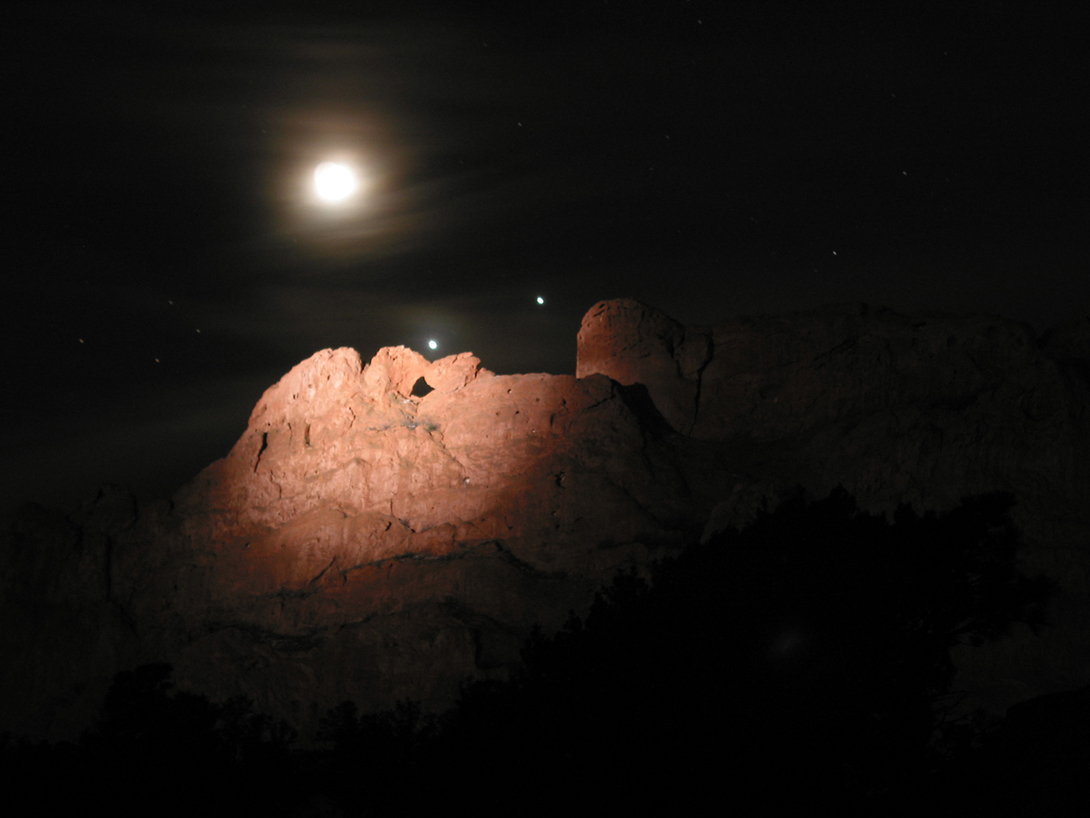
I have been working on this poem ever since I first saw the amazing conjunction of the Moon, Jupiter, and Venus several weeks ago. I don't know why a simple sonnet gave me so much trouble, except that my mind, time, and energy are completely consumed by work these days. This not even the poem I intended to write, which would have ended with the line:
THE GODS DRAW NEAR TO OFFER THEIR NOEL.
Maybe that poem is still forthcoming.

But back to the topic of the heavens! This meeting of Luna (or Silva), Jove (or Glund) and Aphrodite (or Perelandra) was a glorious once-in-a-lifetime experience. We sat and looked at it one evening for a long while until it sank below the treeline. My head was, of course, full of thoughts of the potential significance of this union: Beauty meets the King of the Gods while Virginity presides. And then Michael Ward sent me an article he wrote about C. S. Lewis's thoughts on observing this same conjunction in 1953.

Here are some beautiful photographs of the conjunction.

Meanwhile, enjoy this belated sonnet.


Cosmology

Until the still moment of the turn of Time
When Incarnation changed the spin of space,
Devout Angelicals of Heaven turned
About the planet of the human shape.

At the Nativity, the orbs of love
And intellect reversed their centrifuge:
They sang their fierce chant and burnt their wake
Around the solar image of their Liege.

But then creation lost her fixity
About a hill cris-crossed with lamentation;
On Sunday morning, relativity
Danced giddy with acentric adoration.

Now once a year the gods align and sing,
Awaiting their eternal choreography.


photo by Doug Zubenel

10 March 2008

Alternatives to the Allegory of the Cave

Reading: Great Expectations by Charles Dickens; Possession by A. S. Byatt
watching: Harry Potter 5
listening to: Sense & Sensibility on tape; Loreena McKennitt's An Ancient Muse


Well, the second Platonic post didn’t elicit many responses at all! Let’s try this final topic.

Can you suggest alternatives to the Allegory of the Cave? These could be new allegories or modes of explaining the Platonic conception. They could be other understandings of the universe and meta-universe. In other words, if you are not a Platonist, what are you and how do you explain physical and extra-physical realities and their relationships? Can you devise an allegory for an Aristotelian understanding, or for a Berkleyian idealism, or for any other conception? Or, you could suggest works of art, literature, or other media that present either a new way of visualizing Plato’s controlling concept or an alternative worldview?

So I shall begin.

There are many works of art that present new ways of understanding Plato’s worldview. I have endeavored to present most of them in classes. These are, I believe, the best:
The Matrix
The Great Divorce by C. S. Lewis
The Last Battle by C. S. Lewis
The Place of the Lion by Charles Williams
I read Dante’s Divine Comedy in a Christian neo-Platonic light (allusive pun intended), as the narrator travels through projected images reflective of the real condition of saints in the Heavenly Rose.

Oh, and another you’ve never heard of, “Danaher: The Musical.” This musical, based on the life of a professor of philosophy at Nyack College, was written by a professor of English (and an Inklings specialist), Dr. Charles Franklin Beach, and the music was composed by a classmate of my sister’s, James Gardener. My sister, Nadine, played Prof. Danaher’s wife. It’s a hilarious and uneven work with more potential than polish, written mostly for the amusement and accolades of its own community, Nyack College. The young Danaher, an avid reader of Plato, tripping on LSD, experiences a psychedelic vision of Christ accompanied by a multi-layered distortion of “Bridge over Troubled Waters” and disco-style strobe lights. The result is his conversion to Christianity and a song entitled “Out of the Cave and Into the Light.” Very sophomoric, but entertaining and not without truth.

Other than that, I think I’ve already done my share of developing a Christian reverse neo-Platonism that sees its ultimate reality in Heaven, rather than in a pre-existent world of forms.

Here’s a poem of my own that works off of the shadow and copy concept, plus a little sehnsucht thrown in to connect the Forms with Desire.


The Myth of Memory

I finally learned to dive,
and found joy hovered there:
a sphere of longing sublimed with the lake.
Below me, an indeterminate color hung
like shadows cast on grass;
above, desire quivering in a sunlit circle.

Well-mouth, cave-mouth, it shone:
compelling, fixing my imagination
on its unknown and unlabeled hues.
That strange, inviting light held me;
I crystallized, became the prism,
casting scattered shafts
from each toe and finger, every hair.
Is it that light I long for in my dreams?

In an underwater limbo
suspense and longing intermingled.
Delicious, like a taste;
refreshing, as if I drank and it were pure;
wet and pulsing like the act of love.
That unity in isolation seemed
the archetype of other, severed, pleasures:
I swam submerged and drowning in desire.

What did I want? Not that muddy lake,
that real dive split in fragments by my five
unpracticed senses, spluttering in fact.
Not to catch the fascinating disc of sunlight
on the surface. Not to stay and drown;
no, not to stay and contemplate.
Fish do not live suspended in a state
of constant wonder—or perhaps they do.
Maybe that explains the lack of eyelids,
always awake, always in sudden shock.

Everything that happens goes too fast.
I never felt desire while I dove.

And yet, I read my recollections
as if feelings will be real,
as if every ecstasy will be itself
and every moment, lingering.
I live like longing will be unified and re-embodied
in the consummation and consecration of desire.

~ Admonit

17 January 2008

Planet Narnia invitation

You are cordially invited to attend
an exciting evening of lecture and discussion entitled
“C.S. Lewis’s Narnian Secret”
by Dr. Michael Ward

Scholars have long debated over the apparent disunity of The Chronicles of Narnia and have searched for a hidden theme. Dr. Ward offers a brilliant, original reading of Narnia, revealing correspondences between Lewis’s books and the Seven Heavens of Medieval astronomy.

Saturday, February 2nd, 6:30 pm
The Master’s Academy of Fine Arts
258 Main Street, East Greenville, PA
Entrance fee: $3.00

for more info, call or email Sorina Higgins
484.866.2147 or garyandsorina@yahoo.com
or look at Dr. Ward’s website
Please note that this event is for children ages 12 and up only.

Dr. Michael Ward is a writer, speaker, and Anglican clergyman. Since 2004 he has been Chaplain of Peterhouse in the University of Cambridge. Between 1996 and 1999 he lived and worked at The Kilns, C.S. Lewis’s Oxford home. From January 2007 he will be lecturing internationally on the subject of Planet Narnia. You are also invited to financially support this event in order to help defray Dr. Ward’s traveling expenses. If you would like to contribute, please contact Sorina Higgins or the Master’s Academy.

15 January 2008

Planet Narnia is out and about!

Dr. Michael Ward's book, Planet Narnia: The Seven Heavens in the Imagination of C. S. Lewis, has been released from Oxford University Press. Dr. Ward will be speaking at my school in February; an official inviation will follow soon. In the meanwhile, you can view his tour schedule and read about the book here. I'm reading the book now, and a full review will follow shortly. For now, here are some thoughts, which I'm posting around the web to help hustle the excitment along.

I heard Dr. Ward speak back in the summer of 2006, and I was instantly both a fan and a skeptic. His theory about the reason for seven Chronicles of Narnia is fascinating, beautiful, and—so I thought—implausible. But since Dr. Ward was a very compelling speaker (and he’s coming to speak at the school where I teach; see his tour schedule at www.planetnarnia.com ), I bought the book and am in chapter four at the moment. Wow! I’m more a fan than ever, and barely a skeptic. I’ve come to the conclusion (like Jim Como) that if Dr. Ward is wrong, it doesn’t even matter, because his reading is completely lovely, plausible, useful, scholarly, thorough, and everything else a critic’s reading can be. But it’s more, too. It seems that he is inside of C. S. Lewis’s head, thinking CSL’s thoughts after him (if that’s not sacrilegious!), quoting from all CSL’s works as glibly and facilely as if he wrote them (or more; CSL was notoriously forgetful of his own writings, though of nobody else’s), tying together disparate elements with ease and grace. His memory is prodigious, his scholarship impeccible, his writing clear and organized, his case lively and delightful. If Narnia needed any boost in popularity or any raising in the academic mind, here it is!

20 December 2007

Golden Compass Review

Review of The Golden Compass

So, I’ve seen the movie! I took several students to see it on Tuesday, and we preceded and followed the movie with some excellent discussion as to the merits and dangers of both the book and the film. Before I discuss the movie, let me recommend one absolutely essential post by Jeffrey Overstreet to you. Please read it! And here’s a really good review by Alan Jacobs, and here’s a link to a site where you can download a podcast from Mars Hill, Audition, on which Alan Jacobs in interviewed regarding Pullman’s book and the new film.

OK, first of all I’d like to talk about The Golden Compass as a film only, without reference to the book. Well, I’m not a filmmaker, nor a professional film critic, but I do love movies. And I’d say that as a movie, The Golden Compass was 100% successful. The score was compelling, the pace good, the visual effects beautiful.

The casting was very good. Mrs. Coulter (Nicole Kidman) was sexy and dangerous and slimy; Lyra (Dakota Blue Richards) hard and fast and sharp and just perfect, really; Lord Asriel (Daniel Craig) perhaps a bit smaller and slighter than I pictured him, but with piercing eyes and an intense presence; Gandalf’s (I mean Ian McKellen’s!) voice good for the bear; Lee Scoresby (Sam Elliott) perfectly gritty and gravelly; Serafina Pekkala (Eva Green) extremely mysterious and sultry; and Fra Pavel (Simon McBurney) disgustingly creepy. A stunning cast. Saruman (Christopher Lee) for one of the leaders of the Magisterium is just right; I hope we get to see more of him in the other two films.

And the acting is superb! Each actor had very convincing gestures and unique voices. Their physicality was in each case excellent. Serafina Pekkala’s deep voice, with a rasping edge, accentuates her inhuman sexuality and supernatural power. Lee Scoresby’s habit of talking sideways with a crooked grin (a bit reminiscent of Harrison Ford as Han Solo) expressed his easy-going caution. Lyra is great. That girl is an extremely talented actress. She has a very mobile face, with a crookedy grin of her own and a lopsided way of speaking well adapted to a Liar. She could play innocent, ignorant, fierce, stubborn, and even sexy. She’ll be amazing as the series goes on. She has a powerful independence and attraction that will fit perfectly with the Rousseauian young romantic in the later books, especially the last.

Finally, and very importantly for this story, the CGI surpassed my expectations. I was afraid we’d have a repeat of the sickening pathetic beaver buffoons from LWW. But these computer-generated animals looked very realistic and quite solid. And—best of all—there was no stupid humor associated with them. They were not Disney cute and fuzzy critters; they were not simply anthropomorphized children; they were not (thankfully!) silly. They were animals; rational animals; daemons. My only disappointment with the children’s daemons was that they didn’t shape-shift very often. When they did, the transformations were smooth and convincing. There was a moment when Pantalaimon turned from a brown ermine into a white one; quite nice. There was a lovely moment when he effortlessly slid as a small mammal off of a roof into a bird-shape, so that the fall glided into a flutter. Beautiful! I would have enjoyed many more changes. But my commendation to the CGI artists, and to the director for rejecting the comedic impulse so often gratified with talking animals.

Now, let’s move to the next phase of discussion: The Golden Compassas a film adaptation of the book.
This is definitely one of the most satisfying book-to-movie adaptations I have seen. There was a lot of plot streamlining, some character merging, and a good deal of simplification that happened in the transition process. However, these simplifications are necessary in order to adapt a novel of 350 pages into a 2 hour movie. I would have been happy had the filmmakers decided to go the Lord-of-the-Rings-three-plus-hour-epic route. The book deserved it. But I’m happy that there were no shocking plot changes (like in Frankenstein--the 1931 version, which I saw recently) or character destructions (like Faramir) or ridiculous additions (like the atrocious riding the ice scene in LWW!) or pervasive alterations of tone and emphasis (like in the beautiful new Pride & Prejudice). I have only two criticisms.

First, there was a painful lack of detail. I know most details have to go in the cutting down to a screen play, but there were surprisingly few of those little, careful, meticulous visual or dramatic details that often raise a movie up a notch. The camera didn’t often get close; the writer didn’t often slow down to build up a climax in dialogue. That was a disappointment.

Second, the movie quit at a warm-and-fuzzy moment three chapters before the end of the book, chopping off an extremely important episode that alters the trajectory of the trilogy. This is a huge fault, in my opinion! I understand why this was done, I imagine. It kept the first movie all in one world and didn’t introduce the many-universes theme that dominates the second book. It ended on a happy note, rather than catapulting Lyra into the grand tragedy, as Pullman actually does at the end of his first volume. It made the movie feel a bit more coherent; it can almost stand alone if it doesn’t make enough revenue for the filming of the other two volumes (I’m sure it will, though).

All in all, those criticisms aren’t huge. The ending was a shock; the four of us in the theatre who had read the book raised our arms and voices in protest, shouting and groaning as the credits rolled. A nice moment of literary solidarity.

OK, now let’s turn to the larger discussion: The worldview presented in The Golden Compass as film and book, and in the His Dark Materials trilogy as a whole. I’ve already discussed the book, here. I really don’t have much to add to what I said before, what Jeffrey Overstreet says here, and what Alan Jacobs says here.

Here are the main points of potential danger in The Golden Compass. As Alan Jacobs points out, if a writer of fantasy is skillful enough to make you trust in his secondary world, he is also skillful enough to make you trust his moral judgments. In other words, it’s nearly impossible not to suspend belief while immersed in a really good work of subcreation. That’s the nature of the genre, and of the human imagination. Therefore, if you (or especially your children) see this film, keep your antennae of discernment up and alert at all times! The main reason for such caution comes from a convoluted literary history. William Blake said that in Paradise Lost John Milton was “of the devil’s party without knowing it,” and many critics have read the great epic from that point of view ever since. An epic must have a hero; Satan seems to many readers to be the most convincing candidate. Now Philip Pullman, as he has said explicitly in many interviews and elsewhere, is of the devil’s party and is fully conscious of that fact. He reveals his allegiance in his opinion of the Narnia Chronicles, which he calls “One of the most ugly and poisonous things I have every read”; “They have no shortage of nauseating drivel.”

If you take your kids to see this movie, or if they read the book, ask them these four questions before and after:

1. Who is good and who is bad in Pullman’s moral universe, as postulated in this story? What are their characteristics?
2. What is the Golden Compass and who wields it?
3. What are daemons?
4. What is Dust?


An understanding of each of these four topics reveals Pullman’s ingenious imagination, but also exposes his anti-religious agenda. Let me expound.

1. In Pullman’s moral universe, as explained by Alan Jacobs, basically anyone who rejects authority (and ultimately the Authority, God, Yahweh) is good. “Good” characters include Lyra, Lord Asriel (who may correspond to Milton’s heroic Satan), and many outsiders such as Gyptians, Witches, and Armored Bears. “Bad” characters are lumped together under the Magisterium (The Church). So it’s a simple binary: reject God, and you’re good; believe in God, and you’re bad.
2. The Golden Compass, or Aletheiometer (“truth-measure”) is essentially a tool of divination. It resembles a crystal ball, tarot cards, or an ouija board. Lyra is able to wield it by instinct, for which she goes into a trance and lets the meanings come into her mind. It was formed through some kind of astrological study. Now, of course Christians do not have to toss their hands in the air and run in fear from astrology and divination in a work of fiction. After all, Lewis’s “Space Trilogy” is fundamentally astrological in its original Medieval understanding. However, teaching children to admire a character who so closely resembles a contemporary fortune-teller or medium may have its potential dangers.
3. The daemons are perhaps the most brilliant creation of Pullman’s fertile, original imagination. They are the external expression, at once bestial and anthropomorphic, of an individual’s soul. Every physical interaction they have with their humans can be read allegorically—such as the shape-shifting abilities of children’s daemons, the limited distance which a daemon and its human can separate, and so on. However, there are at least three potential dangers if they are not pointed out to a young reader/viewer. First, the very name, which is pronounced “demon” in the movie. Pullman chose their name quite cleverly. According to the OED, “daemon” has three definitions. 1: a divinity or supernatural being of a nature between gods and humans; 2. an inner or attendant spirit or inspiring force; 3. an evil spirit or devil. Pullman’s daemons are all three, and we must be careful about encouraging children to want to have a personal demon as a constant attendant! Second, Darlin suggested that the external nature of the daemon might have a dualistic connotation, suggesting that our bodies and spirits are separable and independent (although I think that the ultimate purpose is the opposite, since when a human dies, his daemon dies, too, and vice-versa). Third, a daemon is almost always the opposite sex from its human. This suggests that we each are actually both genders—a theory which leads directly into the explicit homosexuality in a later book. Children should be warned about these implications of the otherwise amazing and desirable daemons.
4. Dust is, in a way, the plot of the whole trilogy. How it is viewed by the opposing parties can be seen as a microcosm for Pullman’s entire project. According to the Church (the Magisterium), Dust is original sin. It does not collect on children because children are “innocent”; its accumulation causes temptations, lust, evil thoughts. According to nearly everyone else, everyone we come to love in the course of the series, Dust is consciousness. By extension, it is human creativity, imagination, accomplishment, reason, art, romance… everything that makes the human life worth living. And thus one must embrace and actively practice “sin” in order to be a happy and worthwhile individual. And by golly they do!

These are just a few of the warnings I gave to my students, and I recommend giving them to yourself, your children, and your students. Once these facets of Pullman’s worldview are recognized, go and enjoy the beautiful movie and the brilliant book! But don’t say I didn’t warn you.


One final question, on a related but slightly different topic. Just before the movie began, one of my students (“Darlin”) asked, “Do they ever make movies that are just movies anymore? It seems that all the new movies are adaptations of books.” Indeed, it does. At least, the movies with a grand scope, good effects, epic scale, and a huge box office success. Here’s a list of some new movies I’ve seen in the last year or so:
1. Amazing Grace
2. Anna & The King
3. Becoming Jane
4-6. Elizabeth, Elizabeth I, and The Virgin Queen
7-10. The First 4 Harry Potter films
11. Kingdom of Heaven
12. Les Miserables
13-15. All 3 Lord of the Rings
16. Marie Antoinette
17. Merchant of Venice
18. Narnia: The Lion, the Witch, & the Wardrobe
19. One Night with a King
20. Phantom of the Opera
21. Pirates of the Caribbean I
22. Pride and Prejudice
23. Romeo + Juliet
24. Shakespeare in Love
25. Star Wars
26. The Nativity Story
27. United 93
28. Million Dollar Baby

Fifteen of them are adaptations of books (counting the Biblical stories); ten others are historical or literary subjects. Maybe this says more about my taste than about current filmmaking trends; what do you think?

14 October 2007

Mythology and the Ineffable

I would like to suggest that there are places in Lewis's work where he committed the unavoidable error of the religious writer, especially the mystic. This is the central paradox that an ecstatic experience is beyond comprehensionand therefore beyond words; yet the mystic employs words to express it. Of course, it would not be recognized as ineffable if an attempt were not made to communicate it. Lewis was aware of this powerful paradox. In advising a young writer, Lewis warned: “If you become a writer you’ll be trying to describe the thing all your life: and lucky if, out of dozens of books, one or two sentences, just for a moment, come near to getting it across” (Letters III:766). Earlier, he had written: “in a sense, one can hardly put anything into words: only the simplest colors have names, and hardly any of the smells. The simple physical pains and (still more) the pleasures can’t be expressed in language” (Letters II:947). How much more a transcendent mystical encounter with Deity!

Now, Lewis himself was not a mystic. He was a plain Church of England man. However, several of his characters undergo mystical experiences—-Ransom in Perelandra (218-19), Jane in That Hideous Strength (318-19), Orual in Till We Have Faces (308). Orual is the best example, since she is a pre-Christian figure. The ambiguity of mystical experience enabled Lewis to describe Orual’s visions and revelations in language similar to that of, say, Julian of Norwich. Since mysticism is non-sectarian, Lewis could use a pagan living in the time of the Greek Golden Age to speak universal spiritual—-even Christian—-truths.

But in his obsessive attempt to choose the correct words for his longing, Lewis forgot that, as Carl Jung explained, its nature was compromised by taxonomy. Placing it into certain words limited it. Lewis must have felt this problem, for as soon as he settled on one signifier or collection of terminology, he abandoned it/them and tried again. This is a microcosm of his essential dilemma: unifying fact and fiction, theology and imagination, Christianity and paganism.

Lewis was, in some ways, too much of a scholar for his own literary good, always imitating, modeling, copying, and modifying. While he had many novel thoughts of his own, he could hardly find a new form in which to shape them, for he had read too many books and memorized all he read. The Pilgrim’s Regress is a highly esoteric intellectual update of Bunyan’s Pilgrim’s Progress; The Great Divorce is a parody of Dante’s Divine Comedy with an appearance by George MacDonald; the Narnia Chronicles are a gallimaufry of mythologies; the Cosmic Trilogy is a poly-generic Paradise Lost with Greek, Roman, and medieval mythology-astrology-theology mixed into science fiction and Christian evangelical tract; only Till We Have Faces is pure, triumphant Myth.

Perhaps this literary posturing expresses Lewis’s refusal to move forward. In his scholarly work he was always looking to the past. He lectured on medieval and renaissance literature and wrote three sizable scholarly works in that field: The Allegory of Love, The Discarded Image, and the sixteenth-century volume of the Oxford History of English Literature. He also tried to revive outmoded forms—such as allegory and epic—and meters such as Sapphics, Asclepiads, Alcaics, Hendecasyllabics, and Scazons (Poems v). Was all of this a rejection of modernity?

Perhaps it was. But the pendulum swings again, back to tastes more like his than like Eliot’s. One scholar believes that Lewis’s Sehnsucht is a basic continuity between nineteenth and twentieth century literature and is useful for understanding modern literature (Carnell 191). He suggested that scientific naturalism needed to wind down before Myth could regain the ascendant (Carnell 126). Perhaps that is happening. Relativity and quantum mechanics have undermined much of the scientific certainty many people expected by the year 2000. The theories of Freud are giving way to holistic psychiatry: “Along with the development of fields such as genetics and tools such as neuroimaging, psychiatry moved away from psychoanalysis back to a focus on physical medicine and neurology and to search for the causes of mental health conditions within the genome and the neurochemistry of the brain” (Wikipedia). With the making of The Lord of the Rings and The Lion, the Witch, and the Wardrobe into best-selling films, fantasy sales are hot in America. Along with Narnia on the top ten films of 2005 were three other fantasy hits: The War of the Worlds, Harry Potter and the Goblet of Fire, and Star Wars Episode III: The Revenge of the Sith (Cinema Blend). Children are hungry for magical beauty, tales of wonder and adventure. Nancy Drew and Hardy boys mysteries, The Babysitter’s Club, etc., are giving way to Harry Potter and Eragon.

So perhaps in the long run C. S. Lewis’s failure is a success. He never managed to define “It” to his own or our satisfaction; but in Till We Have Faces he finally admitted his failure and stopped classifying, defining, categorizing. He painted a vague, liminal, suggestive picture of Orual’s encounter with the god, and stopped short of describing (or naming!) the god Himself. Orual heard the voice of the god and looked up, but the “vision to the eye had, I think, faded one moment before the oracle to the ear." Lewis did not describe the god, I believe, for two reasons. First, because leaving the encounter to the reader’s imagination allows his audience to participate in his “unsatisfied desire.” This is perhaps the most powerful example of beautiful indeterminacy in all of Lewis’s work. The fragment is more suggestive, and thus more powerful, than any description could be. Second, he did not describe the god because he could not: a god’s appearance is ineffable. There are moments of slippage in this description where Lewis tries to modify language so that it can bear the weight of its message. He uses “the most dreadful, the most beautiful” as nouns instead of adjectives; he repeats “dread” and “beauty”; both are attempts to make language do more than it can do and convey to the human brain more than words can convey. But he stopped short before the signifier utterly failed, for what signs can visually describe a god?

Thus Lewis serves as midwife at the reader’s imaginative childbirth: he does not present an image of the god, but the reader will picture it him/herself. And he has turned religion into (not a fantasy, but) a fantastical, fantastic story. Thus we, along with Lewis, can continued to find satisfaction in a hungry filling, a consummate longing for the Divine Being.

11 October 2007

Christianity as True Myth


Child, if you will, it is mythology. It is but truth, not fact: an image, not the very real. But then it is My mythology. The words of Wisdom are also myth and metaphor: but since they do not know themselves for what they are, in them the hidden myth is master, where it should be servant: and it is but of man’s inventing. But this is My inventing, this is the veil under which I have chosen to appear even from the first until now. For this end I made your senses and for this end your imagination, that you might see My face and live. What would you have? Have you not heard among the Pagans the story of Semele? Or was there any age in any land when men did not know that corn and wine were the blood and body of a dying and yet living God? -—The Pilgrim’s Regress 169
In the Space Trilogy, as we have seen, Lewis took a pre-Christian mythology and an astrological system and combined them into a work of glorious Christian fiction. In Till We Have Faces, he went one step further: he simply told a myth, without ever breaking into New Testament language or inserting Pauline doctrine or drawing Anglican conclusions. How, then, is Till We Have Faces anything other (or more) than simply a retelling of a Pagan myth?

Well, the simple answer is that Lewis used Psyche’s and Orual’s relations with the god of the mountain as metaphors for true spiritual relations between a Christian’s soul and Christ. But this easy answer doesn't tell the whole story. A fuller interpretation needs to include Lewis’s concept, that Christianity is the one myth that happens to have happened, and that all other myths contain shreds of Christian truth because they are foreshadowing the actual events of Christ’s earthly life (cf. Surprised 62).

After years of studying philosophy, literature, mythology, and religion, Lewis had learned not to ask Which is “the one simply true religion among a thousand religions simply false?” Instead, he asked “Where has religion reached its true maturity? Where, if anywhere, have the hints of all Paganism been fulfilled?” (Surprised 235).
Dyson and Tolkien showed me… that if I met the idea of sacrifice in a Pagan story I didn’t mind it at all… I liked it very much and was mysteriously moved by it… I was prepared to feel the myth as profound and suggestive of meanings beyond my grasp tho’ I could not say in cold prose ‘what it meant.’ Now the story of Christ is simple a true myth…. the Pagan stories are God expressing Himself through the minds of poets … while Christianity is God expressing Himself through what we call ‘real things’” (Green 117).
By calling Christianity “The True Myth,” Lewis did not mean to suggest that the details recorded in the Bible, especially the Gospels, did not happen. On the contrary, he believed that “Myth does not equal the non-historical; myth equals the non-describable. The outline of the mythological story is analogous to the metaphor in poetry. …The distinction of mythology and history must be a result of The Fall” (Carnell 124-5; cf. Perelandra 45, emphasis mine). Lewis insisted that there had been an historical person named Jesus; that He did live and teach and speak the words the Gospels record; that He did perform miracles, die, and rise from the dead bodily; and that His death was efficacious for salvation—-in short, all those essential points of the Creeds. But Lewis also thought that the whole Gospel story had the emotional and imaginative power of a myth: a God comes to earth, dies, is reborn in the Spring.

The following passage from the letters explains more of Lewis’s ideas about mythology and truth.
Anyway, if you take the sacrificial idea out of Christianity you deprive both Judaism and Paganism of all significance. Can one believe that there was just nothing in that persistent motif of blood, death, and resurrection, which runs like a black and scarlet cord through all the greater myths—thro’ Balder & Dionysus & Adonis & the Graal too? Surely the history of the human mind hangs together better if you supposed that all this was the first shadowy approach of something whose reality came with Christ—even if we can’t at present fully understand that something (II:35).
Thus Lewis, the mature Christian who led a generation back to the Bible through his BBC broadcast talks and held an honorary doctorate in Theology was able to write with absolute comfort inside an entirely pre-Christian, Pagan world. Till We Have Faces was the scaffolding whereby Lewis was able to give images of kingship, birth, love, sacrifice, ritual marriage, loss, despair, wandering, blood, death, resurrection, and visionary ecstasy.

09 October 2007

The Mythology of the Space Trilogy


Jove gazed
On woven mazes
Of patterned movement as the atoms whirled.
—“Le Roi s’Amuse,” Poems 23


In his "Space" trilogy C. S. Lewis "baptized" astrology and mythology and turned them into a vehicle for his Christian message. In what ways was Lewis following the medieval astrology? Professionally, as a scholar of medieval literature, and fictionally, as a vehicle for spiritual truth.

There are [at least] seven specific ways that Lewis revived the Ptolemaic cosmology. First, medieval astronomers and theologians believed that “space” was not empty, dark, and cold. They called it “The Heavens,” and pictured the distances between planets as golden, bright, full of life and light (Discarded Image 112). When Ransom is kidnapped in Out of the Silent Planet and taken aboard a space ship, he discovers to his amazement that one side of the ship faces a sharp darkness, punctuated by glittering cold stars (Silent Planet 21). The other side basks in perpetual day, an “empyrean ocean of radiance” (p. 32) The light is golden, the heat invigorating rather than stultifying; it massages his body into health and vitality, making him feel “vigilant, courageous and magnanimous” (p. 29). It is like soaking in “a bath of pure ethereal colour and of unrelenting though unwounding brightness” (p. 31). In this golden Heaven, Ransom encounters spiritual beings very like the higher orders of angels in the system of the early church. Lewis calls them “eldila.”

The presence of these semi-divine beings fills the distances between planets with fair light and a sense of animation. In the passage from Earth to Mars , Ransom experiences a delight specifically tied to its physical stimulants: he feels “a heady, bounding kind of fear…poised on a sort of emotional watershed from which, he felt, he might at any moment pass into delirious terror or into an ecstasy of joy” (Silent Planet 23) which settles down into “a severe delight” (31). Human beings traveling through that golden essence are literally surrounded by spirits who experience sublime delight and partially communicate that ecstasy to the senses of their material fellow-beings. By describing the medieval Heavens, Lewis created a physical place in which his spiritual longing could be objectively located.

Second, Lewis made his planets match up to those of the Ptolemaic system. This is not to say exactly that he positions earth in the center of the solar system. Rather, in the end of That Hideous Strength, when the gods come to visit Ransom on earth, there are only five (not nine): Viritrilbia, Perelandra, Malacandra, Glund, and Lurga (p. 317). These are his names for Mercury, Venus, Mars, Jupiter, and Saturn. Aristotle did not know about Uranus, Neptune, and Pluto and Ptolemy also included the Sun and Moon in his system. Thus, the planetary gods of Homer, Virgil, and Dante descend into the bedroom of Elwin Ransom of Cambridge, and turn out to be servants of the Most High God (320).

Third, each of Lewis’s planets had a sort of guardian angel: an Oyarsa (Silent Planet 119-21). The Oyarsa is the ruler of the planet and also its spiritual personification or even its soul. In The Discarded Image Lewis wrote: “each sphere, or something resident in each sphere, is a conscious and intellectual being, moved by ‘intellectual love’ of God” (115). Lewis’s five planets literally participated in the Great Dance guided by their Archangels. By investing each planet with a supra-personal intelligence, Lewis physically manifested eternal longings.

Fourth, these Spirits or Angelic Beings are good, ultimately good in some fundamental spiritual sense. But of course, to a believer in astrology, the planets often gave “bad influences” to human beings, causing plagues, floods, and other disasters. But Lewis explains: “they are bad only in relation to us… the fault lies not in the influence but in the terrestrial nature which receives it…. ‘Bad’ influences are those of which our corrupt world can no longer make good use” (Discarded Image 116-17). The narrator of Perelandra experiences this with singular intensity when he first meets an eldil:
I felt sure that the creature was what we call ‘good,’ but I wasn’t sure whether I liked ‘goodness’ so much as I had supposed. This is a very terrible experience…. suppose you struggle through to the good and find that it also is dreadful? …Here at last was a bit of that world from beyond the world, which I had always supposed that I loved and desired, breaking through and appearing to my senses: and I didn’t like it, I wanted it to go away (Perelandra 19).

He realized that Good is something other than, greater than, and even, in some sense, inimical to our fallen natures. This is something a medieval astrologist or theologian (and it is apparently possible that one individual could be both) would have understood more readily than a Modern or Post-Modern scientist or teacher of religion.

Fifth, there was another species of spiritual being in the Middle Ages: daemons, those who inhabited the “sublunary” sphere of the earth (Discarded Image 117). These came to be identified with demons, or fallen angels (118). These are active in the Cosmic Trilogy, too. Earth is known to the other Oyarsas as “Thulcandra,” the Silent Planet. There was a time when she spoke, or her Oyarsa spoke, to the other members of the Field of Arbol, but she or he or it rebelled and fought against the others (Silent Planet 121). This, of course, is an identification of Lewis’s science fiction universe with both the Greek/Roman hierarchy of gods and goddesses and medieval angelology and cosmology.

Sixth, Ransom was able to get about because of a convenient medieval convention: everyone speaks the same language on all the other planets, which also happens to be the same language that the Oyarsas speak. When he first realized that there were rational beings on Malacandra, Ransom hoped he might discover “the very form of language itself, the principle behind all possible languages” (Silent Planet 55). This is not without precedent: according to Dante, Adam spoke a language before the Fall that is now extinct (Paradiso XXVI:124-129). Lewis calls this “Old Solar,” and gives it to all extra-terrestrial beings: “The original speech was lost on Thulcandra, our own world, when our whole tragedy took place” (Perelandra 25)—which tragedy was the “bent Oyarsa” or Satan’s rebellion against the order, and his desire to corrupt other worlds, which led to our own planet’s disappearing into a state of siege and our first fore-mother’s eating “Of that Forbidden Tree, whose mortal taste / Brought death into the World, and all our woe, / With loss of Eden” (Paradise Lost III:2-4). Of course, as Lewis reminded his readers, “I don’t mean the idea of a cosmic language as anything more than fiction” (Letters 2.667).

The seventh, final, and most important association between this solar system and Lewis’s writing is not the gods themselves, but the motion inherent in Dante’s spheres and the cause of that motion. George MacDonald wrote: “The whole system of the universe works on this principle—the driving of things upward to the centre” (CSL's LettersII:616, paraphrasing MacDonald, Unspoken Sermons, First Series, pp. 194-5). In this system, one ray of light comes from God—-Aristotle’s unmoved Prime Mover (Discarded Image 113)—-and illuminates the Primum Mobile, giving it motion, power, and life (Paradiso XXX: 39-41; 52; 106-109). “All power, movement, and efficacy descend from God to the Primum Mobile and cause it to rotate… [it] causes that of the Stellatum, which causes that of the sphere of Saturn, and so on, down to the last moving sphere, that of the Moon” (Discarded Image 102). Medieval writers and thinkers projected onto the physical elements and objects of the universe our own human strivings and desires: a “kindly enclyning” as Chaucer calls it (quoted in Discarded Image 94). This carries a strong suggestion of anthropomorphism, as if apples emotionally desired to fall towards the ground and planets longed passionately to spin towards the Empyrean. Such anthropomorphism is implicit in Aristotelian physics, as Lewis shows.
Dante went one step further and personified his planets literally: each sphere spins because it loves God and ardently desires to be near Him. The best physical expression its love can manage is this glorious and dizzy orbiting in a perfect circle. Lewis discusses how this whole model, truly devotional in Dante, is apparently contradictory to the Christian idea of “I love God because He first loved me” (I John 4:10, 19), but on second thought harmonizes perfectly (Discarded Image 114, 120). Even in Aristotle’s saying, “He moves as the beloved,” Lewis liked to argue (LettersII:153), “there is, after all, an active verb.” Perhaps God is sending His love out towards the spheres, causing them to love Him and rush towards Him along their fixed paths. Immortal longing is embodied in their very orbits.

Like Dante’s, Lewis’s planets have a clear theological motive for motion: “the revelry of insatiable love” (Discarded Image 119). In the Cosmic Trilogy, it is incarnate in their persons: “Pure, spiritual, intellectual love shot from their faces like barbed lightning” (Perelandra 199-200). Perhaps this is why the Earth is stationary in Dante’s universe (cf. Discarded Image 139): it has fallen, waived its share in the Great Dance, and denied its passionate desire for God. It is “Thulcandra”; the Silent Planet.

Thus, the Interplanetary trilogy took this scattered Greek, Roman, and medieval mythology-astrology-theology and unified it into one embodied spiritual system to the enrichment of a Christian approach to these systems. It can no longer be said that “this cosmology …is not fused with high religious ardour in any writer I know except Dante himself” (Discarded Image 120); for Lewis took the heavens and the arrangement of the planets and turned them into a paean to the Christian God, embodying his immortal longings in the orbits and Oyarsa of his planets.

08 October 2007

Is Christianity Mythology?

...or vice-versa? or neither?
In this post, I'll begin exploring C. S. Lewis's idea that mythology prefigured Christianity. I would be happy to read your responses. Do you believe that a writer of Christian poetry or fiction can use mythological symbols to represent truth? Or is that dangerously like heresy or paganism? Why do you think there are so many common threads between Christianity and all the myths? Are they all true? ... and so on.


Like most authors of either the spiritual or the fantastical (or both; compare George MacDonald, Charles Williams, J. R. R. Tolkien, or even Dante and Milton), Lewis was always searching for symbols and images that would best carry the essential Ideas of his story-telling. In his children’s tales, he often turned to “dressed animals.” In a poem entitled “Impenitence,” he wrote: “they all cry out to be used as symbols… parodies by Nature / Formed to reveal us / Each to each” (Poems 2, ll. 20, 21-3). He also used a multitude of characters from mythology, folktales, and fairy tales. His writings are peopled with fabulous creatures and gods of all sorts. Walter Hooper claims:
Lewis did not, of course, believe in the factual existence of Dryads (any more than Spenser or Milton); nor did he believe in their non-existence as a nihilist would. The whole rich and genial universe of mythological beings—giants, dragons, paradises, gods—were to him abbreviated symbols of qualities present in the world (Poems vi).
But he did hope that he would meet these creatures in Heaven! (Pike 38). He thought that since these beings—-giants, for example-—appear in the tales of many different cultures, they must personify persistent human impressions—-such as the sensation that we are small in the universe and powers larger and stronger than ourselves haunt its dark corners. In The Weight of Glory, Lewis explained that “we have peopled air and earth and water… with gods and goddesses” (Weight of Glory 16) because “though we cannot fully participate in Nature, …we feel that we are somehow meant to do so; therefore we invent deities to inhabit and enjoy Nature from the inside for us” (Kulberg 6). In both the Narnian stories and in all his other fiction, he ransacked the rich heterogeneous universes of mythology, tumbling the results together in a delightful—-or frustrating—-hodge-podge.

For Lewis did not choose one culture’s mythology and build upon it alone throughout his life. While there was one system which he used more than any other, and used coherently in his own imaginative universe (the Ptolemaic cosmology), he often picked and chose from among Greek, Roman, Norse, and Irish mythologies. The "Narniad" alone, for example, is peopled with fauns, talking beasts, centaurs, dryads, satyrs, a Minotaur, Bacchus, Silenus, Maenaeds, naiads, the river god, dragons, dwarves, giants, and a Pegasus (also a Phoenix and Centaurettes, according to the Disney film!).

This miscellany did not delight everyone. J. R. R. Tolkien, a good friend, colleague, and fellow Inkling, disliked the Narnia Chronicles precisely because of their mixture of mythologies. Tolkien had felt all his life that England lacked a great national mythology of its own, like those of Greece and Rome, since even most quintessentially British legends—-King Arthur’s—-are actually French in origin. Thus Tolkien set about to create a consistent legend cycle, with roots in the Norse sagas and other Germanic folklore. He set himself the task of creating all the languages of his peoples, then found that language presupposes a history or mythology, and so worked his way backwards into the ancient history of Middle Earth. He never finished his task. The Hobbit and The Lord of the Rings, thorough and consistent though they are in and of themselves, are only the narrow latter end of an epic reaching back millennia. After Tolkien died, his son Christopher gathered together his father’s notes and complied something like what the magnum opus was to have been: The Silmarillion.

Lewis’s “Silmarillion,” his consummate and consistent mythology, is his "Space" Trilogy; his masterpiece is Till We Have Faces. These two extremely different works deploy mythology in different ways, just as each expresses the quest and consummation of Sehnsucht differently. Both express truth in profoundly mythical ways. But before I examine these text, I would like to discuss how C. S. Lewis was able to communicate Christian truths through pagan mythology by means of his his interpretation of General revelation-- so that will be my next post!

25 September 2007

Romanticism: Pagan or Pre-Christian?

C. S. Lewis explicitly links Romanticism with a kind of pre-salvific prophecy, and I would like to explore that idea and its utility and truth. Here are some thoughts.

The Pilgrim’s Regress: An Allegorical Apology for Christianity, Reason, & Romanticism, published on 25 May 1933, was the first book C. S. Lewis wrote after his conversion , and his first full-length prose work. It is a generalized spiritual autobiography, modeled on Bunyan’s, and recounts the hero’s evolutions of thought from an Anglican childhood through atheism, materialism-realism, a touch of occultism, philosophical idealism, pantheism, and theism to Christianity.

Ten years after the first publication of The Pilgrim’s Regress, Lewis defined and categorized nine kinds of “romanticism” in the afterword. Seven of these—excluding movie star affairs and the religious mode—are to be found in literature. They include, but are not limited to, the historical period of literature which began in the late eighteenth century in Germany and reached a peak in the works of the British Romanic Poets (Blake, Wordsworth, Coleridge, Shelley, Byron, Keats, Charlotte Smith, Felicia Hemans, Anna Laetitia Barbauld, Joanna Baillie, Letitia Elizabeth Landon et al). In addition to works of art associated with this cultural epoch, Lewis discusses other kinds of small-R romanticisms ranging from celebrity love-affairs through adventure novels, magic, heroism, abnormal or macabre tales, egoism and subjectivism, political revolutions, delight in nature, and his peculiar variety of religious experience.

The Pilgrim’s Regress-—in its subtitle An Allegorical Apology for Christianity, Reason, & Romanticism—explicitly connects John’s/Jack’s sensation of longing with Romantic literature. Book 8, chapters VIII and IX, “History’s Words” and “Matter of Fact,” propound the central symbols of the allegory: the “Rules” of John’s childhood are the Old Testament Law, given to the Jews. His Island was one of the many pictures given to Pagans; in theological terms, General Revelation allows elements of truth to infiltrate every system of mythology or literature, evoking longing for the Giver of Truth. Both the pictures and the Rules—Sweet Desire and rigid morality—come from and are designed to lead back to the Landlord, or God. The character named History explains to John that Romanticism (here the allegory breaks down entirely) gave the clearest pictures: “Romanticism is valuable precisely because it precludes idolatry: other intimations of immortality were pictures of something not of this world, so people worshipped the thing. But the Romantics made pictures of real things and infused them with the Something Other that invoked Joy."
After the first publication of The Pilgrim’s Regress in 1933, Lewis ran up against serious difficulties with this book. He realized that he had been, as he puts it in the afterword, needlessly obscure. He had expected that his readers would understand the association of Romanticism with his particular brand of spiritual longing. By 1943 he discarded the label “Romanticism,” but remained uncertain of what to call it. He tried the terms “intense longing,” “sweet desire,” “enchantment,” “the Blue Flower,” the “dialectic of Desire,” and “immortal longings”; all attempts to signify an “intense longing… yet the mere wanting is felt to be somehow a delight… this hunger is better than any fullness; this poverty better than all other wealth." These terms are still closely related to the characteristic diction of Romanticism and “the Sublime.”

For approximately one hundred years, beginning in the middle of the eighteenth century, “the sublime” was a widely debated subject. Thinkers and writers sought to discover the source, significance, and nature of passions, especially those connected to aesthetic experiences. While they described different catalysts of the sublime, they agreed that its attendant emotions were the strongest that human beings were capable of feeling. Several Romantic poets chose joy as a definitive emotion in their writings on the sublime. Lewis’s diction of desire, due to its use of “joy” and its explorations of sublimity, is therefore inescapably linked to Romanticism.

While Lewis unambiguously stated that his longing was not itself a kind of nostalgia, the close identification of the Romantic Sublime with his “It” led him into a reactionary backward glance at the history of European literature. In Lewis’s opinion, writers like Morris, Coleridge, and Wordsworth gave the clearest pictures “of real things” infused “with the Something Other that invoked Joy." Therefore, Lewis worked hard in his creative and professional spheres to keep their kind of literature alive. He had a religious axe to grind, too: he thought that Romantic poetry offered something very much like heavenly heraldry, and consequently very much like Christianity. “The only non-Christians who seemed to me really to know anything were the Romantics; and a good many of them were dangerously tinged with something like religion, even at times with Christianity." He insisted that the poems and novels of the most spiritually interfused writers were nothing but signposts—stimulating the yearning while only hinting at its object. But he was not above following the bright drops of Romanticism’s “spilled religion” on the floor of the history of literature. Lewis believed that spiritual honesty would force seekers on and on until they found that-—not the longings themselves, but-—the object of their desire lay on the other side of the canyon, and had been sending messages across.