Pages

Showing posts with label Nature. Show all posts

29 September 2013

On "Islands of Joy" and new writers

He has made everything beautiful in its time. He has also set eternity in the hearts of men; yet they cannot fathom what God has done from beginning to end. —Ecclesiastes 3:11

These hauntingly beautiful lands… somehow never satisfy… —C.S. Lewis, Letters I:970

The times has come, the walrus said, to talk of names and things. The name of this blog has officially changed to “Islands of Joy.”

I wanted something less personal, less private, more artistic, and more expressive of the vision of this blog than the obscure “Iambic Admonit.” I am also bringing on a few new writers and focusing the content a bit more. The name is inspired by C.S. Lewis, who is perhaps my greatest literary inspiration. His writing as simple and profound, imaginative and rational. He is the master of the perfect analogy, and a storyteller of consummate skill.

Throughout his entire life, Lewis has haunted by “an unsatisfied desire which is itself more desirable than any other satisfaction… I call it Joy” (Surprised by Joy).

Islands of Joy” are moments of sehnsucht or sweet desire evoked by art, poetry, music, or nature. A line from Tennyson, a phrase by Wagner, a glimpse of Turner, or a sudden wind across a field of wheat—and the soul springs up, yearning for something more, but not sure what it wants. It wants to possess the beauty: to ingest it, devour it, assimilate it. It wants to become that beauty. It wants to make more beauty. And it wants to know Who made that beauty in the first place, then be united with Him.

This desire shot through C.S. Lewis's heart, a painful, glorious yearning, at the sounds of certain words, the sight of a distant landscape, or the strains of sublime music. He tried a wild variety of words for this experience throughout his life: It, Romanticism, heraldry of heaven, intense longing, sweet desire, enchantment, the Blue Flower, the dialectic of Desire, immortal longings, divine discontent, the authentic thrill, the heraldry of heaven, inaccessible longings, ice-sharp joys, unfulfilled desire, and Sehnsucht. He finally settled on “Joy,”

So a lot of the content on this blog is inspired by or related to C.S. Lewis, J.R.R. Tolkien, Charles Williams, and the other Inklings. The primary writer, Sørina Higgins, is a Charles Williams scholar: please check out her other blog The Oddest Inkling, all about Williams. All the other writers enjoy the works of the Inklings, some as fans, some as scholars.

Here on Islands of Joy you will find book reviews, film reviews, articles on Inklings themes, and other Inklings-related posts. You will also find discussions of any arts that take our fancy at the moment. There is plenty of analysis of Doctor Who.

There is another Lewis connection, too. He lost his mother at age nine, and later wrote: “With my mother's death all settled happiness . . . disappeared from my life. There was to be much fun, many pleasures, many stabs of joy; but no more of the old security. It was sea and islands now; the great continent had sunk like Atlantis.”

In those astonishing encounters with great art, we are lifted out of the gray, dull, or stormy sea of everyday experience, shot through with a dart of longing. Those moments are bright sparks in the darkness of sin, violence, depression, and drudgery. As Chaucer wrote: We blunder ever, and poren in the fire, / And, for all that, we fail of our desire. But the desire keeps taking hold of us, sharp as swords, sweet as sex, swiftly-passing as the wind. It is a kind of wanderlust, a yearning to travel to:
The land where I shall never be
The love that I shall never see.
Lewis Letters I:283, quoting Andrew Lang
There is a huge theme in European literature of longing for Western Islands: Atlantis, Avalon, Númenor, Valinor, Venus/Perelandra, Sarras.... I hope to write or edit a book on this topic one day.

But rare is the traveller who reaches one of these longed-for islands.

Because the whole point of the longing is that it cannot be satisfied in this life. It is a signpost to Heaven. All satisfactions here fail to satiate, because we really want God.

In the meanwhile, we alight momentarily on these islands of joy, stopping to gaze at a painting, read a poem, listen to a piece of music, or stare out at the horizon.


21 June 2011

Form & Content

I've had a little article about form and content published on the blog of the BioLogos Forum. There's a place at the bottom for comments, so yours would be much appreciated. I also thought about starting up a conversation here about the BioLogos Forum itself and its ideas -- it exists to try to bridge the apparent gap between faith and science by using the arts -- but first of all I have no time, and secondly people so rarely comment here that it wouldn't be much of a conversation anyway! So, read the article if you like, leave a comment if you are moved to do so, and have a lovely day.

~ Sorina

07 April 2011

Artful writing about veggies

Here is a lovely little article about the art of vegetable gardening, written by a friend of mine. Enjoy!

04 April 2011

Link to a poem

I have had a poem published on the blog of the BioLogos Foundation. If you enjoy it, or if it sparks some thoughts, please consider leaving a comment here, there, or both. Thanks!

01 January 2010

January Poem of the Month

This stanzaic, Medieval-minimalist poem was inspired by the Hopkins sonnet that I posted for Christmas. And the image off of which it grew is taken from a Chinese Checkers board on which I remember playing as a child. There are other allusions, images, and ideas that tie it together. Can you figure out what they are? What are the four dragons? What is the "ether"? And where did I get the "Stylized winds with ridiculous cheeks"?


Mappa Mundi


Four mortal dragons corner the earth
As capitals gild the Evangelists
With prodigal colour, with glory-ink:
Ecstatic, illuminates fear.

Dragonflies draw down spears of fire
and dragonwings weave the visible air
while dragonwalks stalk a thunder land
and dragondeeps quiet the sea.

Scarlet are their mile-long tongues:
Golden their keyhole irises.
The planet is squared in their slender bones
And time quartered between.

Dragonflies draw down spears of flame
and dragonwings weave the visible sky
while dragonwalks stalk a thunder ground
and dragondeeps quiet the waves.

Earth lies spread like an ancient chart
Before the eyes of its dragon kings.
Rivers are lapis lazuli chains,
Cities scales of bronze.

Dragonflies draw down shafts of flame
and dragonwings spin the invisible light
while dragonwalks tread a thunder drum
and dragondeeps silence the waves.

Stylized winds with ridiculous cheeks
Embouchure every joint of the frame,
Cool with their breath the dragon smoke,
And stir the parchment waves.

Dragonflies loose their fiery shafts
and dragonwings visit the spin of their sight
while dragonwalks thunder a trampled beat
and dragondeeps see into silence.

Four phases of spirit, four inspired flames
Inhale and exhale the germens of earth
And in turn are breathed forth from beyond the page
By the nimbus, the ether——the All?

Dragonflies draw down spears of fire
and dragonwings weave the visible air
while dragonwalks stalk a thunder land
and dragondeeps quiet the sea.


~ Sørina

01 November 2009

November Poem of the Month

Brogue on an Empty Road


the fields are lonely, Lovely
while rabbits dislodged at the sound of me
and I by the magpies above
in anonymous trees
spring quick with the consonantal heft
past ivy-sleek windings and streaks
of whatever is left from whatever was said


unseen cattle shadow my steps
the other side the ditch the hedge
or else my foreign feet
echo their clumsy phobias
their bovine gentle bulk


Ben Bulben’s head sage with clouds today,
distant as eyes of livestock
watching solitude and glad of it

‘Are y’on the wrong road?’
a timeless, wind-worn farmer asks
but who’s to know
and how high lifts the ancient slope
and how far goes the growing thing


I reach beneath the bramble-branches of the rose
searching for a tuber that goes away, away
a long way back

beyond where hope has opened out
into lonely, Lovely,
into now.


~ Sørina

01 August 2009

August Poem of the Month

This is the second section of the poem I posted last month. I hope that a few more sections are forthcoming.


II.

Up a dried-out river bed, along an almost panoramic ridge,
sudden burst of rain and hail. Temperatures turned.
And rounding a turn, the cone loomed bare: doom in the very rocks.
Nothing else so sheer, nothing so spare
with no trip to spare, no mercy between a slip and the air.
A crumbling peak was the only material reality against the intolerable sky.
A force of will the only wall against the mental fall.
Every step of my foot took one more foot of its steppes.
Whatever the body does, does something to the soul.
The enormous pressure of the empty space behind
nearly broke my little mind.
I panted to hold the panic back,
thought by not thinking, progressed by repression
and ignorance.
And I can see my body arc, out, curved like the rainbow through which it falls,
glorious in suspension. A waterfall of raven hair against the clouds, the color
of flesh in contrast to the Irish green and blue, a masterpiece
and a disaster. The crash of bones on distant stones, the spatter of blood
in penitence for insuccess. Whatever the body does…

But it did not. The mind must be enormous, to enclose in one ignored corner
such a massive swathe of space, undusted. If I can pack
a sidereal fear and my idea
of the entire size of the universe,
not ending with the atmosphere, on past planets, out past galaxies,
(all pressing, more than the heaviest pack, on my unstopping back)
into some tiny corner of my mind and hide it there
(just a nagging, unacknowledged noise: a dust feather in a draft),
then how huge is my mind!
Whatever the psyche does….

25 December 2008

A Poem for Christmas

Natal Astronomy
To Jupiter, Venus, and the Moon in Conjunction
1 December 2008


You have no similitude, ye gods of heaven
in this Advent night:
you are not, nor resemble, eyes
or jewels or flames of intellect:
to my poor senses little more
than holes torn in the dark-night-of-the-soul
upholstered ceiling of the sky
through which the Empyrean peeps.

Yet I see those planets through layers, like a lens:
a thousand pages from a hundred books
between my vision and their light,
papyrus, parchment, vellum, ink and print
between this nighttime glory and my sight.
Colored by association
with the wisdom of the ancient mind,
with a mountain of mythology,
a wider and more devout imagination
that read the heavens—read them to me:
read their personalities
and souse me in their influence!
Gashes of God-light
dousing my open skull.

Peel them back, these chapters of personification,
make thin the mystery.
But I cannot see the source.
Where is the Urtext for the stars?

When did Jove become the king of gods?
How did those little Greeks, untelescoped,
know he went garmented in royal red,
bled from a giant’s wound, the largest of the heavenlies
and heavy with the arbitration of his ring—his crown?

Who told Homer Aphrodite wore a womb-like atmosphere,
was soft for love, was beautiful in mists and sea-foam airs?


The dust-cold Luna, I suppose,
looks barren in her secondary light
and strings her tidal bow
and lets her maddening shafts
at women’s loins and madmen’s eyeballs—
But how did Norsemen measure Saturn’s aged pace?
They could not catch his frost across the light-years.
Or weaponed Gaels see the Martial red when they looked over
Hadrian’s wall at bloody Roman fields?

The pattern, somehow, the star-field dance,
was like a text. Was less than words,
and therefore more: was poetry.
Was story, and had characters.
A seed without a mother, an unfathered thought
conceiving and repeating, painting deities
on the Sistine ceiling of the sky.

And every figurine foreshadows truth.

For how else could they now, and thus, converge?
Majesty, Virginity, and Love:
how fitting, how exact. They close the circle.
For only once in every human life,
this time of year when every leaf is sheathed with glass,
these gods draw near to offer their Noël.


-- Sørina

11 December 2008

December poem of the month


photo by Steve Lantz


I have been working on this poem ever since I first saw the amazing conjunction of the Moon, Jupiter, and Venus several weeks ago. I don't know why a simple sonnet gave me so much trouble, except that my mind, time, and energy are completely consumed by work these days. This not even the poem I intended to write, which would have ended with the line:
THE GODS DRAW NEAR TO OFFER THEIR NOEL.
Maybe that poem is still forthcoming.

But back to the topic of the heavens! This meeting of Luna (or Silva), Jove (or Glund) and Aphrodite (or Perelandra) was a glorious once-in-a-lifetime experience. We sat and looked at it one evening for a long while until it sank below the treeline. My head was, of course, full of thoughts of the potential significance of this union: Beauty meets the King of the Gods while Virginity presides. And then Michael Ward sent me an article he wrote about C. S. Lewis's thoughts on observing this same conjunction in 1953.

Here are some beautiful photographs of the conjunction.

Meanwhile, enjoy this belated sonnet.


Cosmology

Until the still moment of the turn of Time
When Incarnation changed the spin of space,
Devout Angelicals of Heaven turned
About the planet of the human shape.

At the Nativity, the orbs of love
And intellect reversed their centrifuge:
They sang their fierce chant and burnt their wake
Around the solar image of their Liege.

But then creation lost her fixity
About a hill cris-crossed with lamentation;
On Sunday morning, relativity
Danced giddy with acentric adoration.

Now once a year the gods align and sing,
Awaiting their eternal choreography.


photo by Doug Zubenel

21 November 2008

Entanglement, Affirmation, and Negation

I have begun reading Louisa’s book, and would like to share some initial thoughts here. I don’t think I’ll be writing a play-by-play as I read, but these thoughts tie in so nicely with some themes of this blog that I just have to share them.

The introduction alone is food for thought. There, not explicit but certainly latent, is an idea that physics has wrestled with for a long time—and, interestingly enough, so has Christianity. Louisa and I have had conversations about this difficulty in our intellectual and practical spheres. It is the tension or conflict between The Way of Affirmation and The Way of Negation.

These two devotional Ways, two approaches to worship, were important concerns in Charles Williams’ thought and work. I will explain what they are, some of their implications, some of their occurrences in CW’s writing, and finally what in the world they have to do with physics. Louisa, if you’re reading this, please chime in!

The Way of Affirmation is the use of images and metaphors in the worship of God. The clearest example is in the veneration of icons. Perhaps Eve could share some of her experience with Russian Orthodoxy, and explain more about the valid (as opposed to idolatrous) use of images in devotion. But the Way of Affirmation is not confined to physical images. It also affirms the use of mental images—pictures, as it were, for God—and metaphors. God is a mother hen gathering her chicks; God is a strong tower fortifying His warriors; God is the wall of the sheepfold, protecting His vulnerable flock. All of these metaphors have Biblical precedent, and the Way of Affirmation encourages their use in devotional practice.

The Way of Negation, on the other hand, rejects the use of all images as reductive, misleading, and ultimately idolatrous. Edward tore down the icons and crucifixes; Cromwell whitewashed the churches. Following the same impulse, some modern Christian writers (I think J.I. Packer is one) adjure their readers to reject all mental images and metaphors, since none can adequately express God’s attributes. They encourage people to think about God Himself, and not finite human ways of understanding Him. [I’m sure you see my opinion, that this is an inherent impossibility, given the finitude of the human mind, and an unnecessary overcorrection, given the plenitude of Biblical imagery].

Charles Williams allowed both sorts of characters into his novels, allowing both points of view talking time. Richardson in The Place of the Lion is the clearest expression of the Via Negativa. He meditates himself into a mental place beyond image, beyond word, almost beyond thought, until he ends up calling God “Nothing.” One the other hand, the smallest or strangest events in CW’s metaphysical thrillers can represent God so strongly as to seem almost identifications with Him. The most extreme example is at the end of The Greater Trumps, in which one character asks if Nancy, the young lady around whom much of the supernatural action has centered, and who has submitted to being an instrument of redemptive change, is the Messiah. Another answers, “Near enough.” The balance between the two ways is personified in the character of the Archdeacon and in his characteristic mantra: “This also is Thou; neither is this Thou.” Every person, every object, even every event can “be God” to some extent (i.e., can show us something about God’s work and personality), as long as we simultaneously acknowledge that no thing (person, etc.) can ever some anywhere near being God or imitate His attributes in their glorious infinity.

So, then, how on earth does this relate to physics? [I imagine it’s only on earth that it can relate to physics; in the transluner spheres physics are probably transcended by some more perfect understanding!] Well, Louisa touches on this in her introduction by dividing the traditional approaches to entanglement (her central concept of quantum physics) into several camps. Some physicists used a kind of abstractionist approach: the realities of physics can only be expressed in pure mathematics; therefore, metaphors, word-pictures, diagrams, analogies are inappropriate, because they are inherently misleading. Others, however (I think Einstein is in this group) affirmed the use of drawings and comparisons. Think of the little figures of atoms looking like solar systems, with particles orbiting the nucleus. Think of Schrodinger’s cat in the box analogy.

So my comparison should be clear. The Ways of Affirmation and Negation seem to be pervasive routes of human thought, and are not limited to religion or science. I think this kind of division could probably be traced in other fields, as well. The visual arts; indeed, Louisa uses the analogy of representative vs. abstract art in her introduction. Music: think operas or programmatic instrumental compositions, like Beethoven’s 6th Symphony, vs. dodecaphonic or aleatoric works or even purely formal pieces such as sonatas and fugues.

I’m not really using these ideas to try to make a point or anything. Obviously I’m more of a Way of Affirmation kind of girl, but I see the beauty and the theological/scientific advantages of both. So, I guess I’m just encouraging you to ponder both, and observe which you tend to use in your devotional life and in your making of art.

16 November 2008

The Age of Entanglement

Louisa Gilder, one-time contributor to this blog, has just published her first book! It is entitled The Age of Entanglement: How Quantum Physics Was Reborn, and is available here. Louisa is not only a childhood friend, writing partner, and brilliant Christian conversationalist, she's also a fantastic writer. I have just ordered the book, so haven't read the final version, but I did have the privilege of reading a draft years ago. That version was much longer, and included an embedded dramatic work, since excised, that I hope she'll publish as an independent work someday. The Age of Entanglement is a lively, delightful romp through the minds, ideas, and lives of several noted physicists, especially John Bell, and their work on entanglement--what Einstein called "spooky action-at-a-distance." The book is perhaps most aptly called the biography of an idea, and imaginatively recreates conversations to bring the physicists and their concept to life. I'll have to post again after reading it!

05 May 2008

May poem of the month

Please consider purchasing a copy of
THE SIGNIFICANCE OF SWANS
by
SØRINA HIGGINS
with cover photography by Rosie Perera.
Sørina’s book may be pre-ordered online by going to Finishing Line Press, clicking on the “New Releases and forthcoming titles” link, and scrolling down the alphabetical list. Your copy will be shipped to you on 8 August 2008. Please assist with early sales by ordering this book soon. Tell your friends! Order multiple copies as gifts!


I'm thankful that this poem of the month, with the accompanying photo by Rosie, is no longer relevant! This year, unlike some, we have a beautiful spring with flowers and not a hint of snow. It's been rainy some days, but today is just a day of May perfection. Enjoy!


Photo by Rosie Perera


There is Heartbreak in Heaven
Meditations while listening to Chopin in the snow

I know what a heart feels like when it breaks.
I once knelt in a tiny chapel in the dark, under arched
stained glass, shaken with the kind of weeping
that is red like the inside of a broken body,
gold like threads of life unraveled, shaped
like shattered windows or unfinished songs. Lovely,

and unendurable. This day is nothing like it: lovely
with a gentle kind of comfort, but the beauty breaks
my heart nevertheless. It doesn’t take much: trees arching
over the path, heavy with sparkling winter, weeping
willows dripping into their own shadows, disembodied
cries of hidden kingfishers—the sounds and shapes

of a February run stretched out and quietly shaped
by a river curling its path to lead to loveliness
unbearable, out into solitude so silent I fear to break
the softness with my double tread. Larch
and lilac, sleeping: the very whiteness makes me weep,
as does the music of my pulse: the beauty of a body

that is young—yet knows the intimations of the body’s
coming age. I would not lose my memory for my shape,
would not lose ideas in exchange for imaginary love,
yet wonder how the mind goes on in broken
flesh, wonder if an ugly figure feels the archetype
of what it should have been. I should not weep

on such a day for thoughts; yet I am weeping
to the music that I wear close to my body
in my very ears: a study in the colors and shapes
of sorrow. Each stricken string a single tone of beloved
melancholy. I wish I could stop the breakneck
pace of snowflakes: slow them so the gothic architecture

of each microcosm lifts its tiny architraves
and crystal naves against the silent sun and sweeps
the sky with leaded glass. I believe anybody
could pray in a cathedral made of ice, a shapely
sepulcher of frost. If that is so, more lovely
still the vaults and domes of unbreakable

splendor where I will break my heart on every archway,
dance and weep inside a body formed of perfection,
heal the shape of inside wounds, and laugh for love of sublime sorrow.

-- Sørina Higgins

03 March 2008

March Poem of the Month

Double Vision
After Coleridge

The poet wanders in the lane
that leads from thinking into dreams
and watches pictures in the sky
above her almost sleeping mind.
What is it makes a poet mad?
What is it gives her double sight?
For in her lines two images
are one, two meanings overlap
like holograms or magic eye.
Rain to snow is prose to verse;
a mother is a silken tent;
a lover is a summer’s day.
That day is open to the heaven’s airs
like consciousness to new ideas.
That sun is heady to the birthing brain
like champagne pouring into clear
and ardent atmospheres of pairs.
That sky is all one color, so she knows
that from her harmonies of rhyming
and her melodies of feet
trust is true and solid like the vault
of cloudless sky; something must have meaning
like each truss of moted sunbeams
bolted to interpretative earth.
The question is, which one of many truths?

A cloud comes by without a word,
for words don’t equal things;
the sky’s a sound, or sky is soundless—
both very much the same—
and I do not have pictures in my brain.
Colors are external to my sense,
and so are shapes: ideas
come feathered-footed, formless, whispering
in shapes as close to shapelessness as are.
The summer day is there, but does not wait,
whether I go barefoot in its creeks
or sit and wonder what day’s flavor is,
or what its pitch if it were played as tune,
or how to use it as a metaphor.

This is not enchantment, and it is:
the mystery of meaning in a sound,
the miracle that you can read these lines,
the supernatural seeing of the things
I’ve merely named. And I have learned
that something like a summer day may live
in my own house, in my own heart, and I
have only to take off my stupid shoes.

~ Admonit

01 February 2008

February Poem of the Month

A Barren Mind
In response to “Beachy Head” by Charlotte Smith

I have no rock sublime on which to stand
And ponder God’s creative act, no sky
High-flung for millions of miles above
My head, no stars in sacred orbitals,
Indeed, no nature anywhere. Instead,
An asphalt carpet alienates my feet
And cardboard, concrete dolls’ dilapidated
Warehouse hallways frame my bedlam blues.

Besides, had I a symphony of stone,
A full-voice choir—sixteen parts—of planets,
A landscape fit for painting in my head:
I would not sing an ex nihilo song.
Not I. Why ponder on beginnings, fiat,
When what’s made is burgeoning to bursting
In your brain, when you have spoken worlds
In words and lined the universe with rhyme?
No such stuff is in my thoughts. I think
About the other end: the end, finis,
When rocks and sky collide and stars confide
Their last lamentings to their empty space,
When cliffs invert and valleys leap, when views
Of vivid beauty say what they have meant,
When I am severed from my mortal me,
Released from urban’s smogged humanity.
What then? Why then, the terror closes in.
That’s when the finite opens up, that’s when
Both speed and distance multiply the dark.
There is a void. The endlessness is fear.
Like waves with curling wave-tips, without sand;
Like pebbles falling, never hitting ground;
Like echoes shouted, never coming back:
A soul untethered, ricochet, rebound,
A boomerang of self without a source.

Out there the longings turn to nakedness.
No images of white clouds, castled lands,
Auriferous streets, and music visible
Have any commerce with the horror there.
Picnickers ignore all haunted caves.
But caves are vortexes, and swallow sun,
Swallow themselves, swallow the swallowing,
Make dizzy my desires in a shriek.

The problem is a three-dimensioned mind.
Shapes devoid of sides can only leer
So what do I expect out there? Somewhere
Where words like where are points without a plane—
Or all is plane, and plain, and points the way—
There’s light. There must be light, because the dark
Is very dark indeed, so dark I cannot see
Beyond itself and therefore think it’s all.
It could be all. What I don’t believe
Could very well be just the thing I feel.

~ Admonit

12 July 2007

The Myth of Memory (short version)

For the July poem of the month I posted a long poem, and Rosie correctly pointed out that "less is more"; the poem seemed both repetitive and wandering. Inspired by her critique and by an upcoming contest asking for poems of 40 lines or fewer (and assisted most ably by my long-suffering roommate), I've revised it. Voila:


THE MYTH OF MEMORY

I finally learned to dive,
and found joy hovered there:
a sphere of longing sublimed with the lake.
Below me, an indeterminate color hung
like shadows cast on grass;
above, desire quivering in a sunlit circle.

Well-mouth, cave-mouth, it shone:
compelling, fixing my imagination
on its unknown and unlabeled hues.
That strange, inviting light held me;
I crystallized, became the prism,
casting scattered shafts
from each toe and finger, every hair.
Is it that light I long for in my dreams?

In an underwater limbo
suspense and longing intermingled.
Delicious, like a taste;
refreshing, as if I drank and it were pure;
wet and pulsing like the act of love.
That unity in isolation seemed
the archetype of other, severed, pleasures:
I swam submerged and drowning in desire.

What did I want? Not that muddy lake,
that real dive split in fragments by my five
unpracticed senses, spluttering in fact.
Not to catch the fascinating disc of sunlight
on the surface. Not to stay and drown;
no, not to stay and contemplate.
Fish do not live suspended in a state
of constant wonder—or perhaps they do.
Maybe that explains the lack of eyelids,
always awake, always in sudden shock.

Everything that happens goes too fast.
I never felt desire while I dove.

And yet, I read my recollections
as if feelings will be real,
as if every ecstasy will be itself
and every moment, lingering.
I live like longing will be unified and re-embodied
in the consummation and consecration of desire.

~ Admonit

01 July 2007

July Poem of the Month

THE MYTH OF MEMORY

I finally learned to dive,
and found joy mysterious and unsettling
hovered there: a sphere of longing
sublimed with the lake.
Below me all appeared an indeterminate lightlessness
the color of afternoon through spring-new leaves
or dawn’s shadow cast on grass;
above: desire quivering in a sunlit circle.

Well-mouth, cave-mouth, it shone
like virgin oil spilled on the surface
of a sea-born Paradise: compelling,
fixing my imagination
on its unknown and unlabled hues.
What color did it cast?
—I do not know.
That strange, inviting light held me;
I crystallized, became the prism,
casting scattered shafts
from each toe and finger, every hair.
Is it that light I long for in my dreams?

That shade of light
from woods-between-the-worlds
made mystery. In an underwater limbo,
suspense and longing intermingled.
I remember yellow, brown, and green;
and then a fading gradient into monochrome.
I was the center of something
all-surrounding, a type of solipsistic
smoothness drenching grace
over my land-clumsy arms and legs.
Delicious, like a taste;
refreshing, as if I drank and it were pure;
wet and pulsing like the act of love.
That unity in isolation seemed
the archetype of other, severed, pleasures:
I swam submerged and drowning in desire.

What did I desire? Not that muddy lake,
that real dive split in fragments by my five
unpracticed senses, spluttering in fact.
Not to catch the fascinating disc
of sunlight on the surface.
Not to stay and drown;
no, not to stay and contemplate, for
the very brevity of underwater music
gave a glimpse behind the veil.
Fish, submerged forever,
do not live suspended in a state
of constant wonder—or perhaps they do.
Maybe that explains the lack of eyelids,
gazing in a perpetuity of awe,
always awake, always in sudden shock.
Alba-cool, slick as satisfaction.

Everything that happens goes too fast,
and nothing is, but only was or has been.
It must be in memory meaning grows.
Without it, sehnsucht hovers
undescribed and unidentified,
while dives and sun-discs dissipate in time.

I never felt desire when I dove, but fancy joy
had stabbed me underwater
somewhere in the past.
Then I have longing only second-hand,
or not at all. It is just one of those
sensations people speak of, poets say.
If every minute lives at one remove,
have I ever had one feeling of my own?
Nothing is, but made in memory,
and my immortal longings mere charade.

I yearn to have a yearning of my own—
or say I do. I read significance in himmelslust
as if feelings will be real,
as if every ecstasy will be itself
and every moment, lingering.
I live like longing unifies and re-embodies
in its consummation
and the consecration of desire.


~ Admonit

01 June 2007

June Poem of the Month

I've been writing in counterpoint with Gerard Manley Hopkins these days, trying to imitate some of his rhythms and consonances. So here's a bit of an exercise after reading his "Spring"
(which you can find here).


With what kind of body

The seed is tilled in, tended, and dead.
Brown shelled, tiny, a round naught, smooth spot
on the palm and then gone, ah well.
A million fellows fall through fingers
and die on rough dirt where they hide. Until spring.

And the thing they are born to some warm morn
we could sing to, so peach-yellow, sea-pink,
and thin rich green seems it, too thick in the field
to be trundled in arms full, bundled in waves
where the wind dares to tumble. Trebled
in texture, thrice trebled in sight and in sweetness
to sense: see what a seed comes to,
see what death has done now!


What you sow does not come to life unless it dies.
When you sow, you do not plant the body that will be,
but just a seed, perhaps of what or of something else.

—I Corinthians 15:36b-37

17 April 2007

What is the world made of?


Admonit asked us to think about: What is this world made of, ultimately or fundamentally?
(I posted my reply in the wrong place... apologies for the duplication)

I am also interested in the evolution of people's ideas about what the world is made of. I'd love to know more.

Since I rambled, here's my short answer on what, as i understand it, physics says about the question:

Long ago, Democritus said: the world is made of Atoms & the Void.

This was an incredibly fruitful proposition, but now, in its pursuit, atoms & the void have lost their independent existence.

These days, quantum physics suggests answers like:
The world is made of energy.
OR
The world is made of information.
OR
The world is made of correlations.

here's my long answer:
For millennia, physicists have been calling the smallest piece of any given element an “atom,” meaning INDIVISIBLE. But in the late nineteenth century it began to appear that all atoms themselves were made of a few common materials. You can build a Lego house with only one kind of building block, you can write a message in Morse code with only two kinds of symbols, and you can construct the hundred-odd elements of which the world (and we) consist from architectural arrangements of only three kinds of particles. Gold and oxygen, lead and helium, arsenic and calcium--they are all made of the same three things: electrons, protons, and neutrons. In itself, an amazing discovery.

The protons & neutrons together make up the nucleus, which is a hundred thousand times smaller than the atom as a whole. The electron is even tinier. The atom--and thus you and everything that is built from atoms--is mostly as empty as the skies.

Meanwhile Einstein showed that space and time are not independent & eternal but are all part of one thing, which we now call spacetime (special relativity, 1905). Then in General Relativity (1916), he showed that space--emptiness--is affected by what is in it. Spacetime is bent by matter.

But it gets weirder and more amazing. In 1928, Dirac discovered that light could spontaneously become a particle of matter and a particle of antimatter--for example, an electron and a positron. Matter is spontaneously created out of light. It happens all the time and it can go the other way too: if a electron finds a positron, they will annihilate each other in a burst of light--matter becomes light.

This all goes to verify Einstein's famous statement of 1905 that matter and energy are different forms of the same thing
(E = mc^2).

Similarly, when the huge accelerators send sub-atomic particles crashing at each other, where you might expect fragments of broken particles, instead you find a host of NEW particles, far more and bigger than could fit inside the supposedly smashed particle. Matter is created out of the energy of the collision.

So... what is the world made of? "atoms" are not the final answer, and neither, really, are "elementary particles," which can endlessly be turned into each other or created out of energy. (So we don't even need to go into quarks, which are the constituents of neutrons and protons!)
Maybe "energy" is an answer.

But it can't be the whole answer, because one of the facts of quantum mechanics is that things seem to be changed by, or to depend on, observation. As to what that means, or if it means anything, there almost as many perspectives as there are quantum physicists. But the fact is that our most fundamental theory of "what the world is made of" has this feature, that it seems to say that matter on the atomic scale instantly reacts to being observed.

Many of the new wave of physicists who are interested in information theory would say that INFORMATION is what the world is created out of. Their motto is "IT FROM BIT" ("it," as in "i saw it. it was right there" and "bit" being the smallest piece of information, 1 or 0). I wish i could explain this whole point of view, but i don't come close to understanding it, so i can only mention it for the interested mind.

Finally, other physicists have, in wrestling with quantum mechanics, come to the conclusion that the most fundamental thing about the world is CORRELATION--that correlations between objects are more fundamental than the "objects" themselves, which change when they are observed, etc. The most dramatic correlation of quantum physics is the phenomenon of entanglement, where a particle that has once interacted with another particle, no matter how far they ultimately separate, acts as if it is responding to measurements done on its faraway friend.

You can see why people begin to think religion and quantum physics have something to say to each other, and i definitely caught echos of quantum physics in the two beautiful posts on "the epistemological role of love" and "we are what we behold." Not to mention the world beginning with "LET THERE BE LIGHT," or "IN THE BEGINNING WAS THE WORD."
A disclaimer, though: it always seems to be a mistake to tie religion down to science, because science will always change.

01 April 2007

April Poem of the Month


Since this is my philosophy month, here's one with a Platonic perspective. Comments/critique/responses welcome.

Substance

If all I touch is shadows, every sight
like fog on focused visions, each sweet taste
an after-taste, and songs just aging echoes—
what exponential ecstasy awaits!
Imagine: Here, the ocean’s westward music
drives me mad; I weep for marble’s whiteness;
and the slightest wind-blown scent of rose
winds labyrinths and mist-fronds of delight—
but There! if There, the body’s narrow windows
burst to banks on banks of lake-lit glass,
how much more perfect will a flower be,
its flimsy Type fulfilled; belief at last
as much more certain as each rock more real;
and my substance-senses one with all that they reveal.

~ Admonit

17 July 2006

Turner & the Sublime

Read: Just bits and pieces of books on early modern theatre, actors, etc. Started Antony & Cleopatra.
Watched: An excellent Bollywood movie; I'll have to get back to you on the title.


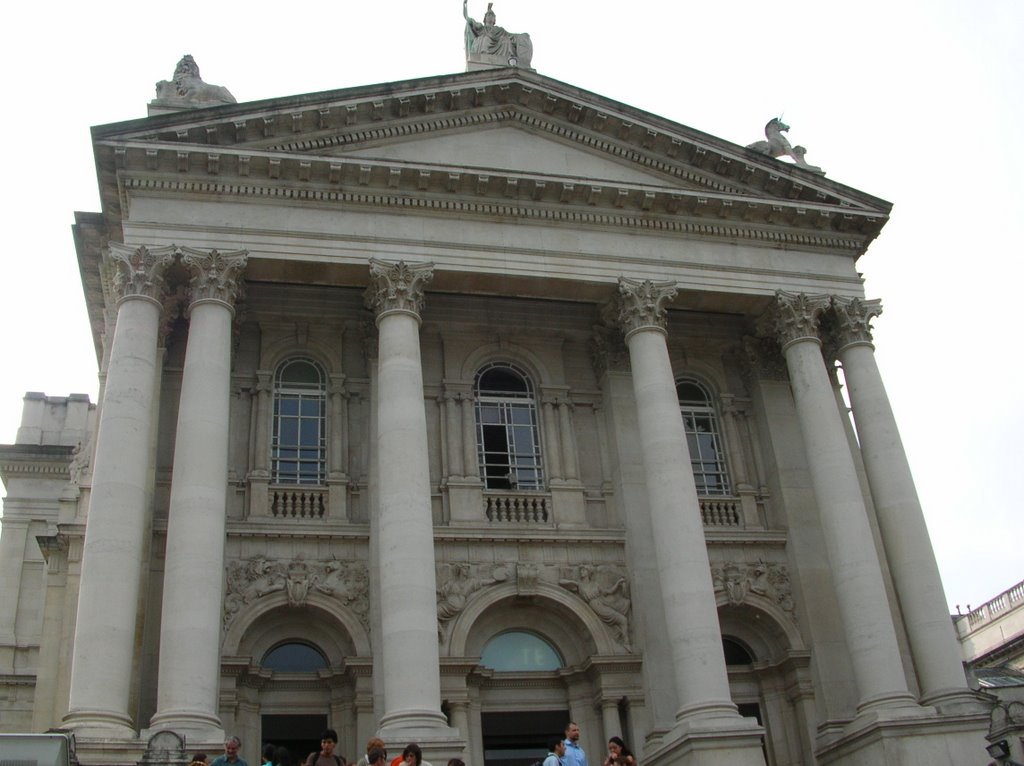
Last week I had the very great blessing of spending a couple of hours in the Tate Britain museum. More hours would have been an even greater blessing, but what was given me was enough to sink me almost in wonder. I went to see the John William Waterhouse works, knowing that that museum owns six of his works—more than any other gallery. However, only two were available on display, the others being in storage or lent out. Yet I will not complain about even two Waterhouses. That’s two more than I’d seen live before. One was The Martyrdom of St. Eulalia, which seems to me different from, and of deeper feeling and meaning than, most of his works. Or at least the popular ones. And I saw The Lady of Shalott! The one in the boat. That was a rare privilege, but more on that below. There were Millais works—Ophelia!—Holman Hunt, Leighton (both of the Leightons, I think), Rosetti—Proserpina, ah me—and TEN ROOMS of works by Joseph William Mallord Turner. Not just broom-closet-sized rooms either, but your state-dining-room-sized chambers, with many paintings measuring well over ten feet in at least one direction. I guess I’m young enough to be still impressed by sheer size and numbers. But think of the work that man did! Room after room after room of enormous paintings, all (as far as my untrained eye can tell) of excellent quality, many masterpieces. And nearly every museum in the “western” world, be it ever so humble, has at least one. That man was dazzlingly prolific. The Tate rooms were very well organized, and quite moving. If you ever get a chance to go there, do! If you have been there, please tell us about it.

What struck me at once was the organization of the rooms by theme. That seemed a brilliant addition. The first room, the largest, was in a typical chronological format, with a time life of Turner’s life and world events presented on the wall above the paintings. That was super helpful. Then there was a landscape room, a seascape room, a “rural England” room, a room with works including either foreign settings or classical ruins or both—I don’t remember—collections of drawings and unfinished works and studies. But the second room along the main corridor was the one that brought me the flash of sehnsücht. This was entitled “Sublime Landscape”. The mere words made me gasp. There are a few words that do that, a few phrases of delight and longing. Anybody and “the Sublime” is just about enough to do it to me, but Turner and the Sublime? That pushes me over the edge.

Fishermen at Sea
Why? Well, it goes back to C. S. Lewis’s definitions and experiences of joy, of course. It’s partly delight by association; I love the poetry of the Sublime, I loved the course I took on that discourse last summer, I love the art of the period that toys with the idea, and I love Turner. But it’s more than that. There are many things I love and would go far to see/hear/read/eat/watch/enjoy, and yet they spark no deep seated thrill of delight and longing. Shakespeare is that way. I would go across oceans (hum, I guess I have, haven’t I?) to watch live Shakespeare well done. And it thrills me, the language gets into my brains and my blood and there runs its hot and heady course, but there are few lines that are “Sublime.” Shakespeare’s is a cognitive pleasure, a pleasure of craft and skill, like Bach, like Escher, like Schönberg. And yet… and yet…. “The dark backward and abysm of time” gives me the Sublime shiver, as does Hamlet himself in his “trappings and his suits of woe,” even before he begins to speak his melancholy and supernaturally-charged verse. So all this is just to say that I am no Edmund Burke, that I have not the mind for making fine distinctions, for limning razor-edged categories with this in—this out, or for closing in on sharp definitions of exclusion and decision. No, with me it is all a mad rush and swirl of delights, joy upon joy, pleasure and approval and admiration all mixed up together in poetry and painting and theatre and trees.

Hannibal crossing the alps in a snowstorm

But tells you little about the Turner display. Burke was not, however, apropos of nothing, for he was quoted in the Sublime room in the Tate. He said something like this:
Whatever in any sort excites the ideas of pain and danger, that is to say, is in any sort terrible, or is conversant with terror, or is in any way analogous to the terrible, is sublime; that is, it is productive of the strongest emotion the mind is capable of feeling.

And there were also quotes from Addison’s The Spectator on the walls, to the effect that nature is not only lovely, she can also be terrible. The pictures on the walls were of nature in her terrible aspect: storms at sea, great tempest-tossed waves, lightning splitting the sky and the earth, whole sides of mountains shorn off and crashing into chasms below. I’ve put into this message little clip-arty versions, so you know what I’m talking about, but one needs to see the real thing. The size is part of it, the sheer overwhelming enormity of seven feet of canvas stretched across your vision, with the ocean roaring in all its imagined rage along the width of your sight. The texture of the brush-strokes is part of it, too, and there I think Burke would concur. It is not all smoothness and grace, as two-dimensional prints make us think. The very paint itself is rough and deep.

The Deluge
All this, which is much, and yet has not come near my point. What I find most fascinating about the “discourses of the Sublime” is their affinity with and aversion to the spiritual. As I wrote in a paper last summer, “Burke was striving to construct ‘a secular language for profound human experience…’ (from Adam Phillips intro. to Burke’s A Philosophical Enquiry…). The discourses of the sublime and beautiful were carefully and intentionally not converging with religion. They attempted to construct a secular semiotics and semantics (from Isobel Armstrong’s lectures).” A mouthful of words. But the point is this.

I believe encounters with the Sublime are really and truly divine experiences, that is to say, little brushes with God’s power and beauty and might and terror. Though the Romantics were at great pains to dismiss God, I think that argues all the more for His work in what they saw. Burke, Wordsworth, et al, were trying to find new terminology, non-religious terminology, for what the mystics and martyrs and fathers of the church would have called visions, God’s presence, general revelation, heavenly ecstasy, glimpses of heaven, holy transport, and the like. Words notwithstanding, it is what it is. [Another time we should talk about words, what they do, what they cannot do, what power they have to change or call forth or represent—or not. Perhaps I will recant what here I have writ, about “words notwithstanding.”] But in those paintings, made by a man via with the talent of a sub-creator, depicting divinely-created nature in her mood most unfriendly to little man, I see the hand of God. Couch it in what words you will: the Sublime is still and always an encounter with the Deity.