Listened to: South African Gospel (CD in The Rough Guide series)
Read: Two short stories: "The Five-Forty-Eight" by John Cheever and "Distant Music" by Ann Beattie (in Wonderful Town: New York Stories from The New Yorker, edited by David Remnick).
Apropos to our recent exchange about what is beauty, there's an interesting post (and subsequent discussion) on what books one would choose if teaching a university course on aesthetics, on the blog of my fellow Regent alum Gideon Strauss. I recognized and have read and agree with some of the suggestions there (Jeremy Begbie's Voicing Creation's Praise and part of Nicholas Wolterstorff's Art In Action). Click here to see the blog entry.
17 March 2006


16 March 2006
Teaching Art to Young People, or Learning it From Them?
I recently had the joy of spending two-and-a-half days taking care of two girls, ages 9 and 11, for their parents. Among the many fun things we found to do was photography. Prompted by the older one's request to give it a try, I decided to teach them how to use my fancy digital camera to take pictures. It was delightful to share the joy of creating art with young people, and see them take pleasure in what they could realize from their imaginations. I was also quite impressed with their artistic sensibility. They seemed to intuit that they could shift their point of view by moving around with the camera to change how the subject looks in the final result. The younger one was particularly good at zooming in close to make the subject or a small detail of it fill the frame. And the older one delighted in focusing on the subject while throwing the background out of focus, a technique she only had to ask me how to do with the camera's controls, but she already had the idea that's what she wanted to do.
This got me thinking about how young people develop the sense of recognizing beauty. Is it innate? Is it something you can teach? I remember the story my pastor told of the time when he took his whole family on a trip to India, when their children were little. His son, about age two at the time, taught him something about the human capacity to appreciate beauty. They were approaching the Taj Mahal from a muddy parking lot, and you couldn't see the majestic structure yet because it was behind a fence. But all of a sudden they came out into the open and there was the Taj Mahal looming ahead of them. The little boy breathed in a gasp of astonishment as soon as he saw it. It was then that my pastor friend realized he had in that little toddler a human being capable of appreciating beauty.
Young children also love the sounds of language. While they can't appreciate the more subtle aspects of poetic imagery yet, they can recognize and delight in repetitions of sounds, rhymes, puns, etc. And they seem to be always inventing their own little songs and poems. I can't remember what poet it was who was asked "When did you start writing poetry?" and he responded, "When did you stop?"
If you've ever had the chance to spend some significant time around children (this was really the first time in my adult life that I have!), you know that they teach you to see the world from a child's perspective again. I found my creativity enhanced by being with these girls, watching and participating in their artistic endeavors with them.
This got me thinking about how young people develop the sense of recognizing beauty. Is it innate? Is it something you can teach? I remember the story my pastor told of the time when he took his whole family on a trip to India, when their children were little. His son, about age two at the time, taught him something about the human capacity to appreciate beauty. They were approaching the Taj Mahal from a muddy parking lot, and you couldn't see the majestic structure yet because it was behind a fence. But all of a sudden they came out into the open and there was the Taj Mahal looming ahead of them. The little boy breathed in a gasp of astonishment as soon as he saw it. It was then that my pastor friend realized he had in that little toddler a human being capable of appreciating beauty.
Young children also love the sounds of language. While they can't appreciate the more subtle aspects of poetic imagery yet, they can recognize and delight in repetitions of sounds, rhymes, puns, etc. And they seem to be always inventing their own little songs and poems. I can't remember what poet it was who was asked "When did you start writing poetry?" and he responded, "When did you stop?"
If you've ever had the chance to spend some significant time around children (this was really the first time in my adult life that I have!), you know that they teach you to see the world from a child's perspective again. I found my creativity enhanced by being with these girls, watching and participating in their artistic endeavors with them.
14 March 2006
Why bother?
I’m going to add this to each post/comment, and I encourage you to do so too:
Today I’ve listened to: Beethoven’s Piano Concerto No. 5, the “Emperor”
Today I’ve read: Many Dimensions by Charles Williams
Yesterday was a fantastically beautiful Spring day. 80º, sunny, perfect. I sat outside listening to the myriads of birds, thinking, “Who needs music when we have the melodious and harmonious calls of birds? Who needs poetry describing nature when the real thing is so much more real and so much more satisfying? Who needs novels when the world and people and even trees have more depth and colour and meaning? Why do we bother with art, anyway?”
Then I picked up Many Dimensions. And I knew the answer. Whether or not I can articulate it, I knew and felt it. Nature is what it is and does what it does, but there was that book. It was alive. No, the characters were alive. No, they are something different and better than living. They are permanent, though they pass through my mind only while I read and when I think on it, or dream the story into my life as I did last night. The crisp psychological detail, the spiritual enormity, the trueness of it is unparalleled and indispensable. I almost venerate those characters. Yes, I want to emulate them. The stillness of Chloe, the silent acquiescence of her will to God’s, makes me want to change my name to Serena and live in tranquility. I ate that book up as a goat grazes away all things green, as a man in the desert consumes water. I wanted to read it as fast as I could, yet I grieve now that it is finished.
That is one reason to do art: to keep us starving and fed, to take us away from family and duty but give us back to spirit, to submerge us and lift us below and above all this beautiful material existence.
Today I’ve listened to: Beethoven’s Piano Concerto No. 5, the “Emperor”
Today I’ve read: Many Dimensions by Charles Williams
Yesterday was a fantastically beautiful Spring day. 80º, sunny, perfect. I sat outside listening to the myriads of birds, thinking, “Who needs music when we have the melodious and harmonious calls of birds? Who needs poetry describing nature when the real thing is so much more real and so much more satisfying? Who needs novels when the world and people and even trees have more depth and colour and meaning? Why do we bother with art, anyway?”
Then I picked up Many Dimensions. And I knew the answer. Whether or not I can articulate it, I knew and felt it. Nature is what it is and does what it does, but there was that book. It was alive. No, the characters were alive. No, they are something different and better than living. They are permanent, though they pass through my mind only while I read and when I think on it, or dream the story into my life as I did last night. The crisp psychological detail, the spiritual enormity, the trueness of it is unparalleled and indispensable. I almost venerate those characters. Yes, I want to emulate them. The stillness of Chloe, the silent acquiescence of her will to God’s, makes me want to change my name to Serena and live in tranquility. I ate that book up as a goat grazes away all things green, as a man in the desert consumes water. I wanted to read it as fast as I could, yet I grieve now that it is finished.
That is one reason to do art: to keep us starving and fed, to take us away from family and duty but give us back to spirit, to submerge us and lift us below and above all this beautiful material existence.
13 March 2006
Never travel without a book....
Take a look at this web site! As Rosie said when she sent it to me, "What a novel idea!" Perhaps we should all do it, and "turn the whole world into a library."
click here for Book Crossing
What would you leave for everyone and anyone to read? I would leave
Till We Have Faces by C. S. Lewis, the single greatest book, humanly speaking, or maybe Mere Christianity. But I'm sure there could be other, quirky, random, hard-to-find books that would do well in this sort of exchange. What would you send out on the waves of human flux?
click here for Book Crossing
What would you leave for everyone and anyone to read? I would leave
Till We Have Faces by C. S. Lewis, the single greatest book, humanly speaking, or maybe Mere Christianity. But I'm sure there could be other, quirky, random, hard-to-find books that would do well in this sort of exchange. What would you send out on the waves of human flux?
09 March 2006
If Beauty is Truth, is this beautiful enough?
Here is today's question:
What makes a good work of art?
What is a good poem? Mere technical prowess? Mechanical precision married to intensity of thought and feeling? Perspicacious observation? Or "a certain je ne sais quoi," to quote Peter Schickele?
And what is a good quality photograph, from an artistic point of view? What makes a piece of music a work of genius? Can we list off the items that make it great? Or does greatness transcend the individual features? When is a painting wonderful? Are only subjective evaluations valid, or are there objective measures of quality?
Here is a poem we can talk about, maybe, in relation to this. It's formless, and it's talking about the difficulty of writing poetry about God! So it can spark a meta-conversation (love it!). Is it any good? If so, how can it be? It follows no form. If it's no good, how do we know that? Against what standard? So, have fun.
17 February 2006
Lines on Listening
Anger blooming little starflowers on my eyelashes
overflow, overflow
Why do You leave me wandering in my own hollow cries?
Why must I shout and shout into this,
my own ringing echo?
Blank white overcast sky pressing down out of reach
rumble of something on thunder
mumble, mumble
How can I draw Your shape
on a blank white page
when my brush is dipped in and dripping
with silence—empty silence—
when my pen holds a slim cylinder
of entropy—shifting slipping—
muttering gibberish?
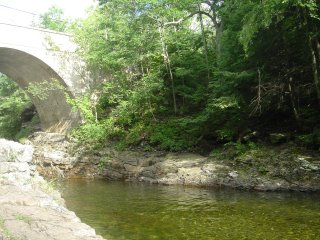
Yes, I do see the mountains.
They do fade range after range after range,
six at least, majesties mist-paling off to a wrinkled horizon.
And I do feel how clean this river-water is,
how cool, how absolute by itself and in its pouring over boulders.
I do hear it chattering below this pool,
Murmur murmur over a crunch of rocks,
but I do not know what it is saying.
What makes a good work of art?
What is a good poem? Mere technical prowess? Mechanical precision married to intensity of thought and feeling? Perspicacious observation? Or "a certain je ne sais quoi," to quote Peter Schickele?
And what is a good quality photograph, from an artistic point of view? What makes a piece of music a work of genius? Can we list off the items that make it great? Or does greatness transcend the individual features? When is a painting wonderful? Are only subjective evaluations valid, or are there objective measures of quality?
Here is a poem we can talk about, maybe, in relation to this. It's formless, and it's talking about the difficulty of writing poetry about God! So it can spark a meta-conversation (love it!). Is it any good? If so, how can it be? It follows no form. If it's no good, how do we know that? Against what standard? So, have fun.

17 February 2006
Lines on Listening
Anger blooming little starflowers on my eyelashes
overflow, overflow
Why do You leave me wandering in my own hollow cries?
Why must I shout and shout into this,
my own ringing echo?
Blank white overcast sky pressing down out of reach
rumble of something on thunder
mumble, mumble
How can I draw Your shape
on a blank white page
when my brush is dipped in and dripping
with silence—empty silence—
when my pen holds a slim cylinder
of entropy—shifting slipping—
muttering gibberish?
Yes, I do see the mountains.
They do fade range after range after range,
six at least, majesties mist-paling off to a wrinkled horizon.
And I do feel how clean this river-water is,
how cool, how absolute by itself and in its pouring over boulders.
I do hear it chattering below this pool,
Murmur murmur over a crunch of rocks,
but I do not know what it is saying.
01 March 2006
Intentionality in Art
Here's a question for you all: How much does the poet's or artist's intention matter in whether art is really art? I am a photographer, and while I know what to do to make an artistic photograph, sometimes I surprise myself by what comes out on film or screen. And sometimes I don't even recognize a photograph as good art until someone else sees it and comments on it. A photo I took on a recent trip to New Zealand (currently showing in the Lookout Gallery at Regent College, reproduced here at right) 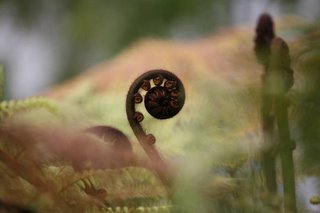 is turning out to arrest the attention of everyone who sees it. But I didn't recognize it as a winner when I first saw it. In fact, I didn't even notice it as one of the relatively good ones. But when I was showing my slides to an artist friend, she stopped at that one and told me it was incredible. And after looking at it for a while longer, I began to agree with her. Does the fact that this beauty came from somewhere outside of my intentional control change my relationship as artist to this work of art? Is it still art? Is this unexpected discovery of art an experience that other artists in other art forms (including poets, writers) have ever felt?
Art historian Laurel Gasque had a chance to view my photo in the gallery and commented on it thus:
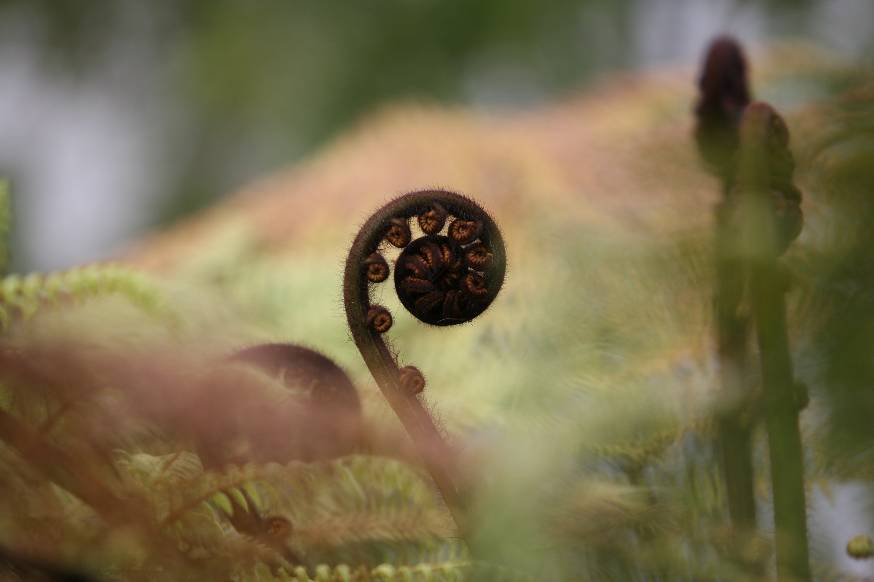 is turning out to arrest the attention of everyone who sees it. But I didn't recognize it as a winner when I first saw it. In fact, I didn't even notice it as one of the relatively good ones. But when I was showing my slides to an artist friend, she stopped at that one and told me it was incredible. And after looking at it for a while longer, I began to agree with her. Does the fact that this beauty came from somewhere outside of my intentional control change my relationship as artist to this work of art? Is it still art? Is this unexpected discovery of art an experience that other artists in other art forms (including poets, writers) have ever felt?
Art historian Laurel Gasque had a chance to view my photo in the gallery and commented on it thus:
Your work I would suggest is a Romantic take on the [German] photographer...Karl Blossfeldt. Art and nature are austerely and classically joined in his work. Painting and sculpture arrest my attention more than photography, but when the latter does, it does in a big way.
Blossfeldt's work which I first saw in Basel many years ago grabbed me in a special way that made me stop and honour the complete exquisite elegance of God's creation, its structure that makes all human design a footnote. Thank you for your work taking me back to this memory and kind of basic reflection.
I hope you find Blossfeldt's work of interest. You might find it static, but for me it arrests my attention, slows me down to consider God's amazing handiwork and consider it and mediate on it and relish all the inspiration it has given down through the ages to mostly anonymous artists who worked in the decorative arts, embellishing our lives not with the frivolous, but a reflection of archetypical form.
I located an online exhibit of Blossfeldt's Urformen der Kunst (Artforms in Nature). I do find it static, but I can see how Laurel saw my work as a Romantic take on some of his fern photos. Do you find that his work or mine better draws one's attention to God's handiwork? I am still trying to work out what my vocation is as an artist. One of my intentions is surely to bring glory to God and highlight his handiwork, but if I may take poetic license and apply Scott Cairns' thoughts to my photography, I would hope that I could create anew as well as merely showing a poor shadow of something that exists already in nature. Is photography as an art form inherently incapable of doing the former? What are your thoughts? Feel free to comment specifically on this photograph, even to critique it.
The Neo-Platonic Problem
Caveat lector: this is going to be really long and esoteric! If you don’t have time to read it, skip to the end!
By the way, go Augustine!! Fantastic segue, Rosie.
Yes, I confess. I am an “Inklings”-style Christian Neo Platonist. I do believe that all we see here is but a shadowy antitype of its perfect type or Form, which will be revealed in the new Heavens and the new Earth. Everything we see here will be fulfilled. There seems to be some Biblical evidence for this theory. The strongest is in the book of Hebrews. That author knew his Republic! Hebrews 8:1-5 (NASB) reads:
And it’s a beautiful idea. We will become what we will be, in full perfection. Every color will be more vibrant, every sound more resonant, every taste more vivid. More than this: I imagine we will be able to see the entire spectrum of colors, experiencing those far beyond our 10% current range. We’ll be able to hear the entire spectrum of sound, above a dog’s whistle and below an earthquake rumble. We’ll be able to distinguish textures and temperatures more subtle than we even know exist. More still than this! Perhaps, perhaps we’ll be able to see sound, hear colors, taste music, paint with words. Perhaps synesthesia is a bit of what is to come. In short, I would not be one bit surprised to get to Heaven and find it to be what Lewis described in The Great Divorce and The Last Battle. Or at least, those seem apt descriptions of the Valley of the Shadow of Life: who knows what “Deep Heaven” may contain?
But such a view might be limited. Why should I hold heaven—the final infinite, the beginning of forever, the unending landscape, the eternal timeline—to the standard of the Shadowlands? Why should what’s there be simply what’s here, only better? Hum. So, one spanner in the works of my philosophy.
I have tried to adapt Lewis’s concept, and fix some of the theological and eschatological inconsistencies, by putting the World of Forms into the future. I decided several months ago that I did not think that these Forms exist right now in any Ideal Realm or World of Pure Forms, unless that resides in the Mind of God. Plato’s is in the Past, Present, and Future, eternal in all 4-D directions, if I’m not mistaken. So, to Christianize mine, I’ve put it into a time after Christ returns. Yes, yes, of course I realize God is outside time, etc., etc., and maybe this terminology does not apply. And that my only proof-text seems to say it does exist now. But by having Perfection exist in an already-not yet realm, I thought I had freed it up as an arena for art. Here’s how. I’m going to take a long tangent to say how.
The contemporary Christian poet Scott Cairns has written an excellent article entitled “Elemental Confusion: Towards a Sacramental Poetics.” In this profound and challenging article (April 2005 [in progress]), Mr. Cairns contests that the primary reason for the failure of contemporary American verse (especially, but not exclusively, Christian poetry), is that the poem has become merely “a document of prior experience.” The poem must not be a description of a past moment, it must be a moment itself—an epiphany, a revelation, a creation (8). Art, then, to take Tolkien’s word, is not only itself sub-creation, but a catalyst of further sub-creation, or sub-sub-creation, or meta-sub-creation? The “Sacramental” in his title weaves together the theology Communion with an aesthetic of poetry. Firstly, he gently exposes what he sees as the shortcomings of some denominations who strip the elements down to mere reminders. This, he says, is like poetry which only commemorates a past event and does nothing in itself. It is a kind of theological and poetic poverty, as he sees it. Then he presents a eucharistic view of communion, in which participants in some way or other take Christ into their mouths each time they partake of those elements. This, according to Cairns, is how poetry should work: it must contain a living, present, moment: a power, a presence. His definition of “the poetic” is sublime—and I do not use that word lightly—“the presence and activity of inexhaustible, indeterminate enormity apprehended in a discreet space” (4). That beautiful, spiritual, dangerous comprehension will resonate in me for a long time hence.
This view of poetics is rooted in a metaphysics of language: what is a word? What does it signify? What can it do? Cairns lays out a subtle distinction between a paralyzing, shallow, enervating belief that words are merely signs, meaningless noises, versus a rejuvenating, regenerating, generative faith that words are something more (7). He supports this claim with a brilliant discussion contrasting the ways in which the Greeks used their words for “word” with how the Apostle John used Logos. I will quote at some length here.
Therefore, not only are these two views of words different, they illustrate the fundamental contrast of two entire worldviews. Athens and Jerusalem are eternally separated in Mr. Cairns’s theology and aesthetics.
And his aesthetics bring us back to my problem. He states, quite unequivocally: “For the belated poet—the belated writer of any genre, really—the neo-Platonic model can be as crippling as it is meager.” (10) Wham. Why? Because (Mr. Cairns believes) it reduces poetry to the thin, whining, cheap task of retelling stuff that was much better in actual experience than it can ever be in these noise-symbols put together in some order to try to evoke a shadowy picture of the Thing Itself. It cripples the poet, too, because s/he always carries the burden that past poets were closer to the original and therefore better, and that s/he will always limp along with a weaker voice than theirs.
I say, Not so. Why not? Because the Christian neo-Platonism that C. S. Lewis et al passed along to the modern believer is not such a weak thing. Mediated as it was by a Sacramental theology, displayed as it is in dazzling prose, it is a poetic force to be reckoned with. In the Chronicles of Narnia, the Space Trilogy, Till We Have Faces, Tolkien’s fantasy series, Charles Williams’s The Place of the Lion, and so on, I certainly perceive “the presence and activity of inexhaustible, indeterminate enormity apprehended in a discreet space.” The space is, granted, a much larger space that that of, say, Hopkins’s “God’s Grandeur,” Herbert’s “Love Unknown,” or Luci Shaw’s “M. C. Escher’s Three Worlds.” But the unabashedly neo-Platonic works of the Inklings can never be accused of being constructed of prior, “subsequent,” or “belated” (9); they are “occasion[s] of ongoing, generative agency” (4). How is this possible?
I think it must be because of the essential transformation neo-Platonism made in coming into the modern Christian era. It seems to have been wrested from a backward-looking, secondary position to a forward-looking, primary status. The object of a Christian Platonism is not a prior world of forms, nor even a present and inaccessible place of Real Things, but a moving towards and even-increasing apprehension of a future state of perfection. The eidos does not exist yet. Perhaps it did exist, in some more tenuous sense, in the mind of God before creation. But now it is always beginning to be created, day by day, on this fallen earth and in the lives of the saved.
The physical world is not a shadow, but a foreshadow. It prefigures what is to come in the new heavens and the new earth. The process of sanctification could perhaps be called an unshadowing (oo! Maybe that’s the right title for my haiku!), or a gradual lifting of the veil to reveal the hidden perfection. Every moment is a real moment, a true moment, and the more true the more of redemption reality it reveals. Thus a poem written now is more true, more right, more poetic if it resonates with both the current reality of justification and the future truth of glorification. We live in the woods between the worlds, and our verses are made here too. We wait with our faith unconsummated. Words have meaning, but they are more the musical sounds leading us on to hear the music of the heavenly spheres than complete symphonies in themselves. People, objects, and events hold in themselves the seeds of what they will bloom into. The most true poem is that which most fully lifts the veil that hangs between Now and What God has prepared for those who love Him.
And, if anyone is still interested enough to keep reading! this brings me back around to sacrament. In this view, the rite of communion is three-fold. First, it is a remembrance of a past event, yes. Christ said, “Do this in remembrance of Me.” Third, it is a looking forward to a future event: the wedding supper of the Lamb, when all will be fulfilled and all will be revealed. But secondly, in the Now, it is a real spiritual presence. Not a real physical presence any more than Heaven is on Earth at this moment. But an actual communion with Christ Himself, crucified and resurrected, and a communion with each other—all the body of believers in Christ everywhere and everywhen. It is a moment of transcendence, but transcendence brought down and close: perhaps an instant of “the presence and activity of inexhaustible, indeterminate enormity apprehended in a discreet space” and a particular time. With this three-fold vision, the poet can wait patiently for the consummation of love and art and simultaneously embrace Mr. Cairns’s invaluable advice to write dynamic, living moments of communication, embodiment, correspondences, and meta-sub-creation. As his article closes, let the poet create “the new made thing—bearing the mark of the hand that shapes it, bearing the traces of its origins, and bearing from this collaboration of past and presence a possible next moment, a future” (14), because the future is in the very words.
So, that’s a whole lot of blah blah blah. What do you all think? Is it possible to be a neo-Platonist and a great poet? Or does Platonism suck the life out of words and make them mere dry dusty signs?
By the way, go Augustine!! Fantastic segue, Rosie.
Yes, I confess. I am an “Inklings”-style Christian Neo Platonist. I do believe that all we see here is but a shadowy antitype of its perfect type or Form, which will be revealed in the new Heavens and the new Earth. Everything we see here will be fulfilled. There seems to be some Biblical evidence for this theory. The strongest is in the book of Hebrews. That author knew his Republic! Hebrews 8:1-5 (NASB) reads:
Now the main point in what has been said is this: we have such a high priest, who has taken His seat at the right hand of the throne of the Majesty in the heavens, a minister in the sanctuary, and in the true tabernacle, which the Lord pitched, not man. For every high priest is appointed to offer both gifts and sacrifices; hence it is necessary that this high priest also have something to offer. Now if He were on earth, He would not be a priest at all, since there are those who offer the gifts according to the Law; who serve a copy and shadow of the heavenly things, just as Moses was warned by God when he was about to erect the tabernacle; for, “See,” He says, “that you make all things according to the pattern which was shown you on the mountain.” (emphasis mine.)The earthly priests served in a tabernacle which was a shadow and a copy of the tabernacle in heaven! Wow. Perhaps some of you Greek scholars could tell me if the same words for “shadow” and “copy” are used in Hebrews and in Plato? But think about it: it seems that God gave Moses basically a blueprint of a tabernacle that existed in Heaven, and Moses built the best copy he possibly could under terrestrial conditions with mortal artists and finite materials. Then, I guess, when we get to Heaven we’ll see the real one? And just as the old men wept to see Zerubbabel’s temple, poor copy as it was of Solomon’s, so we will rejoice to see the original of which everything here is but a poor imitation!
And it’s a beautiful idea. We will become what we will be, in full perfection. Every color will be more vibrant, every sound more resonant, every taste more vivid. More than this: I imagine we will be able to see the entire spectrum of colors, experiencing those far beyond our 10% current range. We’ll be able to hear the entire spectrum of sound, above a dog’s whistle and below an earthquake rumble. We’ll be able to distinguish textures and temperatures more subtle than we even know exist. More still than this! Perhaps, perhaps we’ll be able to see sound, hear colors, taste music, paint with words. Perhaps synesthesia is a bit of what is to come. In short, I would not be one bit surprised to get to Heaven and find it to be what Lewis described in The Great Divorce and The Last Battle. Or at least, those seem apt descriptions of the Valley of the Shadow of Life: who knows what “Deep Heaven” may contain?
But such a view might be limited. Why should I hold heaven—the final infinite, the beginning of forever, the unending landscape, the eternal timeline—to the standard of the Shadowlands? Why should what’s there be simply what’s here, only better? Hum. So, one spanner in the works of my philosophy.
I have tried to adapt Lewis’s concept, and fix some of the theological and eschatological inconsistencies, by putting the World of Forms into the future. I decided several months ago that I did not think that these Forms exist right now in any Ideal Realm or World of Pure Forms, unless that resides in the Mind of God. Plato’s is in the Past, Present, and Future, eternal in all 4-D directions, if I’m not mistaken. So, to Christianize mine, I’ve put it into a time after Christ returns. Yes, yes, of course I realize God is outside time, etc., etc., and maybe this terminology does not apply. And that my only proof-text seems to say it does exist now. But by having Perfection exist in an already-not yet realm, I thought I had freed it up as an arena for art. Here’s how. I’m going to take a long tangent to say how.
The contemporary Christian poet Scott Cairns has written an excellent article entitled “Elemental Confusion: Towards a Sacramental Poetics.” In this profound and challenging article (April 2005 [in progress]), Mr. Cairns contests that the primary reason for the failure of contemporary American verse (especially, but not exclusively, Christian poetry), is that the poem has become merely “a document of prior experience.” The poem must not be a description of a past moment, it must be a moment itself—an epiphany, a revelation, a creation (8). Art, then, to take Tolkien’s word, is not only itself sub-creation, but a catalyst of further sub-creation, or sub-sub-creation, or meta-sub-creation? The “Sacramental” in his title weaves together the theology Communion with an aesthetic of poetry. Firstly, he gently exposes what he sees as the shortcomings of some denominations who strip the elements down to mere reminders. This, he says, is like poetry which only commemorates a past event and does nothing in itself. It is a kind of theological and poetic poverty, as he sees it. Then he presents a eucharistic view of communion, in which participants in some way or other take Christ into their mouths each time they partake of those elements. This, according to Cairns, is how poetry should work: it must contain a living, present, moment: a power, a presence. His definition of “the poetic” is sublime—and I do not use that word lightly—“the presence and activity of inexhaustible, indeterminate enormity apprehended in a discreet space” (4). That beautiful, spiritual, dangerous comprehension will resonate in me for a long time hence.
This view of poetics is rooted in a metaphysics of language: what is a word? What does it signify? What can it do? Cairns lays out a subtle distinction between a paralyzing, shallow, enervating belief that words are merely signs, meaningless noises, versus a rejuvenating, regenerating, generative faith that words are something more (7). He supports this claim with a brilliant discussion contrasting the ways in which the Greeks used their words for “word” with how the Apostle John used Logos. I will quote at some length here.
When the evangelist and theologian, Saint John, uttered Logos as his word for Word, he was making what I suspect to be a very Jewish point with a very Greek gesture. Until that moment, logos was generally consigned to the transcendent realm of Platonic Ideas, the realm of Real Things, of which the apparent world was supposed to be only a shadow. When Saint John wrested Logos from the ether and placed it in the muck among us, he was articulating a collision of realms, a collision whose concurrently disruptive and generative powers Christians have all but forgotten…. the neo-Platonic notion of the written word assumes it to be a name merely, it is, in practice, perceived as a sorry substitute for the spoken word, which is itself a sorry substitute for the thought, which is a sorry substitute for the very distant Idea—that objective reality to which we have no real access…. (7-8)
Therefore, not only are these two views of words different, they illustrate the fundamental contrast of two entire worldviews. Athens and Jerusalem are eternally separated in Mr. Cairns’s theology and aesthetics.
And his aesthetics bring us back to my problem. He states, quite unequivocally: “For the belated poet—the belated writer of any genre, really—the neo-Platonic model can be as crippling as it is meager.” (10) Wham. Why? Because (Mr. Cairns believes) it reduces poetry to the thin, whining, cheap task of retelling stuff that was much better in actual experience than it can ever be in these noise-symbols put together in some order to try to evoke a shadowy picture of the Thing Itself. It cripples the poet, too, because s/he always carries the burden that past poets were closer to the original and therefore better, and that s/he will always limp along with a weaker voice than theirs.
I say, Not so. Why not? Because the Christian neo-Platonism that C. S. Lewis et al passed along to the modern believer is not such a weak thing. Mediated as it was by a Sacramental theology, displayed as it is in dazzling prose, it is a poetic force to be reckoned with. In the Chronicles of Narnia, the Space Trilogy, Till We Have Faces, Tolkien’s fantasy series, Charles Williams’s The Place of the Lion, and so on, I certainly perceive “the presence and activity of inexhaustible, indeterminate enormity apprehended in a discreet space.” The space is, granted, a much larger space that that of, say, Hopkins’s “God’s Grandeur,” Herbert’s “Love Unknown,” or Luci Shaw’s “M. C. Escher’s Three Worlds.” But the unabashedly neo-Platonic works of the Inklings can never be accused of being constructed of prior, “subsequent,” or “belated” (9); they are “occasion[s] of ongoing, generative agency” (4). How is this possible?
I think it must be because of the essential transformation neo-Platonism made in coming into the modern Christian era. It seems to have been wrested from a backward-looking, secondary position to a forward-looking, primary status. The object of a Christian Platonism is not a prior world of forms, nor even a present and inaccessible place of Real Things, but a moving towards and even-increasing apprehension of a future state of perfection. The eidos does not exist yet. Perhaps it did exist, in some more tenuous sense, in the mind of God before creation. But now it is always beginning to be created, day by day, on this fallen earth and in the lives of the saved.
The physical world is not a shadow, but a foreshadow. It prefigures what is to come in the new heavens and the new earth. The process of sanctification could perhaps be called an unshadowing (oo! Maybe that’s the right title for my haiku!), or a gradual lifting of the veil to reveal the hidden perfection. Every moment is a real moment, a true moment, and the more true the more of redemption reality it reveals. Thus a poem written now is more true, more right, more poetic if it resonates with both the current reality of justification and the future truth of glorification. We live in the woods between the worlds, and our verses are made here too. We wait with our faith unconsummated. Words have meaning, but they are more the musical sounds leading us on to hear the music of the heavenly spheres than complete symphonies in themselves. People, objects, and events hold in themselves the seeds of what they will bloom into. The most true poem is that which most fully lifts the veil that hangs between Now and What God has prepared for those who love Him.
And, if anyone is still interested enough to keep reading! this brings me back around to sacrament. In this view, the rite of communion is three-fold. First, it is a remembrance of a past event, yes. Christ said, “Do this in remembrance of Me.” Third, it is a looking forward to a future event: the wedding supper of the Lamb, when all will be fulfilled and all will be revealed. But secondly, in the Now, it is a real spiritual presence. Not a real physical presence any more than Heaven is on Earth at this moment. But an actual communion with Christ Himself, crucified and resurrected, and a communion with each other—all the body of believers in Christ everywhere and everywhen. It is a moment of transcendence, but transcendence brought down and close: perhaps an instant of “the presence and activity of inexhaustible, indeterminate enormity apprehended in a discreet space” and a particular time. With this three-fold vision, the poet can wait patiently for the consummation of love and art and simultaneously embrace Mr. Cairns’s invaluable advice to write dynamic, living moments of communication, embodiment, correspondences, and meta-sub-creation. As his article closes, let the poet create “the new made thing—bearing the mark of the hand that shapes it, bearing the traces of its origins, and bearing from this collaboration of past and presence a possible next moment, a future” (14), because the future is in the very words.
So, that’s a whole lot of blah blah blah. What do you all think? Is it possible to be a neo-Platonist and a great poet? Or does Platonism suck the life out of words and make them mere dry dusty signs?
Subscribe to:
Posts (Atom)