I am exaggerating a little in the title. I can and do read non-fiction; more now than ever. I regularly read bits and pieces of literary criticism, history, biography, apologetics, and so on, but I rarely read a work of non-fiction straight through for fun. I generally treat it as reference materials. Recently I've been trying to be more intentional about reading non-fiction works cover-to-cover. Too many years of my life have gone by for me to remain ignorant in many categories! But one of the main motivating factors has been reading Louisa's book. And this leads me to the first way that I "can't read non-fiction":
1. My brain has atrophied
So, I'm trying to read Louisa's brillant, challenging book, and I find that too much novel-reading has weakened my brain cells. When I was in graduate school, I was more used to applying mental power to understand, classify, and apply difficult writing. But now I'm used to reading only what high schoolers read, plus pleasure reading! So I need to get my brain back in shape.
But that's not the serious problem. That's my own fault, and [more or less] easily remedied by some good brain-application. The more serious difficulty is:
2. Works of non-fiction convince me of the opposite of what they are attempting to prove.
Yes. You see, I am such an in-grained skeptic that I naturally argue with writers. I search for the holes in the arguments, look for alternative interpretations, and consider what might be written to prove the exact opposite. I recently read Between Heaven and Hell by Peter Kreeft; a delightful little Socratic dialogue with C. S. Lewis trouncing the weak atheistic and humanistic arguments of [caricatures of] Aldous Huxley and J. F. Kennedy. It's a cute book, but it has some problems. First of all, Lewis made the arguments better in the first place. Second, JFK and Huxley are really just straw men, not themselves nor even well-rounded 3-D characters at all. Third, the "inescapable logic" that Lewis used to "prove" incontrovertibly that Jesus is God really didn't feel incontrovertible. I'm not a good enough logician to really say what's wrong with the logic, but here's how it felt to me. It felt as if each syllogism, each step of the argument, was correct, but that the sudden conclusions had somehow skipped a point. To me, the point is the "leap of faith" -- Kierkegaard's subjectivity as truth -- but Kreeft never mentioned that. So his wonderful work of great apologetics left me feeling funny and doubtful inside. I'd rather read a great work of spiritual fantasy and sense God's presence in nature, imagination, and art than read a work that "proves" His existence yet leaves me feeling far away from Him.
And it's not just spiritual "non-fiction" that has this effect. I'm also reading The Language of God by Francis Collins. OK, I guess that's spiritual, but the main points are scientific. It's supposed to be proving that evolution is completely consistent with Biblical Christianity. I approached the book ready and willing to be convinced. But the more I read his impassioned descriptions of how Darwinian evolution is proven fact, and beautiful fact, and Biblical fact, the more I feel the whole thing is complete nonsense!
I wonder why this is? Am I just an inveterate skeptic, or is there actually some truth to the idea that FACT CANNOT SURVIVE WITHOUT THE CONSENT OF THE IMAGINATION? Let me know what you think.
14 February 2009


06 January 2009
God’s Design: The Arts as a Way of Being Human, Learning Truth, and Doing Justice
My article in the Spring 2008 issue of Direction Journal is now available online: God’s Design: The Arts as a Way of Being Human, Learning Truth, and Doing Justice.
05 January 2009
Vindicated
Do you remember how upset I was at the Prince Caspian film? Well, take a look at the article below, which I have reprinted from The C. S. Lewis society of California's email newsletter "Logos: The C.S. Lewis Society Update" (January 2009). See what happens when you mess with C. S. Lewis?
Disney Pulls Out of Narnia Films, but Walden Media Remains Committed:
Numerous articles have recently appeared announcing the decision announced on Christmas Eve by Walt Disney Pictures not to co-finance The Voyage of the Dawn Treader, the third of the films based on C.S. Lewis's beloved, 7-volume book series, The Chronicles of Narnia. Disney officials point to "budget considerations" during the economic downturn and poorer performance of the film version of Prince Caspian. In this regard, the first film, The Lion, the Witch, and the Wardrobe, received $745 million internationally at the box office, while Prince Caspian received $419 million. However, some of this decline resulted from a weak and mangled script by director Andrew Adamson, who refused to embrace the full story and theme of the book, as Yahoo! Movies notes in its review:
In addition, as NewsMax reports:
Furthermore, Disney flatly refused to have any pre-screenings of Prince Caspian and would not pursue any special marketing of the film to churches and other Christian markets. In direct contrast, for the first film an extensive and highly effective marketing campaign directed by Motive Entertainment (the marketing experts from Passion of the Christ fame) produced an enormous response from Christian movie goers. Disney however presented Prince Caspian as a strictly secular and violent, fantasy/adventure/romance, and the result was all too predictable.
Meanwhile, interest in the Narniad book series and Lewis's work overall continues to grow unabated among the public worldwide. And here in her January 1st column entitled "A 'Chronicles of Narnia' voyage Disney should take," Los Angeles Times critic Mary McNamara gives Disney a well-deserved scolding for being so short-sighted. The most likely new partner for Walden Media is Fox, which already markets and distributes Walden films using the Fox Walden banner.
Disney Pulls Out of Narnia Films, but Walden Media Remains Committed:
Numerous articles have recently appeared announcing the decision announced on Christmas Eve by Walt Disney Pictures not to co-finance The Voyage of the Dawn Treader, the third of the films based on C.S. Lewis's beloved, 7-volume book series, The Chronicles of Narnia. Disney officials point to "budget considerations" during the economic downturn and poorer performance of the film version of Prince Caspian. In this regard, the first film, The Lion, the Witch, and the Wardrobe, received $745 million internationally at the box office, while Prince Caspian received $419 million. However, some of this decline resulted from a weak and mangled script by director Andrew Adamson, who refused to embrace the full story and theme of the book, as Yahoo! Movies notes in its review:
"As a result, the movie edits out or severely compromises much of the real character development and interesting story lines in the original story and replaces them with Hollywood’s usual bag of tricks: gratuitous amounts of violence, overtly sentimental moments that fail to resonate, and romance that in this case seems disturbingly like mental statutory rape."
In addition, as NewsMax reports:
"Unlike the first 'Narnia' which had a holiday release, the sequel came out in the spring, and it was up against superhero summer fare like 'Iron Man' and 'Indiana Jones.' Disney tried to market it as an action flick, with limited success. Thankfully, Walden remains committed to C.S. Lewis’ remaining books."
Furthermore, Disney flatly refused to have any pre-screenings of Prince Caspian and would not pursue any special marketing of the film to churches and other Christian markets. In direct contrast, for the first film an extensive and highly effective marketing campaign directed by Motive Entertainment (the marketing experts from Passion of the Christ fame) produced an enormous response from Christian movie goers. Disney however presented Prince Caspian as a strictly secular and violent, fantasy/adventure/romance, and the result was all too predictable.
Meanwhile, interest in the Narniad book series and Lewis's work overall continues to grow unabated among the public worldwide. And here in her January 1st column entitled "A 'Chronicles of Narnia' voyage Disney should take," Los Angeles Times critic Mary McNamara gives Disney a well-deserved scolding for being so short-sighted. The most likely new partner for Walden Media is Fox, which already markets and distributes Walden films using the Fox Walden banner.
27 December 2008
The end of the world is near!
Well, maybe not. The end of 2008 is near, but that's not what I'm thinking about, either.
Earlier this school year, several students began a conversation about eschatology and/or the Apocalypse. We talked about the antichrist, various approaches to prophecy, and other end-times topics. While the conversation was brief, it did spark a thought in my mind I've been hoping to pursue. So here it is, with some background thoughts first.
Whenever I read an absolutely unforgettable book -- whenever a work of literature gives me that feeling Emily Dickinson described thus:
-- whenever I read a work like that, I say (whether it's Dante, Shakespeare, George MacDonald, Ayn Rand; or Wordsworth, Edna St. Vincent Millay; or the young adult fantasy novels of J. K. Rowling and Christopher Paolini; Ray Bradbury's short stories; rare moments in Freud or Jung; or, just this morning, "Mirror" by Sylvia Plath --
here's what I think. I think, "This author has touched on ultimate human realities." These books that move me profoundly are always "about" (such a weak word, about) love, life, death, birth, bodies, souls and so on, and these great realities are set into some stark relief so that they are sharper, colder, brighter, and more inescapable than they usually are in daily thought. "The Small Assassin" by Ray Bradbury, for example (in the short story collection The October Country), takes our deeply hidden sense of strangeness (or alienation) from birth and babies and uses it as a source of horrific terror. Pincher Martin by William Golding does something similar with the human body; alienating the character from his own material existence in a terrifying way. The great modern epics -- Lord of the Rings, Narnia taken as a whole, Star Wars, Harry Potter, the Matrix -- face death with stark, vivid power.
Great works of literature often deal with the cosmic moments in human history. Narnia and Paradise Lost with creation; Dante's Comedy with Heaven and Hell. So I got to thinking about the end of the world and how it figures in literature. And I couldn't come up with many examples of books set at the end of the world. I recall the nauseating, nihilistic Cat's Cradle by Kurt Vonnegut. The Last Man by Mary Shelley recounts the life and death of the last human being (oo, couldn't have guessed that ending, could you!?), but not the end of the planet earth. CSL's The Great Divorce tells about the final choice of heaven or hell, but not the Apocalypse. There's Wagner's Ring Cycle, of course (a true Gesamptkunstwerk)--which really is the death of the gods and the beginning of a new existence for humankind, not the end of the world for humans. Similarly, there's the death of "god" in Philip Pullman's trilogy. There's (sort of) the Paradiso -- although Dante returns to earth at the end.
I found a list of "Christian Apocalyptic Novels" on amazon: besides Jerry Jenkins and Tim LaHaye, the only books were a zombie novel by A.P. Fuchs, two novels by John Hagee, and a political thrillers series by Joel C. Rosenberg. They're not exactly on the same footing as Dante, eh?
Here's another list of end-times literature at wikipedia.
What I'm really saying is that I'm surprised there isn't more End-of-the-World literature -- or at least that I haven't come across it. Most fantasies, science fiction adventures, and action films involve some sort of heroic averting of the end of the world; but not many authors, contemporary or classic, seem willing to tackle the end of human, earthly existence. Is it for lack of imaginative ability to depict heaven? What do you think?
Earlier this school year, several students began a conversation about eschatology and/or the Apocalypse. We talked about the antichrist, various approaches to prophecy, and other end-times topics. While the conversation was brief, it did spark a thought in my mind I've been hoping to pursue. So here it is, with some background thoughts first.
Whenever I read an absolutely unforgettable book -- whenever a work of literature gives me that feeling Emily Dickinson described thus:
If I read a book and it makes my whole body so cold no fire can ever warm me, I know that is poetry. If I feel physically as if the top of my head were taken off, I know that is poetry. These are the only ways I know it. Is there any other way?
-- whenever I read a work like that, I say (whether it's Dante, Shakespeare, George MacDonald, Ayn Rand; or Wordsworth, Edna St. Vincent Millay; or the young adult fantasy novels of J. K. Rowling and Christopher Paolini; Ray Bradbury's short stories; rare moments in Freud or Jung; or, just this morning, "Mirror" by Sylvia Plath --
here's what I think. I think, "This author has touched on ultimate human realities." These books that move me profoundly are always "about" (such a weak word, about) love, life, death, birth, bodies, souls and so on, and these great realities are set into some stark relief so that they are sharper, colder, brighter, and more inescapable than they usually are in daily thought. "The Small Assassin" by Ray Bradbury, for example (in the short story collection The October Country), takes our deeply hidden sense of strangeness (or alienation) from birth and babies and uses it as a source of horrific terror. Pincher Martin by William Golding does something similar with the human body; alienating the character from his own material existence in a terrifying way. The great modern epics -- Lord of the Rings, Narnia taken as a whole, Star Wars, Harry Potter, the Matrix -- face death with stark, vivid power.
Great works of literature often deal with the cosmic moments in human history. Narnia and Paradise Lost with creation; Dante's Comedy with Heaven and Hell. So I got to thinking about the end of the world and how it figures in literature. And I couldn't come up with many examples of books set at the end of the world. I recall the nauseating, nihilistic Cat's Cradle by Kurt Vonnegut. The Last Man by Mary Shelley recounts the life and death of the last human being (oo, couldn't have guessed that ending, could you!?), but not the end of the planet earth. CSL's The Great Divorce tells about the final choice of heaven or hell, but not the Apocalypse. There's Wagner's Ring Cycle, of course (a true Gesamptkunstwerk)--which really is the death of the gods and the beginning of a new existence for humankind, not the end of the world for humans. Similarly, there's the death of "god" in Philip Pullman's trilogy. There's (sort of) the Paradiso -- although Dante returns to earth at the end.
I found a list of "Christian Apocalyptic Novels" on amazon: besides Jerry Jenkins and Tim LaHaye, the only books were a zombie novel by A.P. Fuchs, two novels by John Hagee, and a political thrillers series by Joel C. Rosenberg. They're not exactly on the same footing as Dante, eh?
Here's another list of end-times literature at wikipedia.
What I'm really saying is that I'm surprised there isn't more End-of-the-World literature -- or at least that I haven't come across it. Most fantasies, science fiction adventures, and action films involve some sort of heroic averting of the end of the world; but not many authors, contemporary or classic, seem willing to tackle the end of human, earthly existence. Is it for lack of imaginative ability to depict heaven? What do you think?
25 December 2008
A Poem for Christmas
Natal Astronomy
To Jupiter, Venus, and the Moon in Conjunction
1 December 2008
You have no similitude, ye gods of heaven
in this Advent night:
you are not, nor resemble, eyes
or jewels or flames of intellect:
to my poor senses little more
than holes torn in the dark-night-of-the-soul
upholstered ceiling of the sky
through which the Empyrean peeps.
Yet I see those planets through layers, like a lens:
a thousand pages from a hundred books
between my vision and their light,
papyrus, parchment, vellum, ink and print
between this nighttime glory and my sight.
Colored by association
with the wisdom of the ancient mind,
with a mountain of mythology,
a wider and more devout imagination
that read the heavens—read them to me:
read their personalities
and souse me in their influence!
Gashes of God-light
dousing my open skull.
Peel them back, these chapters of personification,
make thin the mystery.
But I cannot see the source.
Where is the Urtext for the stars?
When did Jove become the king of gods?
How did those little Greeks, untelescoped,
know he went garmented in royal red,
bled from a giant’s wound, the largest of the heavenlies
and heavy with the arbitration of his ring—his crown?
Who told Homer Aphrodite wore a womb-like atmosphere,
was soft for love, was beautiful in mists and sea-foam airs?
The dust-cold Luna, I suppose,
looks barren in her secondary light
and strings her tidal bow
and lets her maddening shafts
at women’s loins and madmen’s eyeballs—
But how did Norsemen measure Saturn’s aged pace?
They could not catch his frost across the light-years.
Or weaponed Gaels see the Martial red when they looked over
Hadrian’s wall at bloody Roman fields?
The pattern, somehow, the star-field dance,
was like a text. Was less than words,
and therefore more: was poetry.
Was story, and had characters.
A seed without a mother, an unfathered thought
conceiving and repeating, painting deities
on the Sistine ceiling of the sky.
And every figurine foreshadows truth.
For how else could they now, and thus, converge?
Majesty, Virginity, and Love:
how fitting, how exact. They close the circle.
For only once in every human life,
this time of year when every leaf is sheathed with glass,
these gods draw near to offer their Noël.
-- Sørina
To Jupiter, Venus, and the Moon in Conjunction
1 December 2008
You have no similitude, ye gods of heaven
in this Advent night:
you are not, nor resemble, eyes
or jewels or flames of intellect:
to my poor senses little more
than holes torn in the dark-night-of-the-soul
upholstered ceiling of the sky
through which the Empyrean peeps.
Yet I see those planets through layers, like a lens:
a thousand pages from a hundred books
between my vision and their light,
papyrus, parchment, vellum, ink and print
between this nighttime glory and my sight.
Colored by association
with the wisdom of the ancient mind,
with a mountain of mythology,
a wider and more devout imagination
that read the heavens—read them to me:
read their personalities
and souse me in their influence!
Gashes of God-light
dousing my open skull.
Peel them back, these chapters of personification,
make thin the mystery.
But I cannot see the source.
Where is the Urtext for the stars?
When did Jove become the king of gods?
How did those little Greeks, untelescoped,
know he went garmented in royal red,
bled from a giant’s wound, the largest of the heavenlies
and heavy with the arbitration of his ring—his crown?
Who told Homer Aphrodite wore a womb-like atmosphere,
was soft for love, was beautiful in mists and sea-foam airs?
The dust-cold Luna, I suppose,
looks barren in her secondary light
and strings her tidal bow
and lets her maddening shafts
at women’s loins and madmen’s eyeballs—
But how did Norsemen measure Saturn’s aged pace?
They could not catch his frost across the light-years.
Or weaponed Gaels see the Martial red when they looked over
Hadrian’s wall at bloody Roman fields?
The pattern, somehow, the star-field dance,
was like a text. Was less than words,
and therefore more: was poetry.
Was story, and had characters.
A seed without a mother, an unfathered thought
conceiving and repeating, painting deities
on the Sistine ceiling of the sky.
And every figurine foreshadows truth.
For how else could they now, and thus, converge?
Majesty, Virginity, and Love:
how fitting, how exact. They close the circle.
For only once in every human life,
this time of year when every leaf is sheathed with glass,
these gods draw near to offer their Noël.
-- Sørina
16 December 2008
Listening to C. S. Lewis
Here are several audio clips of C. S. Lewis on YouTube that you might find interesting.
1. CSL defending Charles Williams' metaphysical thrillers by assigning them a new genre.
2. Part of one of the BBC addresses that later became Mere Christianity.
3. Selections (I think it's the introduction) from The Four Loves. Just a tiny snippet defining the 4 Greek words.
Enjoy!
1. CSL defending Charles Williams' metaphysical thrillers by assigning them a new genre.
2. Part of one of the BBC addresses that later became Mere Christianity.
3. Selections (I think it's the introduction) from The Four Loves. Just a tiny snippet defining the 4 Greek words.
Enjoy!
11 December 2008
December poem of the month

photo by Steve Lantz
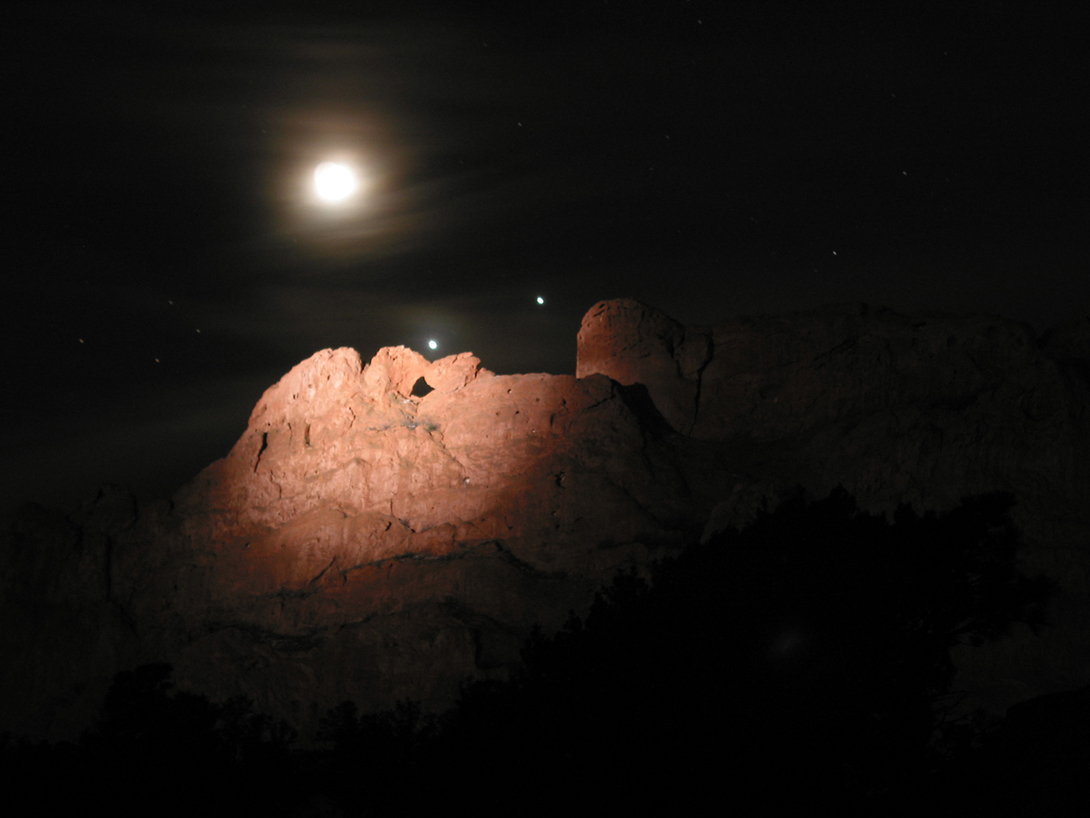
I have been working on this poem ever since I first saw the amazing conjunction of the Moon, Jupiter, and Venus several weeks ago. I don't know why a simple sonnet gave me so much trouble, except that my mind, time, and energy are completely consumed by work these days. This not even the poem I intended to write, which would have ended with the line:
THE GODS DRAW NEAR TO OFFER THEIR NOEL.
Maybe that poem is still forthcoming.
But back to the topic of the heavens! This meeting of Luna (or Silva), Jove (or Glund) and Aphrodite (or Perelandra) was a glorious once-in-a-lifetime experience. We sat and looked at it one evening for a long while until it sank below the treeline. My head was, of course, full of thoughts of the potential significance of this union: Beauty meets the King of the Gods while Virginity presides. And then Michael Ward sent me an article he wrote about C. S. Lewis's thoughts on observing this same conjunction in 1953.
Here are some beautiful photographs of the conjunction.
Meanwhile, enjoy this belated sonnet.
Cosmology
Until the still moment of the turn of Time
When Incarnation changed the spin of space,
Devout Angelicals of Heaven turned
About the planet of the human shape.
At the Nativity, the orbs of love
And intellect reversed their centrifuge:
They sang their fierce chant and burnt their wake
Around the solar image of their Liege.
But then creation lost her fixity
About a hill cris-crossed with lamentation;
On Sunday morning, relativity
Danced giddy with acentric adoration.
Now once a year the gods align and sing,
Awaiting their eternal choreography.


photo by Doug Zubenel
Subscribe to:
Posts (Atom)