Pages

Showing posts with label Shakespeare. Show all posts

28 November 2012

Upcoming PA Shakespeare festival 2013

Pennsylvania Shakespeare Festival Announces 2013 Summer Season
Center Valley, PA – Shakespeare’s Henry VIII and Measure for Measure will receive their first productions at the Pennsylvania Shakespeare Festival in the company’s summer season of 2013. The season will also include Oscar Wilde’s The Importance of Being Earnest, the award-winning comic-thriller, The 39 Steps, and Rodgers and Hammerstein’s legendary musical, Oklahoma!

     “For most of our patrons, the pulse quickens a bit when the opportunity presents to attend a Shakespeare play they haven’t seen, or have seen infrequently,” says Patrick Mulcahy, producing artistic director. “And we are all reminded of why the classics endure.”
            For the third consecutive season, PSF will produce two plays in repertory on its main stage: Measure for Measure and The Importance of Being Earnest. Earnest will be directed by long-time Festival artist Jim Helsinger, who will also play the role of Lady Bracknell.
            Following his powerful interpretation of Sweeney Todd for the Festival last summer, Associate Artistic Director Dennis Razze will direct Oklahoma!  
Oklahoma! is the most produced of all of Rodgers and Hammerstein’s musicals and it was their very first collaboration,” Razze says. “The musical form was forever changed after Oklahoma! debuted, and today it remains a rousing and inspiring tribute to the American spirit.” 
    After garnering Tony and Olivier awards and audience raves around the country, The 39 Steps receives its professional Lehigh Valley premiere with the PSF production. “Even with our proximity to New York, many in our community have yet to experience this masterful, comic whodunit,” Mulcahy says. “With four actors playing 150 characters, this play gives actors a great opportunity to showcase range and test their transformative abilities, and audiences a chance to come along for a wild and exhilarating ride.” Matt Pfeiffer, who previously directed The Complete Works of Shakespeare (Abridged) in 2009 for PSF, returns to direct.
            Henry VIII – one of Shakespeare’s final plays, loosely chronicling the opulent corrosive power struggles of the notorious king’s reign – will be rehearsed similarly to the way Shakespeare’s company would have and in the way PSF presented King John and The Two Noble Kinsmen in the past two seasons. Actors will arrive with their lines learned, rehearse on their own, wear what they can find in a costume shop “raid,” and open in a matter of days. No director – the position didn’t exist in 1613  and no designers. (Most productions at PSF rehearse for three-plus weeks, with a director and a full complement of designers.)
            “With two years of experience now, we’ve found that the actors and patrons embrace this process, and the final production gives our audiences something akin to what we think Shakespeare’s audiences experienced – the thrill of the unexpected, the creative, and the unique power of adrenaline combined with discovery,” says Mulcahy. 
            The 2013 season will also include two productions for children: Beauty and the Beast and Shakespeare for Kids. The season opens May 31 and runs through August 4 in the Labuda Center for the Performing Arts on the Center Valley campus of DeSales University.
            Subscription renewals are currently available to 2012 patrons; new subscriptions will be available after January 1st. 
            The Pennsylvania Shakespeare Festival, a professional company in residence at DeSales University, is the Official Shakespeare Festival of the Commonwealth and a professional, not-for-profit theatre company. An independent 501 c 3 organization, PSF receives support from DeSales University and relies on contributions from individuals, government agencies, corporations, and foundations. PSF is a constituent of the Theatre Communications Group (TCG), the national organization for the American theatre, and a member of the Greater Philadelphia Cultural Alliance, the Shakespeare Theatre Association, the Lehigh Valley Arts Council, and Discover Lehigh Valley.
Main Stage Theatre
Oklahoma! • June 12 – June 30
Measure for Measure • July 18 – Aug. 4
The Importance of Being Earnest • July 10 – Aug. 4
Schubert Theatre
The 39 Steps • June 19 – July 14
Henry VIII • July 24 – Aug. 4

   Beauty and the Beast • May 31 – Aug. 3
Shakespeare for Kids • July 24 – Aug. 3

03 November 2011

James Shapiro wrote Shakespeare?


Take a look at the cover of the book and you'll see what I mean. :)


Contested Will: Who Wrote Shakespeare? by James Shapiro

My rating: 4 of 5 stars


So far, this book is amazing! It purports to be a balanced view of the Shakespeare authorship controversy, and presents the case for Francis Bacon, then the Earl of Oxford, then Shakespeare. The beginning, however, is a remarkable survey of early Shakespeare scholarship (late 1700s), tracing the lines that laid down the kinds of thinking that made the authorship controversy possible. I highly recommend it.


. . .

Now, after finishing this book, I still highly recommend it! It's excellent. It is not unbiased, but a long immersion in postmodernism has taught us that objectivity is impossible anyway. So, it's a lovely, lively survey of (not the authorship question itself, but) WHY people question Shakespeare's authorship. It has a great cast of characters: forgers, lunatics, spiritualists (one guy held seances in which his medium called up Edward de Vere, Francis Bacon, and Shakespeare to get from them the whole story. He did get the whole story of who wrote what, and even got a couple of lousy sonnets out of them. Funny that guys write better when they're alive than when they're dead), philosophers, psychoanalyists (Freud was an Oxfordian), novelists (Mark Twain was, too), feminists, historians, politicians.... It's well-written, quite readable, and (in the end) quite persuasive that Shakespeare of Stratford was the guy after all.

If you're going to go see "Anonymous" (don't know why you'd waste your money, really), read this first!


View all my reviews


Share

28 October 2011

PA Shakespeare 2012 season

OK, so last week I promised to announce the upcoming season at the Pennsylvania Shakespeare Festival as soon as I was allowed. Well, it's now public!

Here is the artistic director's official announcement. This summer's plays will include:

MUCH ADO ABOUT NOTHING
by William Shakespeare
July 11 - August 5

CAT ON A HOT TIN ROOF
by Tennessee Williams
July 19 - August 5

THE TEMPEST
by William Shakespeare
June 20 - July 15

KING JOHN
by William Shakespeare
July 25 - August 5

SWEENEY TODD
by Stephen Sondheim
June 13 - July 1

Wowie kazowie! I am super excited, most especially about King John. Last summer's "Shakespeare untamed" version of The Two Noble Kinsmen (original performance practice, i.e., without a director, rehearsal, blocking, etc!!!) was STUNNING. One of those memorable theatrical experiences that changed my life and will live along as part of me. I've been blessed to have lots of those!! -- but this was certainly up there. I have high hopes for King John. Plus if I just stick around the Lehigh Valley and live long enough, I'll meet my goal of seeing all of Shakespeare's plays live. (I've seen 15 of the, ahem, 40? plays)

Now, I'm also engaged in reading up on the authorship controversy these days in preparation for seeing Anonymous tomorrow. I'll report back on that. I'm sure it will be lavish.


Share

29 October 2006

To Adapt or Not to Adapt

...and that's only the beginning of the question...


Christopher Yeatts as Hamlet in the Pennsylvania Shakespeare Festival WillPower touring production of Hamlet.


Read: Lilith by George MacDonald.
Watched: A one-hour-and-twenty-minute version of Hamlet by members of the Pennsylvania Shakespeare Festival and a “traditional” performance of King Lear by the theatre department of Northampton Community College.
Listened to: lots of Beatles albums, Bach, Chopin, & contemporary Native American singer/songwriters.

I’ve been wondering about adaptations recently. Here’s the question I’d like readers to answer: Do you hold a sort of “sacrosanct” view of texts, that is, that they should never be adapted, or do you think that anything written is available for change & re-presentation? I’m thinking especially of plays, but this conversation could be relevant for music, books-to-movies, etc. So, do you think that an artist’s original work should stand as it is, or could & should it be adapted to suit the mood of the times? Do you think any “real” presentation of a work is possible when moving from one medium to another, such as page-to-stage, page-to-screen, and so forth?

So, that’s it. That’s my question. But that said, of course I have to go on and give my opinion. First of all, let’s just make it clear that we’re not talking about copyright violations. Let’s assume that the material we’ll discuss is either in the public domain or the adaptor has received permission to do whatever hacking, cutting, and pasting s/he may desire.

I used to believe that any text, or indeed any original work of art, was almost sacred, that it should not be touched or changed at all. I was horrified by The Lord of the Rings when it first came out, due to the drastic changes the director made. He ruined Faramir’s character, changed some crucial speeches, and left out the last sixth of the book! Good grief. Well, now I love those movies for their own sake, but still feel a bit of sinking sickness when I think of all the viewers who may never read the books and will always have the wrong impression. I had a similar reaction to “Narnia” an a first viewing. How dare he change nearly every word of the original book & turn it into a fairly lousy screenplay & throw in some retarded scene of cheesy drama on the ice and leave out the Emperor-Beyond-the-Sea & the Deep Magic from before the Dawn of Time, and why were the children whining to go home all the time? You can see I’m rather passionate about this, still. Even though I appreciate those movies for their own sake, as great movies, I shudder when I think of them as visual representations of the books.
But recently I’ve been developing a new attitude towards adaptations. It began this summer in Oxford, when my prof. Emma Smith said many times that she thought the best directors of Shakespeare were those who were not afraid to cut, paste, change, hack, chop, and disfigure to their hearts’ content. Well, she didn’t exactly say it like that, but that was the idea. Her premise seemed to be that any new production of an old play is a work of art in its own right, and must change with the times/places to be relevant, fresh, and compelling. And I’m beginning to agree with her.

The production of Hamlet by the traveling troupe from the Pennsylvania Shakespeare Festival was extraordinary—very dynamic, very alive, very relevant, and totally exciting. Hamlet dressed in black, of course, but it was black jeans & worn dress shirt & ill-tied tie. The set was like Hot Topic or a Goth-style artist’s flat in Harlem: faded purple & black velvet draped across the back, with well-chosen graffiti scrawled across it: “Remember Me” and “Dust” were most predominant. Ophelia was hovering between a Goth look—black net tights, black tank top over ruffled white dress—and girly-cutsie—pink ballet shoes and a flower in her hair. Clearly, they were teenagers going through identity crises. Claudius and Gertrude, on the other hand, were stiff and business-like, with a roaring-Twenties touch, putting them very far out of touch with Hamlet’s uncertain and artistic world. The ghost’s appearance was accompanied by “Mission: Impossible” or James Bond theme-song kind of music, fast, intense, and supremely modern. One of the guards was a girl, dressed in grey spandex, and all those on watch squatted on the alert with flashlights poised. Think Charlie’s Angels. Very slick, very NOW.

When Hamlet went into his little madness game, he shuffled out wearing a T-shirt that hung to his knees, sneakers about two feet long with their white tongues sticking up, a huge white baseball cap on sideways, and a Sponge Bob necklace. He held his book with the spine perpendicular to his hands, and looked for all the world like a cartoon character.

Oh, and did I mention that the production was 80 minutes long? About maybe 1/3 of the text was presented.

My point in relating all these details is this. I’m coming to think that in the fluid medium of live theatre, adaptations should be just that: adaptations. OED says that “adapt” means “make suitable for a new use or purpose” or “become adjusted to new conditions.” [Thank you, OED.] Shakespeare’s plays have been performed innumerable times. And no one performance on stage can possibly claim to be THE ONE AND ONLY definitive performance that interprets every possible detail according to—what? Shakespeare’s intention? Original performance practice? Elizabethan or Jacobean conditions? The ideal hidden meaning expressed in the outward form? No sir-ee. Each production is a new, fresh perspective, yet another way to look at the play. So I’m starting to think, adapt as you will!

Now, that’s what I think about the fluid medium of theatre. Films, I believe, are in a different category. This is because films are static. Once it’s been filmed, that’s it. OK, sure, so they can release the special edition extended version DVD, and I’m glad when they do (waiting for the “Lion, Witch, & Wardrobe” extended to see what they left out—or in, depending on how you look at that). But even so, that’s fixed. So it does, then purport to be at least a definitive version, if not THE one and only. So, back to LOTR. I’m disturbed by how much was left out & changed of that book/epic/series/triliogy/quadrilogy. Wait, it’s not a quadrilogy yet. Has anyone heard if they are indeed making The Hobbit with what’s-his-name Elijah Wood as Bilbo? Because of the great technology, etc., this film is almost worthy of its literary prototype. Almost. And I’m afraid that it will stand in for the thing itself. So I think that when directors are re-making a masterpiece in a static medium such as film, it behooves them to be as true to the original as possible.

But who knows, maybe one day film too will be somehow a fluid medium, and there will as many LOTRs made as Romeo & Juliets. Who knows. And would that be good or bad?

13 September 2006

Macbeth and Predestination

Read: C. S. Lewis: A Biography by Roger Lancelyn Green & Walter Hooper.
Watched: the first part of HBO’s Elizabeth I

This is a re-hash of a previous post. My students & I have been exploring this topic in Language Arts classes recently, so I repost it here for their sakes, looking forward to their comments.

David Taylor once said artists must read their systematic theology. Indeed, I do believe that great Christian art is (partly) only as good as its doctrine. Partly; skill/craftsmanship/aesthetic excellence are also essential. But I also think that the debates over theological points are as fertile as solid convictions. The “Problem of Evil,” for example, functions as the catalyst for large passages in Augustine’s Confessions, Dante’s trilogy, Milton’s Paradise Lost….

And the debate over Free Will vs. Predestination is another such matter. We’ve been reading Macbeth for the last month or more, putting it into the context of cultural controversies. One hot topic of Shakespeare’s time was this problem about “Does God deterimine all things beofre they begin, or are human beings free to create their own [eternal] destinies?” And it was very hot; wars were raging all over Europe in the latter half of the 16th century over Catholicism, Anglicanism, Lutheranism, and Calvinism. Shakespeare, man of the age, was certainly not going to let this red-letter debate slip by. But he also didn’t want to lose his head.

However that may be, the author of the introductory matter in our Norton Critical Edition, Robert S. Miola, claims that “Whatever his personal convictions, Shakespeare clearly adopts a Catholic view of the action and theology of free will in this play” and “the doctrine of predestination renders human action essentially undramatic: when the end is known, preordained, and absolutely just, there can be no real choice, suspense, conflict, or resolution. This conception of divine justice and human action renders pity an impertinence, terror a transgression, and tragedy an impossibility” (pp. xv, xvi).

Maybe we shouldn’t be so sure. I have a problem with that sweeping generalization. I wouldn’t say that predestination freezes all possibility of dramatic action. I’d like to make two points:

1. The characters do not know the ending. They are within a double predestination, as it were. Theologians will pardon me for abusing the term. First, they might be predestined by God, if such is the writer’s or audience’s belief. Second, they are certainly predestined by the intent and will of the artist. Or perhaps I have those in the wrong order?

2. In life, we do not know our ending. The staunchest Calvinist, if he has his wits about him, believes that here inside time we must make choices. Yeah, perhaps God has set the choice before hand, certainly God knows what will be done, but that does not make the psychological and emotional experience of choice any less a reality. Any less real. It is also thus inside works of art.

So, here’s the question: Is Macbeth free to choose his fate, or is he destined to follow the prophecies? We’ve talked about how much the witches knew, could they see the future, would Macbeth have become king even without killing Duncan, are the “equivocating” words of the weird sisters quite “fair” from a spiritual point of view, do telling the future and making big decisions create parallel universes… you know, the usual literary discussions. :)

So now, let’s continue that conversation. Feel free to answer the above question, offer new questions, or give other examples of how this doctrinal dilemma has been the catalyst for great passages of writing. Or I’d really love to see examples of other genres (visual arts, music, etc.) that use this or other theological paradoxes for their meaning and motive!

04 August 2006

The Gallimaufry Again


Material Shakespeare Class with Dr. Emma Smith

[3 August 2006]
So, I turned in my paper, got comments back, & I'm done!! Off to Stonehenge today, around Oxford tomorrow, Dublin on Sunday, off home on Monday! Meanwhile, here are bits of my revised paper to ponder if you wish; it still needs a little more substatiation and revision....

A Gallimaufry of the Gospel:
Mixed Genre and Biblical Structure in The Winter’s Tale


The structure of The Winter’s Tale bears a remarkable resemblance to the overarching patristic-historical biblical narrative, both generically and topically. However, to an Anglican of Shakespeare’s time, the Bible itself would rarely have been experienced in anything but synchronic, thematic weekly readings chosen from Old Testament, New Testament, and Gospels. Therefore, the linear tragedy-pastoral-comedy development which The Winter’s Tale shares with Christian history must have been mediated to Shakespeare through some means other than Sunday services. And indeed it was. While the exposition of typology was a common feature of preaching—interpreting the Old Testament to prefigure the New—a chronological presentation was more readily found in the Medieval Corpus Christi cycles of mystery plays. Shakespeare’s use of a Roman Catholic theatrical form probably implies a desire for the former unity lost in the great schism of the Church, and explains the apparently deliberate involvement of both Catholic and Protestant elements in the play’s conclusion. Shakespeare draws on this pre-Reformation tradition in shaping the tripartite generic structure of The Winter’s Tale, but eliminates central elements of the mystery cycles and any presentation of Christ Himself. This adaptation of Medieval models frees the play from the sixteenth-century charges leveled against “papist idolatry” and reveals Shakespeare’s aesthetic interest in the dramatic power of biblical history’s trajectory.

The question of genre has obtained in discussions of The Winter’s Tale nearly since its publication. Technical or trivial as such labels may seem, naming the play provides a way of seeing it. At the most basic level, a piece of Renaissance drama is already in two “modern” categories: Play and Poem. A playwright was typically called a poet. This particular poem-play is also, according to its title, a “Tale”—a story of wonder and hyperbole. In addition to asking into what generic category the play falls, scholars should also ask why The Winter’s Tale has been so persistently hard to classify. The answer may lie in the fact that it contains within itself three distinct genres that had been related to one another in the Middle Ages but became detached in the Renaissance.

[Here follows a survey of what scholars have said about the genre of TWT.]

The tripartite generic structure of The Winter’s Tale resembles that of the Christian Bible. The play is not, however, a simple Creation-Fall-Redemption narrative. Rather, its development from tragedy to comedy with a pastoral interlude resembles that of Old Testament episodes and the conclusion of the New Testament, connected by a Shepherd’s Play and mediatory Pauline doctrine. “‘A sad tale’s best for winter,’ says little Mamillius, and so the first half of this play is tragic,” writes Wincor; I agree that the first third of the play is compact tragedy. I read the second section as a pastoral Shepherd’s play and the last as a New Testament-style comedy, climaxing (like Dante’s) in a glorious Apocalypse. Therefore, I propose a new genre for The Winter’s Tale: cycle. According to the OED, a cycle is “A series of poems or prose romances, collected round or relating to a central event or epoch of mythic history and forming a continuous narrative; as the Arthurian cycle.” The Winter’s Tale is a series of poetic dramas, each with its own generic qualities, relating closely enough to the central events of biblical history to partcipate in their universal power, but skirting them with enough circumspection to avoid being thrown off the stage. By the time Shakespeare was an adult, the Protestant authorities had banned mystery plays.

[...here was the body of the paper, going through and comparing each section with its corresponding Mystery play. Then I talk about the fact that Shakespeare left out Jesus, skipping over Nativity, Passion, and Resurrection. Now here's the discussion of the ending. Spoiler warning: This gives away the very startling ending of the play!]

The statue scene is Shakespeare’s “most vivid fesitval Cure….no greater Cures were ever seen before on any stage. Spring has come at last, and the Mock Death has been succeeded by a joyous Resurrection” and several joyous weddings. A greater Cure had been often seen by the older members of his audience, and they would remember the Resurrections of Christ they had seen, year after year, in Corpus Christi plays, before those were banned by Protestant Reformers and replaced with whitewashed churches stripped of icons. The Roman Catholic associations of The Winter’s Tale have been well documented and persuasviely argued, but the lack of a celebration of the Eucharist (a contentious subject), the Second Coming ending, the multiple (and seemingly irreconciblae) Roman Catholic and Protestant references suggest that Shakespeare has something else in mind than doctrinal polemic. He is reaching back behind the split for a pre-Reformation Medieval Christianity, not for its doctrine, but for its structure and its beauty. “The ‘miracle’ of a statue of a blessed lady coming to life …emerges not as an endorsement of the truth-value of Romanism but as a recuperation of the aesthetics involved in Catholic devotional practices.”

What exactly is the Medieval aesthetic Shakespeare “cures” in The Winter’s Tale? First, it is technically impressive, containing “masque-like scenes and stage effects, “ which he employs with great confidence, not fearing the current mood that distrusts the visual. Happé notes this feature of the mystery plays in addition to its narrative efficacy: “Besides this sturctural power, one must also consider the dramatic strength of many of the episodes. One notices particularly the ability to centre a play on a striking episode which has a power visual impact.” Think of the static, striking impact of the last scene, when Paulina pulls aside the curtain to reavel, as we think, a statue of Hermione. Think of the shock when she moves, when she comes down off the pedestal and embraces Leontes. Second, it is the emotional effect of the story’s scope, its depths, and its heights. “The biblical drama of the mystery cycles,” like The Winter’s Tale, picked out certain narrative of operatic despair and ecstasy, thus conjuring “emotional engagment with its patterns of fall and redemption, judgment and salvation….the thelogical pattern is given thereby an emotional emphasis it would not otherwise possess.” Third, “the effect on an audience is analogous to religious expereince: an act of faith is required for the enactment of the seeming miracle…. [which] is closer to the incarnational religious aesthetic I described as the basis of medieval art.” The sublime feelings the audience might feel at the close of the play are similar to those felt in lofty moments of religious ritual. By calling up these associations, Shakespeare availed himself of all the artistic power of the timeless—and universal—Dying God myth. In other words, the Bible, the Corpus Christi cycle, and The Winter’s Tale are dramas that engage the eye, the heart, and the soul. In The Winter’s Tale, one of his last and longest plays, Shakespeare harnessed the dramatic power of the three-fold genre, making a cycle—and a spectacle—of his own.

~ Admonit

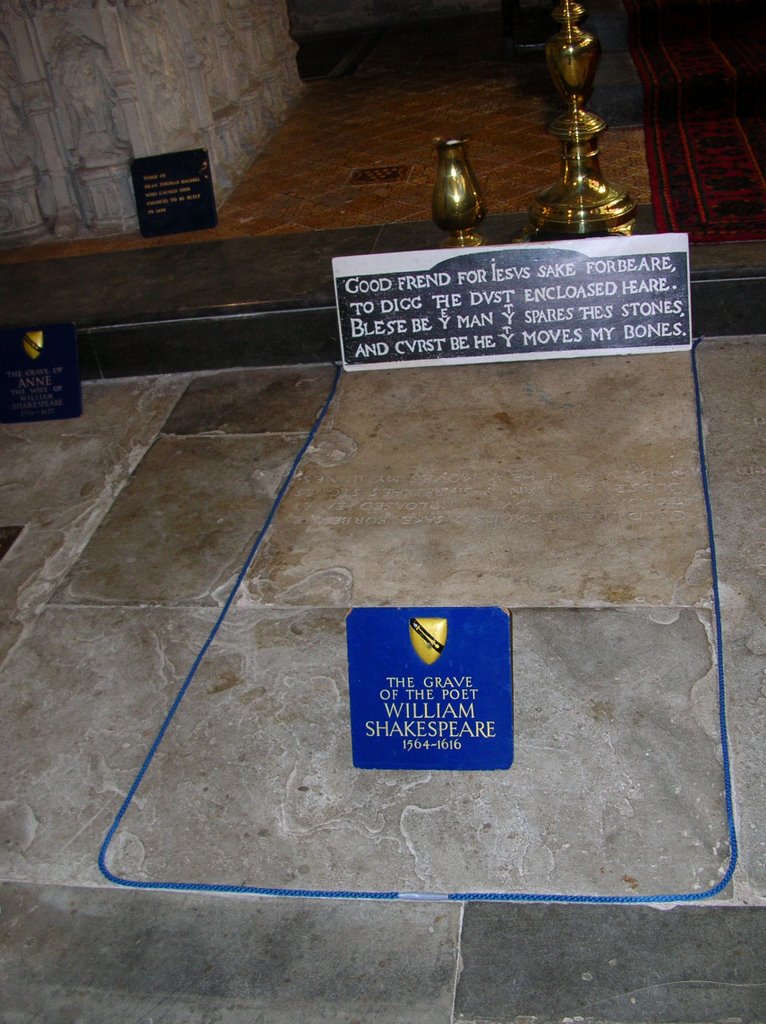
Shakespeare's Grave

29 July 2006

A Gallimaufry of the Gospel

I don't get out much.

Think about it. I've travelled across an ocean and a couple of islands and several countries to get to Oxford, and now the furthest I travel each day is around the block to the library. Then I sit all day in once place, only travelling in my mind. But, O! the places I go!

So I thought maybe I'd share what I'm writing now, little by little. It's a ridiculously massive paper, but it's a massive topic. My biggest concern is whether or not I'm being spiritually honest in what I'm writing. I believe that Shakespeare probably believes it, and that it is possible for someone (me) to make the point I'm making validly from the text, but theologically I'm a bit dubious. See, the conclusion (spoiler warning) is something like:

"Shakespeare’s text is hard to figure out. It has both Catholic and Protestant features. The Bible must be hard to figure out, since 2000 years of debate has not solved the Catholic/Protestant divide. Shakespeare does not come down on one side of these big theological questions. Critics of The Winter’s Tale, like Christian theologians, take the same text and come up with opposite, fully-convinced, well-argued, logical, solidly supported conclusions. This is not to say that there are no correct answers, nor that all interpretations are equally valid. Rather, it is to say that a good piece of writing generates more pieces of writing. Viewing The Winter’s Tale through the literary edifice of the Bible has the reciprocal effect of offering a possible Shakespearean interpretation of the fertility of Church History and the Biblical text."

But I don't believe that the Bible is in any way indeterminate, nor that the Bible equally supports Catholic and Protestant readings. Do you see my problem? But anyway, OK, here's a rough draft for the opening of my paper. I've taken out all the parenthetical citations just to make it tidy; no fear, there's no plagarism in the real thing.


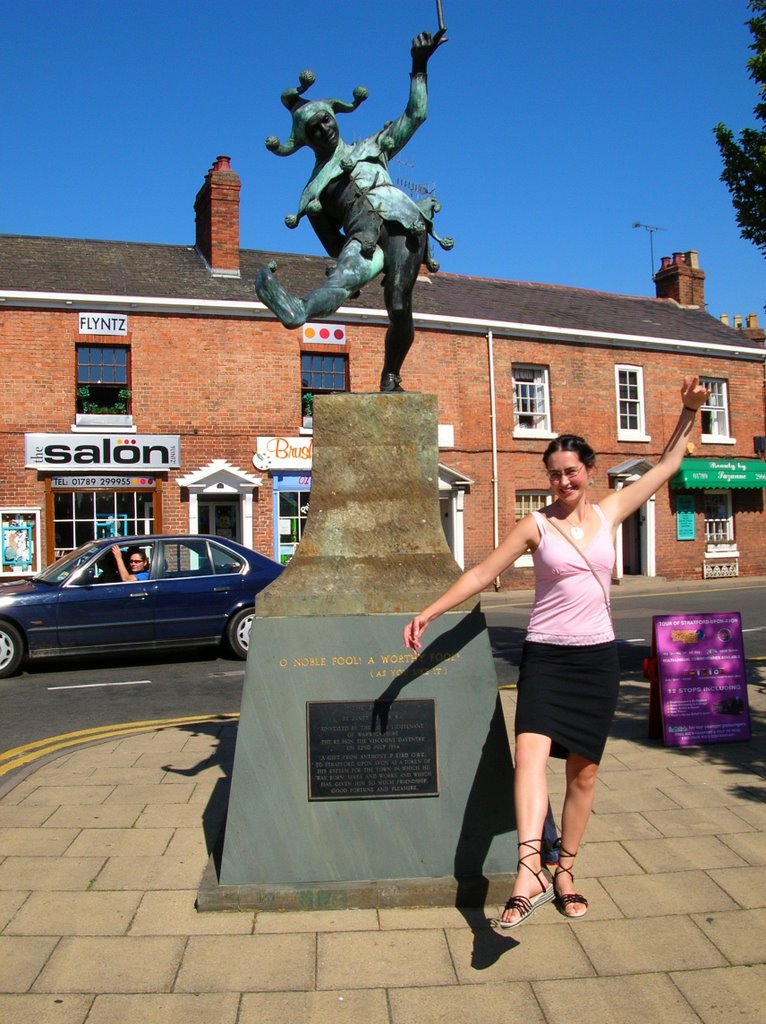
. . . . . . . . . . . . . . . . . . . . Two Fools . . . . . . . . . . . . . . . . . . . . . . . .


A Gallimaufry of the Gospel:
Mixed Genre and Scriptural Structure in The Winter’s Tale

Now faith is being sure of what we hope for
and certain of what we do not see.
This is what the ancients were commended for.
—Hebrews 11:1-2

Like any good preacher, Paulina begins the conclusion of her on-stage/back-stage sermon with “It is required / You do awake your faith.” It is a commonplace in Evangelical churches that every sermon must come around in the end to either the person of Jesus Christ or the listeners’ need for faith in Him. But is it as obvious that Paulina—or Shakespeare—is evoking a specifically Christian, let alone Evangelical, or even Reformation, faith? After all, if The Winter’s Tale is a romance, as little to be believed as a fairy tale, its injunctions apply only to the on-stage crowd and have no metatheatrical application or literal religious reference. Furthermore, the play is set in a vaguely Classical time and place, the gods of the Olympic pantheon freely and explicitly invoked. The name of God does not appear anywhere in the play, although “gods” and “goddesses” do. Yet again, Scripture quotations interspersed throughout the text, and allusions to Christian theology, specifically Pauline doctrine and Mariological practices, abound. Scholars’ religious interpretations range from exact, point-by-point Calvinist allegories through comparisons with Catholic practices relating to the worship of Mary and the veneration of images. Certainly Renaissance authors were comfortable functioning in a dual Christian/Classical universe, but it would be poor scholarship to suppose that the specific mixture and organization of these elements in a given work has no significance.

It seems to me that the structure of The Winter’s Tale resembles that of the Christian Bible. The play is not, however, a simple Creation-Fall-Redemption narrative. Rather, its generic development from tragedy to comedy with a pastoral interlude resembles that of Old Testament-Intertestamental Period-New Testament. Internal thematic elements support this reading, which in turn sheds light on the whole question of what faith Paulina requires and which Faith, if any, Shakespeare endorses. Finally, viewing The Winter’s Tale through the literary edifice of the Bible has the reciprocal effect of offering a possible Shakespearean interpretation of the indeterminacy of Church History and the Biblical text.

16 July 2006

Material Metatheatrics

Here's a bit of what I've been studying this summer, in case anyone's interested. I've posted below the beginning and end of a slightly simplified version of a paper. Now, nobody steal my ideas!

A Play in Parts:
Material Metatheatrics in
A Midsummer Night’s Dream

It has long been a commonplace that A Midsummer Night’s Dream is a metatheatrical play, a commentary on its staged nature and the making of plays. It contains startling and hilarious examples of permeating the “membrane… between our consciousness of the events portrayed and our consciousness of the actual theatrical events that convey the story” (Booth 103). The first scene, two hundred fifty-one lines long, gives no hint that the audience will be reminded of where they sit and how the actors play; then scene two surprises the spectator with:
QUINCE Is all our company here?
BOTTOM You were best to call them generally, man by
man, according to the scrip.
The mere mention of a script onstage serves to awaken the audience’s awareness of theatre as such. Critics have spent much time discussing the self-consciousness of Pyramus and Thisbe as an interpretive device within Dream that mirrors, distorts, commends, and condemns the actions of the play proper (i.e., Holland, Griffiths, Williams). What is not as frequently discussed is the influence, even the reflection, of the precise material conditions of play-wrighting on and in A Midsummer Night’s Dream. Much remains to be said about Dream as an acted piece about acting and a written script about writing plays. The mechanics of company, casting, doubling choices, rehearsal, cues, and actors’ parts are instructive interpretive devices for scholars, students, actors, and directors alike. The purpose of this paper is to examine these technical aspects of Elizabethan play-making and to draw interpretive conclusions from the facts such a discussion brings to light.

[Here I talk about who migh have played whom in the original production--maybe Shakespeare played Quince?--how each player learned his own part without having the whole script available, how cues worked as a result, and how each actor thought the play was all about himself, since all he saw on the page were his lines. Shakespeare uses all of these in A Midsummer Night’s Dream as commentaries on how plays are made.]

The partitioned nature of plays is so far from modern readers’ and play-goers’ experience that they may wonder if Shakespeare had all these details in mind. I believe he did: Griffiths (speaking not about parts but about how to represent tiny fairies) writes, “In view of the play’s stress on relativity of perception… and the metatheatrical elements… it seems entirely possible that Shakespeare, who was after all a practical man of the theatre, was deliberately exploiting the clear physical impossibility of any theatrical representation offering truly diminutive fairies” (Griffiths 5; emphasis mine). Or, in view of his long experience as author, actor, and (possibly) prompter’s boy, it seems perfectly plausible that he was pointing up the relativity of perception that results from study in parts.

Finally, the over-arching structure of the play reflects both that relativity of perception and the importance of metatheatrics—embodied by the mechanicals—to the play as a whole. They, though they have “never laboured in their minds till now,” fortuitously appear to rehearse and prepare for their performance in the second scene, the central scene (III.1), and the second-to-last scene (IV.2). Bottom’s transformation, making him the only mortal to cross fully into fairyland, occurs very near the middle of the play (III.1.107). If his colleagues doubled the four fairies, they would be the only actors to see him in both realms. If the duke and duchess doubled the fairy king and queen, they would bring three realms together. Then the last scene, the performance of Pyramus & Thisbe, would bring all four realms together: Kemp, playing the only character to see both fairies and mortals; a royal couple, reconciled in both worlds; four hired men who do not know the play, but have acted and re-acted inside and outside the woods; four lovers, whose close shaves with tragedy are parodied in serious but farcical sorrow on a stage-upon-a-stage. And perhaps Shakespeare, as Quince, laughing at all of them and at himself. For each actor is a main character in his fantasy; each is a minor character in the play. Maybe A Midsummer Night’s Dream is a cast’s dream-come-true; maybe it is their nightmare. But for the modern director, it is a dreamy opportunity for creative casting/doubling choices, and a delightful play about the technical aspects of Elizabethan play-making.

So, there's a little bit of it. I find it facsinating stuff. Hope you do, too.

~ Admonit

07 July 2006

Material Shakespeare/Material Scripture (Part II)


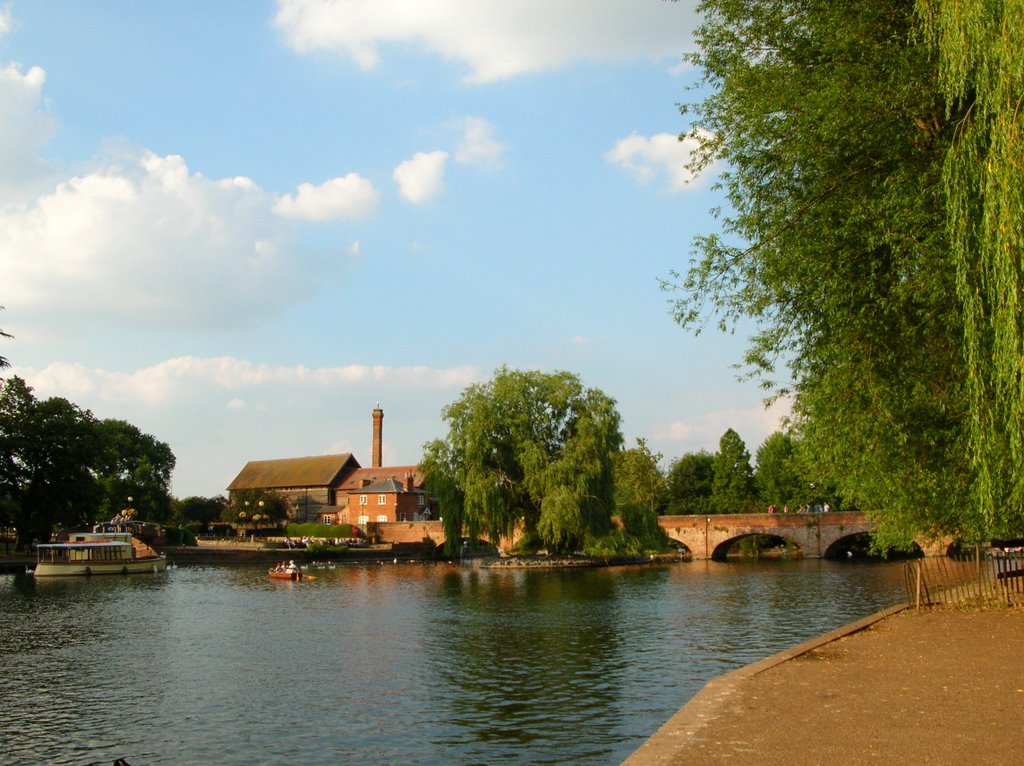
Stratford-upon-Avon

Watched: A Midsummer Night’s Dream live at the open air theatre in London. Fantastic!! One of the best productions of live theatre I’ve ever seen, anywhere. Last summer’s R & J at BreadLoaf was probably the best, but one can’t compare such startlingly different (though inter-related) plays.
Read: bits of books about performances of Dream.

All right, I broke my promise and didn’t post on the postivie aspects of material criticism yeterday. But half an hour before the bus left, I decided to go to London & see the play! So that’s my excuse. I also saw some wonderful Art, but more on that another time.

Material Texts

Now, to return. Rather than seeing cultural of texts as an ugly or disturbing truth, let’s look at it as a fascinating study of ways to interpret the plays and deepen our understanding of them. Knowing how a certain prop, costume, gesture, or word was received is itself an interpretive tool. Below are a few examples, most of which are due to Tiffany Stern, either from her excellent book Making Shakespeare or from her great lecture here at Lincoln college on Tuesday evening. We have established that the text we hold & read may or may not be Shakespeare’s. But it’s somebody’s, and it’s fantastic, whoever wrote it or collaborated on it. So let’s talk about some cultural features which would enhance our understanding of a play.

1. Actors’ parts/cues
In Elizabethan times, and indeed for a long time, maybe even up until the 18th century, actors did not get to see a copy of the whole play. Instead, they got just their own lines, with cues. I’m giving you a longish example so you can really see how it would work. Here’s something like what the Romeo actor would have gotten for the beginning of the scene at the ball:
___________________________years ago.
What lady’s that which doth enrich the hand
Of yonder knight?
__________________________________sir.
O, she doth teach the torches to burn bright!
It seems she hangs upon the cheek of night
As a rich jewel in an Ethiop’s ear,
Beauty too rich for use, for earth too dear.

Looking at a play in parts can be an interpretive device. It makes an actor’s character very plain. His emotions, tricks of speech, style, and vocab are on display. There are places in the plays where a character repeats his cue line—which means the other actor would interrupt him. There are places the cue-lines themselves become jokes, such as in Pyramus & Thisbe. Take a look at this:
Bottom: Cursed be thy stones for thus deceiving me.
Theseus: The wall methinks, being sensible, should curse again.
Bottom: No, in truth, sir, he should not. ‘Deceiving me’ is Thisbe’s cue…. It will fall pat as I told you. Yonder she comes.
One of many jokes here is that ‘deceiving me’ would be the cue in the imaginary script for P & T, but the real cue for the actor-playing-Flute-playing-Thisbe is ‘Yonder she comes.’ One of many meta-theatre jokes.
Another result of part-scripts is that the actors are able to respond in more “natural” ways, because they really do not know what the other character will be saying! They really do not know who will deliver their cues, so they are listening as you do listen to a conversation, and I assume that they would adjust their responses based on what they hear, just as you do when you are formulating a reply during dialogue.

2. The playhouse. The physical location itself could lend meaning. The ceiling of the stage was painted to look like a sky, with stars/sun/moon/etc., and was called the “Heaven” or “heavens.” The area beneath the stage, from which ghosts and witches can emerge, was the “Hell.” These areas had obvious significance. Thus, when the ghost of Hamlet’s father emerges from the “hell,” the audience would know it was no “spirit of health,” but a “goblin damn’d”! So they were wiser than Hamlet, and than we. Here’s a photo of the restored Globe theatre in London:


3. Passions/gestures. Reading the plays in parts points up the emotional content of each role. Indeed, an actor’s skill in early modern times was largely calculated by how suddenly he swung from one passion to another: such as Leontes’s startling, shocking leap into jealously in the begining of The Winter’s Tale. So an actor preparing his part would look for clues, such as a shift from poetry into prose or vice versa, a change in vocabulary, a breakdown of syntax, lots of inappropriate repetition, etc., that could indicate a swift shift of emotion. Then he would choose actions and gestures to make these as explicit as possible on stage. Certain postrures and movements had clear significance. Lying on the floor, for example, meant deafeat or surrender. A woman’s hair, let down from its customary up-do, meant madness or wild distraction.

Perhaps now you can see a little of how studying the stuff surrounding the plays can be very informative, interesting, and fun. From another prrspective, looking at the material and cultural factors surrounding the [divinely inspired] human authors of the Bible can inform and deepen a reader’s understanding. Here’s a good website on the Bible & culture.

I will only give a few examples of how “Material Scripture” can be a helpful interpretive/applicative device.

1. Geography. Knowing the lay of the land is very, very useful for understanding the Old Testament especially. This might be analgous to the “playhouse” above. For example, the scholars and scientists searching for the lost city of Ai (see Joshua chap. 8) did both a topological survey of the potential location and a close reading of the text, and have come to realize that there were two ambush forces in the battle for Ai. The director of that dig, Bryant Wood, has also done stunning work on Jericho. For a long time, scholars didn’t think that the battle for Jericho and the walls falling down really happened the way the Bible says it does. Dr. Wood found beautiful proof it did: slanting piles of mud-brick wall, a piece left standing (where Rahab’s house was), etc.

2. Culture. Just a quick example. You know the verse where it says to give your enemy a cup of cold water, thus heaping burning coals on his head? That sounds like an awfully OT thing to do—getting revenge back-handedly. But in NT times, people had to keep their fires burning, and if their fire went out, they’d go to the neighbor and “borrow some fire.” They’d carry the hot coals home in a pan on their heads, feeling the lovely warmth around them in the cold winter morning. So, if your enemy wrongs you, give him comfort, give him the means of life! Knowing cultural tid-bits like this compares to knowing how an Elizabethan audience would understand gestures and popular phrases.

3. Creationist science. Or Young-Earth Creationism, or Intelligent Design, or whatever they’re calling it now-a-days. Studying something seemingly unrelated to exegesis—geology, the fossil record, astronomy, biology, population studies—sheds light on passages of Scripture. This is like knowing about the Ptolemaic universe in order to better understand Hamlet’s “brave / o'erhanging firmament, this majestical roof fretted / with golden fire.” I don’t have too much to say, but the principle should be clear. Take a look at this site for lots of facts.

That’s it! I’d love to see any other examples anybody might have, or feel free to argue with these ideas if you list.


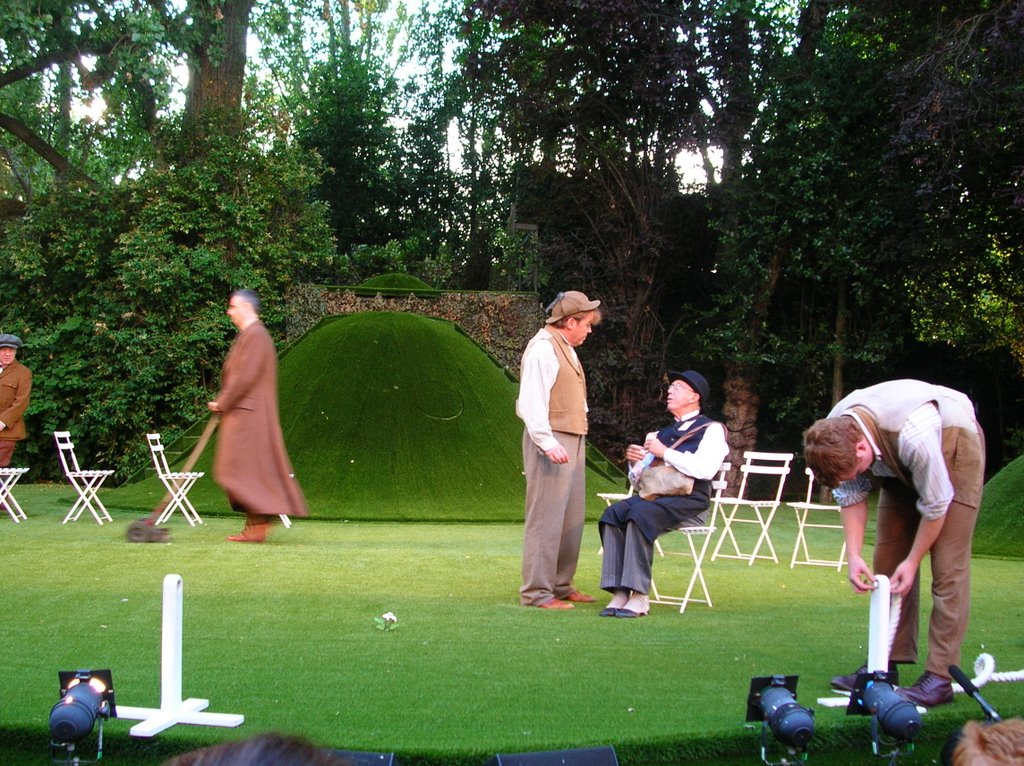
A Midsummer Night’s Dream. The guy with the lawn mower is Bottom.

05 July 2006

Material Shakespeare/Material Scripture (Part I)

Watched: The Baz Luhrmann (i.e., Leo & Claire) Romeo & Juliet. Wow, what a rush!
Read: bits of books on Elizabethan printing methods


The course I am taking this summer at Oxford is entitled “Material Shakespeare.” Here I would like to set out a few of the concerns of the course in order to relate them to criticism of the Bible. The first part of this post will relate to Shakespeare and cultural/material conditions of his time that contributed to the writing of his plays. The second section will illustrate how I see this relating to an understanding (or, in some cases, misunderstanding) of the Bible, and the last will contain a few Scriptural examples.

“Material Shakespeare,” as defined in my course, is all the other stuff—besides the brain and hand of a man named William Shakespeare—that helped to write his plays. At first this seems like an offensive topic: are you suggesting that Shakespeare didn’t write his plays? Well, no and yes. No: he did write them, but cultural and social and practical necessities influenced his choice of words. Yes: there is no way of knowing, in every case, exactly which word Shakespeare actually wrote down on an original and final draft. Other people and factors changed his texts.

Today I’ll post on the negative aspects of this kind of criticism. Then tomorrow I’ll discuss the positive side.

1. From draft to book. Shakespeare, we assume, wrote rough drafts, perhaps revising many times before sending plays to the playhouse. These manuscripts were not treated with the reverence we imagine we’d give to them today. Maybe the prompter made changes, the censor cut things out, the actors altered lines. Furthermore, at a first performance the audience voted at the end whether they liked it or not, and the author might revise it based on their response. By the time the play got to the printer, it was very different from what the playwright originally crafted. Furthermore, he might have made versions of various lengths, some shorter for traveling, some longer for the printer.

2. Printing house. Next, words might get changed accidentally or on purpose in the printing process. Type setters often (but not so often as you might fancy) made mistakes. Just yesterday I found in one copy of Romeo & Juliet (“Q2,” in case you care):
I do protest I never injuried thee,
But love thee better than thon cans’t devise….

Thon? What has happened here is that the printer has put in the letter “u” upside down, creating an “n.” Sometimes, if the compositor couldn’t read the handwriting, he would make a guess and throw in a likely word.

Now, these are both rather negative readings, showing how the text we have may or may not be Shakespeare’s. Perhaps you can see how the principle behind these cultural readings could be applicable to the Bible. At first, this sort of analysis could be threatening to a literal understanding of the Scriptures. Here’s a useful link about criticism of the Bible:
Religious Tolerance.org.
Especially helpful is the section entitled “Reaction of conservative Christians to biblical criticism.”

If we apply the idea that “Shakespeare’s texts are not Shakespeare’s texts” and “there is no way of finding the true original behind all the various copies of his plays” to the Bible, you get some very disturbing conclusions. They would be something like this: “Scripture is not traceable back to any one, determinate text which can be said to have been directly inspired by God.” If we believed that the words originally written were changed, misunderstood, lost, altered on their way to the printed books we have today, that would be very disturbing to our faith.

I have a theory that most modern forms of lit. crit. are, in some deeply hidden subconscious, seeking an intellectually satisfying reason to ignore and discredit the Bible. However, Evangelical Christians, while understanding (of course) that our translations may not be 100% accurate (that’s why our creeds say we believe the Bible is inerrant in its original transmission) do believe we have a very good text of the Hebrew/Greek/Aramaic. From this we make reasonably good translations. We can appropriate the very principles of literary theory that seem threatening and use them to unlock, open, and shed light on our traditional understanding of the Scripture. Tomorrow I’ll give examples of how to do that. Don’t go away mad!

22 June 2006

Shakespeare & the Bible


Finished reading: The Bedford Companion to Shakespeare & A Midsummer Night’s Dream. Now I want to watch every film production there is of it! Any recommendations; what’s your favorite version?

Since the theme of this blog is “poetry & faith,” I thought it would be appropriate to open my Shakespeare studies with some meditations on Christianity, spirituality, and morality in the works of the Bard. I do not intend to make an apologetic here for Shakespeare’s personal faith (knowing nothing about that) nor about the exclusive, orthodox Christianity of his works (not being convinced of that), but rather to trace some relationships of his texts to Biblical truth, whether these relationships are positive or negative. This is by no means intended to be anything like comprehensive! —just a few current thoughts. I imagine, even hope, these thoughts will change throughout the summer. So, here they are. Pardon the sometimes erroneous quotes; I’m working on a train as I travel across Ireland, with only Dream ready to hand.

So here are a few topics for thought and future discussion.

1. Quotations from Scripture

Shakespeare does not often quote directly from Scripture. I do not have a thorough enough knowledge to say whether, when he does, the lines are in the mouths of clowns, educated people, aristocracy… and if they are misquoted or misused. Here’s just one example:

Dream 4.I.207-210. Bottom: “The eye of man hath not heard, the ear of man hath not seen, man’s hand is not able to taste, his tongue to conceive, nor his heart to report what my dream was.” A typical mangling by bully Bottom; and another example of an oft-misused quote. The passage in I Cor. goes on to say: “But God hath revealed them unto us by his spirit.” So Bottom, like many people, takes it up wrong. Bottom often does that.

2. Biblical references

Beyond exact quotations, Shakespeare’s diction is heavily influenced by his familiarity with the vocabulary, syntax, and cadences of both the Bible and the Book of Common Prayer; attendance at Anglican services was mandatory during his lifetime. The Bible he would have heard every week at church was (not the King James, obviously, until 1611, only 5 years before his death) the Geneva Bible. Russ McDonald claims that the Bible was the most important of Shakespeare’s indirect sources (i.e., texts S must have read & known, but which did not supply plots or characters, etc.) The cover page of the Geneva Bible (1560) shows a map of the apostles’ journeys; Shakespeare used its places names in 12th Night (Illyria), Errors (Siracuse), Othello (Cyprus, Pontick Sea), and Julius Caesar (Phillpi) [McDonald 164]. Its tones and timbres can be heard throughout his work.

3. Doctrinal allusions

Heaven & Hell figure prominently in the plays. Whether or not Shakespeare believed in them (and he would have, if he held to either the doctrine of the official church or the banished Catholic faith), his characters certainly do. I am trying to trace whether evil characters typically ignore or flout damnation. Here are some references to Heaven & Hell:

Hamlet: Now he’s praying, now I could do it pat, and so he goes to Heaven, and thus am I revenged?
Rather nastier than we’d like of a “hero,” equivocal though he may be. Murder is not enough for Claudius; he must go to hell, too.

Macbeth said if he could be certain of the consequences of his act, he’d “jump the life to come,” i.e. forget about the afterlife and just do it here and now where he could enjoy the spoils. But he realizes even here he would suffer for his sin—then does it anyway.
Macbeth: There is the bell. Hear it not, Duncan; it is a knell that summons thee to Heaven or to Hell.
I find it strange that he doubts Duncan’s destination, seeing that his virtues are like angels and celestial trumpet blasts.
Macbeth to Banquo in absentia: Thy soul, if it find heaven, must find it out tonight.
More certain, but still that doubt about his best friend’s salvation. I suppose if he can do what he has done, against his character, conscience, duty, loyalty, and hospitality, he realizes anyone is capable of vast evil, even Duncan, even Banquo.

H & H often become metaphoric. In Dream, Hermia says of Athens that Lysander’s love, given the seeming impossibility of their union, “hath made a heaven a hell” and thus puts those two states on earth and into temporality. As many lovers have done, and always shall do, I’m sure. The presence of the loved one brings Heaven, his/her absence, Hell. Microcosm for the presence and absence of God in an absolute, eternal sense, I’m sure, given the constant marital and sexual metaphors for faith/spiritual fidelity in the Bible. Juliet, unable to discover whether Romeo is dead when Nurse comes bearing her babbled news about Tybalt, cries: “What devil art thou that dost torment me thus? This torture should be roared in dismal hell!” Romeo, hearing of his banishment, mourns that “Heaven is here, where Juliet lives, and every cat and dog and little mouse may look on her, but Romeo may not!”
Add to these the interesting fact that the ceiling over the stage was called the heaven, and the “cellarage” beneath, the hell.

Hamlet, interestingly, makes no mention of either place in his great after-life speech. He fears not the fires and pains of hell, but the dreams that may come in the sleep of death, the “something after death, that undiscovered country from who bourne no traveler returns.” If only he could have rest, his “quietus,” he might “jump” the Almighty’s canon which is fixed ‘gainst self-slaughter.

Similarly, characters often refer to providence as a guiding force. Romeo, fearing “some consequence yet hanging in the stars,” throws off his worries with “but he who has the steerage of my course direct my suit [sometimes emended to ‘sails.’].” However, some editors interpret this as a reference of the god of Love, not to the Christian God; hum.

One last doctrinal inference for today. Paulina in The Winter’s Tale seems aptly named: like St. Paul, she harps on themes of repentance, forgiveness, and faith: Stephen Orgel reasons that “the emphasis in the play’s resolution on the evidence of things not seen, the primacy of the spirit over the letter, salvation through faith—on the tenets, in short, of Pauline Christianity—[must] account for Paulina’s name” (Oxford 60). At the end, after having chided the king into 16 years of repentance, guarding him from an (adulterous, it turns out) remarriage, and essentially preserving the chastity and sanctity of the royal couple, asks Leontes to “awake your faith.” He does, and all is restored.

4. Moral “lessons”
This is the easiest to trace, and I’m sure it’s been done ad nauseum. But stop and think, for a moment, about the great moral power of a theatrical masterpiece. Isn’t it much more effective to watch the maddening, hardening, despairing results of murder than to hear “Thou shalt not murder”? Fear of Aren’t you more moved to avoid jealously and mistrust after Othello than after Sunday School? Do you not fear to be an Iago, Macbeth, Richard III, Lear, or even Hamlet more than to be a Scott Peterson, OJ Simpson, Richard Nixon, Saddam Hussein, or Prince William in his Nazi uniform? These modern figures, for all their media hype, seem remote from our everyday experiences, faults, and temptations. When we finish watching the Enron trials, the average American probably does not sense the tugging of his sinful nature towards that wrong: yet when we finish watching Macbeth, we know the depths of our own inclination, and feel that even we, honest and upright as we may be, could stoop to such a deed! If one such as he, with a strong conscience and sense of moral honesty, could do bloody murder, why not we, weakened as we are with materialism and sensuality? Shakespeare makes us beware our sinful selves, and that without platitudes.

So, just some thoughts to whet my appetite. Look for more to come in the future!

12 June 2006

On reading and rereading

Read: Macbeth, A Winter’s Tale, Henry V
Listened to: Vivaldi and Corelli Concerti and Sonatas
Watched: Macbeth (Ian McKellen & Judi Dench in the excellently creepy RSN production), Romeo & Juliet (Jonathan Firth & Geraldine Somerville in a luscious if much-chopped HBO version), Shakespeare in Love

In this post I guess I am raising a bunch of interesting questions and would love to see some discussion. We already asked what do you have memorized, do you memorize poetry. Now let me ask two other questions: First: If you were to recommend one book to read over and over (the “What book would you have if you were marooned on a desert island” idea), what would it be? I guess you can say The Bible if you wish, because that’s part of this discussion, but also what other books of purely human composition yield the most treasures year after year after year? Second: What are the specific values of rereading? What is lost by rereading?

I am deep into my Shakespearean assignments for this summer’s studies, so you will be seeing much about The Bard in these pages for the next two months or so. Most of the plays I’m studying just now are re-reads for me: Macbeth, R & J, Henry V, Midsummer. But nothing is lost to me in re-reading except surprise and freshness, and much is gained. I am one of those cursed with the inability to remember what I’ve read/listened to/watched until I go through it again, and sometimes again. Books stick in my head after a second reading, if at all. The few exceptions to this—books/stories/poems that stick clearly and sharply in my mind on a first reading, those from which I can almost quote lines and describe scenes with great precision—must therefore be excellent works. I often judge a work’s quality by its memorability. My ability to recall phrases, sentences, whole passages after reading a work indicates that it must be brilliantly described; perspicacious, intuitive, and insightful; psychologically plausible, etc., but it’s probably not written with the skill of the 17th century poets! Shakespeare’s writing is imminently memorable, but of such high quality that it usually takes a couple of readings for it to stick. For me anyway. And yet, his cadences are natural, while lofty, his rhymes are musical and often simple; so sometimes a line or a half line resonates for days after even a first reading. For no reason, I had “Art thou a man? Thy form proclaims thou art; thy tears are womanish, they wild acts denote the unreasonable fury of a beast” and “Aroint thee, witch!” rattling around in my brain-pan for days. Shakespeare’s work seems nearly easier to memorize than to understand! Last night I found myself musing over the prologue to R & J: “Two households, both alike in dignity, / In fair Verona where we lay our scene / from old something spring to new mutiny / and civil blood makes civil hands unclean. / From forth the fatal loins of these two foes / A pair of star-cross’d lovers take their lives / Whose misadventured piteous overthrows / Doth with their deaths bury their parents’ strife. Etc. And I find now that the process of memorizing walks hand-in-hand with the process of understanding. Reading a passage over and over in order to comprehend its meanings and shades of meanings, studying the editorial commentary (sometimes pages on a single word), learning about the etymology of the terms, seeing what OED has to say about it… these serve to fix the passage in the mind even as the stages of striving to memorize it bring about enlightenment of the meaning! I long to act in these plays, to memorize and live the parts…. One thing that struck me in Shakespeare in Love (Fiction! Fiction!) was how he apparently had all of his plays effortlessly memorized. So much so that he could play Romeo at a moment’s notice, quote all of Juliet’s lines while making love (hum), etc. Ah, to always have just the right Shakespeare quotation for just the right occasion!

But what about rereading? Why do we do it, why do we need to do it, do we do it enough, should we do it more? I said I am cursed with hardly being able to remember what I’ve read until a second or even third time around. But is that a curse? Not if I go back and back to the same best books and love them more each time. Here again is the link to Kirstin Jeffrey Johnson’s excellent articles on MacDonald; the second is about just this, about rereading Phantastes. I’m even going to quote some parts of her article, because it’s so good, and you might not take the time to read the whole thing via the link. Even if you do, reread it here!

Unraveling Phantastes
Few early Victorians were privileged enough to own many books, and a book was not simply read once and set aside. It was read and reread, the reader engaging with the text ever more deeply, each reading revealing new connections and presenting yet another journey…. Phantastes, like all books before it, expects a long-term relationship with the reader.
It is helpful when reading Phantastes to follow one theme that is noticeable early on in the tale … what it means to “die to oneself,” for instance. As this unfolds, other interwoven themes become evident, providing the next thread for the next read. The more one reads MacDonald, the more familiar one becomes with his primary themes, and the easier it is to follow their relations to each other, as well as to the books alluded to in the tale….
MacDonald points to [other] books not only to introduce them—he is also inviting the reader into a deeper conversation. As one reads the other books mentioned and then returns to MacDonald, suddenly one is part of a conversation that has been going on since God’s first story. MacDonald is responding to Tennyson responding to Blake responding to Dante, who in turn is responding to John responding to Christ, who is reminding us of the words of Isaiah, or the Psalms, or Moses. This conversation between texts is part of the Christian heritage, part of understanding who we are and who God is….
C. S. Lewis wrote that a first read reveals the plot and characters; it is in the experience of rereading that we find wisdom and strength. But be forewarned; rereading Phantastes did change his life.
—Kirstin Jeffrey Johnson

Even before reading Kirstin’s article, I had a personal rule about poetry and dense short stories: read it three times before making any final conclusions about its quality or meaning(s). Of course, some poems reveal nothing I want to pursue on the first reading, and I put them aside in favour of others. Then there are those I will never cease rereading, such as the Divine Comedy, The Prelude, Kubla Khan, Paradise Lost, Millay’s sonnets, the works of Hopkins and Herbert. I come back to these over and over and am always re-amazed.

Hilaire Belloc said of Johnson’s Rasselas: “Every man ought to read Rasselas and every wise man will read it over half a dozen times in his life. Indeed, a man would do well to read it once a year at least, for never was wisdom better put.”

With these ideas in mind, what, then, is really the value of presenting students with selections from great works, which they read once, perhaps barely understand, talk about for a few minutes or part of an hour in a class they may not be very excited about attending, and then set aside? Well, I guess the hope is that they do not set them aside forever. In our discussion about “The Canon,” what to assign in a Christian Classics class, Rosie said something like At the very least, they’ll recognize these names and titles and passages again in the future as being vaguely familiar, and maybe that will push them into further readings and rereadings. Familiarity is friendly, and often is itself and introduction to deeper relationship. Isn’t love at first sight often described as a feeling that I must have met you before, I’ve always known you, I met you in a dream? So let us teachers give our students that good dream, that haze of great literature, that one day they might step through it into the love we ourselves know to be so rewarding! That said, I have higher expectations for my classes, and hope to give more than a vague impression. I hope to encourage some rereading and deeper study of at least the most essential passages of the literature we study. Some works they will encounter in more than one class; so much the better!

Now, perhaps the most important question: What about the Bible? What about rereading the Bible? We are told to meditate on the Word of God day and night, to bind it on our foreheads, to walk about with it in our hearts. Surely these are injunctions to read it over and over and over, to memorize it either intentionally or as a by-product of living with it and in it. Some people reread the entire Bible every year, or favorite books over constantly. The values of Scripture memorization are highly extolled by many wise people, and I have found it rewarding in the past. Now I have subsided into a sort of vague knowledge of many passages, specific quotable knowledge of a sizable handful of popular verses, and a maybe-maybe-not-better-than-average idea of where to find things in the Scripture. Is this enough? How much would be enough? First-century Jewish scholars had the entire Torah memorized. I know a man who has the whole book of Proverbs in his head. The real point is this: What you reread and what you memorize becomes a part of your life. I don’t know how far to go with that. If I go around saying “Is this a dagger that I see before me,” am I more in danger of hell-fire than if I recite the 23rd Psalm? No, but which will be more edifying in the long run? And are rereading and memorizing necessarily connected? Perhaps this fast-paced media world needs to slow down and spend more time on the page, the same pages many times, delighting in the unfolding of the words through maturing years.

-- Admonit